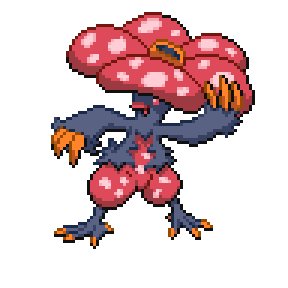
Page 3 / 4 of 3754 pokedex entries by infinex21.
It bathes in strong currents, such as under waterfalls, to keep its metallic body smooth, clean, and polished. It commonly gifts its friends and its Trainer stones that it has smoothed and polished using its feelers.
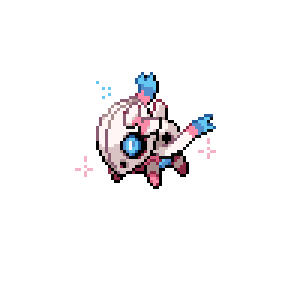
Sylron are obsessed with their own appearances and take great care to keep their steel bodies so polished that they shine and sparkle. They use their feelers to polish themselves and to retrieve metals, ores, and smooth stones to feed on.
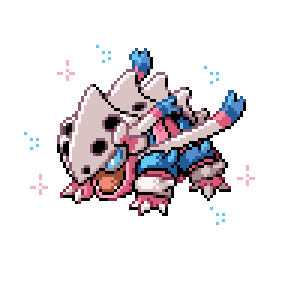
Sylinch use their large, strong jaws to bite through solid rock and form their dens in the resulting holes. Their breath has an unnaturally calming effect that quickly subdues prey they swallow whole.
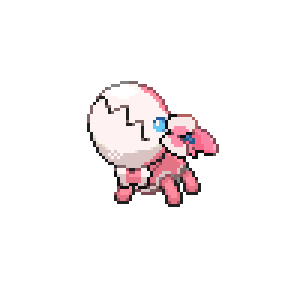
Because they can only fly in short bursts, they have a habit of perching atop humans and Pokémon to help them get around. Sylva exude soothing auras, which help them ride upon others without being attacked.
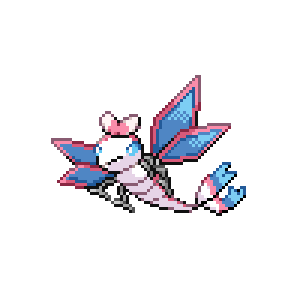
Sylrua are friendly Pokémon who seek attention and friendship with humans and other Pokémon alike. Those who touch their feelers will be granted soothing visions of what their hearts truly desire.

The pollen of its flowers has calming effects on most who inhale it. This Pokémon uses its ribbon-like vines to force its prey to inhale the pollen to quickly subdue them.

Its colorful cap glows in the dark, which has served to help lost travelers many a time. It scatters colorful spores when it feels threatened, which can muddle the mind and make one seem much more calm and peaceful for hours.

Sylpet seek out negative emotions to feed on, so there are many who welcome their presence. They become easily attached to those who are prone to such emotions and cling to them using their ribbons.

Despite initial appearances, its ribbon-like tusks are sharp enough to cut through small rocks. It will charge at foes larger than itself without hesitation, especially if it's to save or protect others.

Sylxure take meticulous care of their ribbon-like tusks every day. Their tusks regrow overnight if they are broken, but they will be downtrodden for days over the loss of their prior tusk or tusks.

Syling communicate with melodious cries that plenty find soothing. So many enjoy their cries that they have been recorded for repeated listening; some of these cries are utilized in select therapies.

Sylinder grow hotter as they become more excited, which, in turn, makes them want to move quicker. They become excited during battle and while playing with their friends.

Sylesta use their feelers to fling fireballs at their prey and their opponents. Although they are bug Pokémon, many still love to hold them due to how soft and warm their bodies are.

Sylrunt are remarkably curious, even so much as to willingly approach strangers to learn about them. They can easily bite through and digest hard foods. Their cries have a noteworthy effect of calming those who hear them.

Sylass have mystic powers that make their very breath capable of freezing unruly foes within seconds if they so desire. Wild Sylass are often found wandering snowy mountains, using their feelers to find the lost and guide them to safety.

Sylcorio will often cheer for others when they fight, though the harmless sparks that scatter from their pom-poms will inevitably soothe the combatants. If they rub their pom-poms together, they can generate stronger bolts of electricity.

Sylmy's large horns exude a calming aura, which is most potent when they touch another living being. Unfortunately, its entire body is covered in a germ-laden mucous membrane; it is strongly advised never to touch this Pokémon.
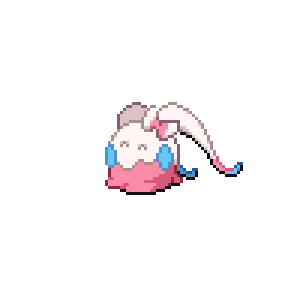
It uses its horns and forelimbs as a form of radar to better sense all things around it. It thinks of nothing other than protecting others and keeping itself fed and rested.

Syldra are covered in a sticky, viscous slime; they are blissfully unaware of how inconvenient this slime is, so they will often hug their Trainers. Their horns exude a soothing aura that grows stronger when they emit loud cries.

It siphons the drive to fight from others through its large forelimbs, forcing them to calm down. It stores these emotions in its large crystals and somehow converts them into energy.

Because these Pokémon exude soothing auras and have plush bodies, they are popular with kids. They must be treated with care, however, or else they will lash out with enough power to shatter a slab of concrete.

It uses its anchor to catch large prey, then ensnares them in its feelers and seaweed to drain them of their vitality. If its body is ever damaged, it will scavenge the remains of ships to repair itself.
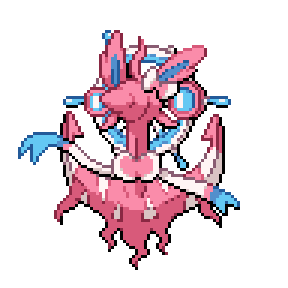
Syleanie use their many tentacles to protect themselves and many others. They prey on Mareanie, which has led their bodies to develop strong antitoxins.
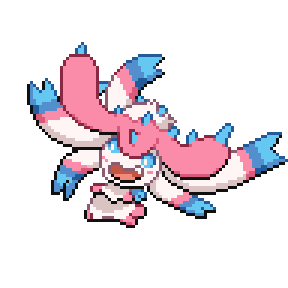
These aquatic Pokémon protect themselves and others using their many bulky appendages. They are especially fond of protecting Corsola from Mareanie and Toxapex; their bodies have potent antibodies as a result.

Sylucha use their feelers to immobilize their prey and their foes before finishing them off with a Flying Press. They tend to forget their own strength as they tackle their Trainers and their friends with full force.

It can use its ribbon-like organs to siphon water and other nutrients from plants or from Grass-type Pokémon. It can store enough of both to last nearly a full month before needing to feed again.

Sylturne are most active at night and search for weary desert travelers to rescue before they may be preyed on. During the day, they become mostly immobile to better retain their stored water.

Sylgast refuses to let anyone touch its shovel, not even its Trainer. It can feed on positive feelings through its feelers, which oddly calm others rather than harm them.

Sylsand exude an aura that soothes others and compels others to play with them; they will even let their feelers be used like jump ropes. They feed on positive feelings, with no known negative effects on others by doing so.

Sylaura are always cold to the touch, even when sick. Many medical facilities keep at least one Sylaura on hand to use their soft, cool feelers to help combat high fevers.

Sylrorus use their feelers to help manipulate the freezing airs released by their crystals to shape ice formations. They will pelt foes and prey with sharp icicles thrown by their feelers.
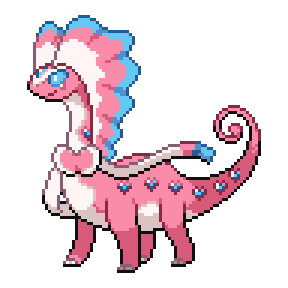
Well-trained and cared-for Sylruff will wrap their feelers around their Trainers' hands as they walk alongside them. They are sensitive to the emotions of their Trainers and stay close to them to offer comfort during hard times.

Sylroc are a peculiar species because they will goad agitators into attacking them and withstand the hits in place of others. Even if they withstand hits for hours, they show no aggression toward their attackers.

The light pouring out from Sylzma's bodies has a powerful soothing effect on those caught in its glow. Unfortunately, the soothing effect never stops and can cause lasting problems with overexposure; cases of comas have been confirmed.
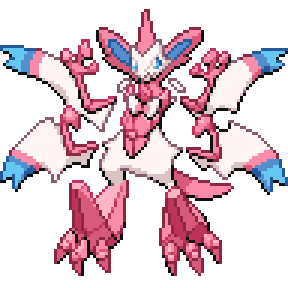
Sylmo-o communicate with each other by striking their head scales together. They never fight together against a singular foe but will butt in to defend one of their own kind if their life is at risk.
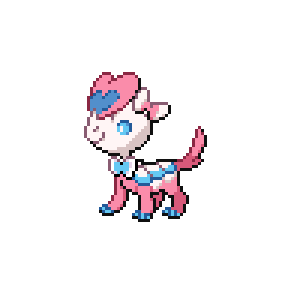
It sheds its scales constantly until its evolution, at which point its scales are said to be tougher than diamond. These vibrant scales are believed to bring luck and good health, so they are used in many crafts.

Its tall ears are sensitive enough to hear anything that approaches them. They quickly flee if they sense danger, their scurrying limbs leaving a pristine path in their wake. They frequently bathe to keep their bodies clean and sleek.
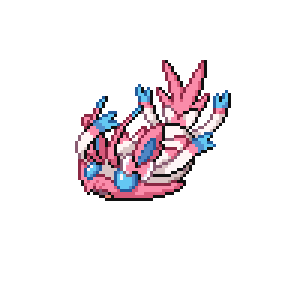
Sylsopod exude a calming aura as they meditate between battles and while they peacefully sleep. They are skillful combatants who utilize every one of their limbs to defend and attack simultaneously.
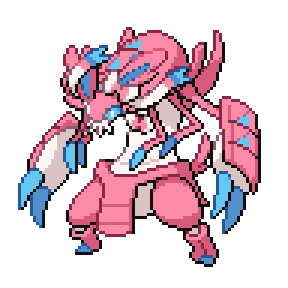
Sylmantis dances elegantly in tandem with its moving feelers to entrance prey and foe alike. When its target draws close enough, it lashes out with its sharp-edged feelers and quickly fells said target.
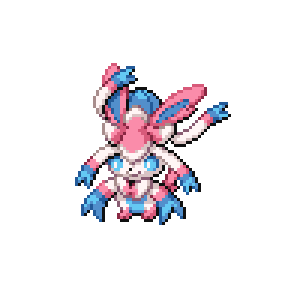
Although Sylpin prefer to avoid fighting, they use their ribbon-like feelers to strike at their foes' weak points without mercy. Their fur is typically soft, but they can flex their bodies to make each hair stand on end like bristles.
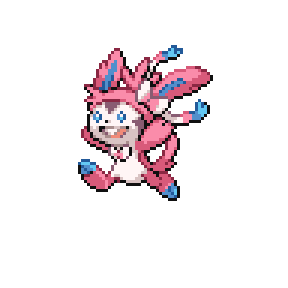
Syladin playfight with one another often, which inadvertently trains their bodies to be strong. They do not hesitate to put themselves between foes for the sake of stopping a fight.
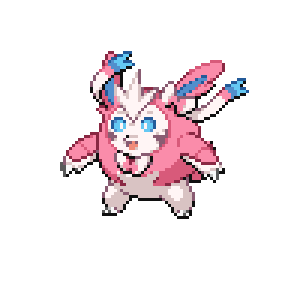
Sylnaught inadvertently become incredibly strong by trying to stop other Pokémon from fighting. Even just one Sylnaught will typically have enough pure strength to hold down and subdue a raging Gyarados before it causes harm.
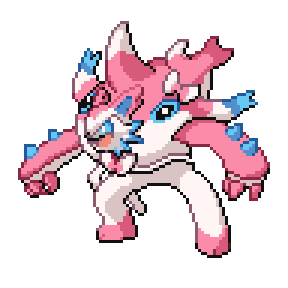
Its delicate bubbles offer protection for its body and a means to subdue larger foes with minimal injury. It uses its ribbon-like feelers to quickly traverse terrain, scattering some of its bubbles in its wake.

Syladier will pluck and fling their own foamy bubbles to subdue others or to minimize harm and damage during fights. Even during battle, they wrap stones in their bubbles before throwing them at their opponents.
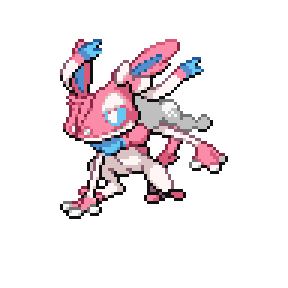
Wild Sylninja patrol their territories with the haste and secrecy of ninjas. If they come across any conflicts, they use their long feelers to ensnare the perpetrators and keep them restrained until their fighting spirit is quelled.
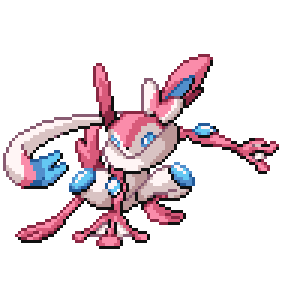
The blue lights emitted from within these Pokémon have a hypnotically soothing effect on those who watch them. Many Sylkaboo have been seen using their feelers to hang from branches and will shine their lights on those who draw near.

Sylix entangle foes and prey using sticky, sweet threads reminiscent of cotton candy. Though considered nuisances to most, these edible threads are prized in many remedies that soothe nerves and dispel anxieties.

It is innately driven to dance the moment it hears music playing. It will even pull others in with it and expect them to dance with it; using its ribbon-like organs, it can even compel opponents to dance rather than to fight.

This wary Pokémon will only appear before people it believes it can trust. Those it comes to view as friends and/or family will be gifted a diamond made through its own powers; these diamonds shine with a bright, soothing light even in the dark.
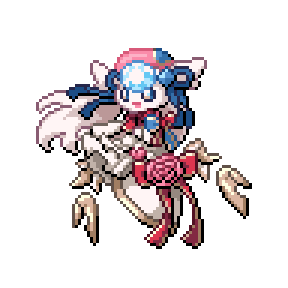
In some past tales, Trainers gave their lovers Syldisc as a means of proposing marriage to them. Some customs see similar values, though more commonly as a gift to apologize to a lover due to this Pokémon's ability to calm anyone and anything.
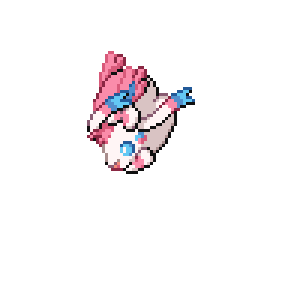
Sylyena are considered meek and timid due to how they will bare their fangs and growl to threaten others. However, they become immensely friendly the moment one pets them, and they emit soothing coos with every pet and scritch.

It's incredibly friendly and even more curious; it darts in zigzag patterns to interact with or investigate its surroundings. Its feelers emit a calming aura that may soothe most agitated Pokémon, allowing it to avoid most quarrels.
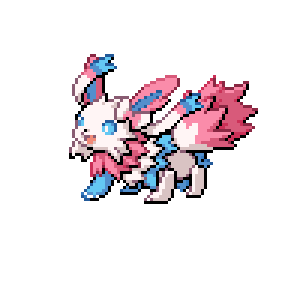
A herd of Sylnoone will interlock feelers as they run so that they may avoid being separated from each other. Their fur is softer than silk and releases calming particles when groomed or stroked.
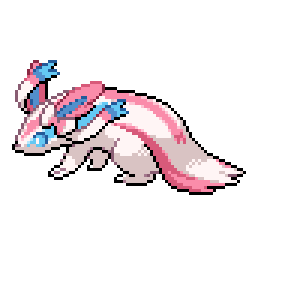
Sylple sleep atop tree branches and use their feelers to hang from them before they descend in search of food. Their spikes secrete a toxic venom most effective on bird Pokémon, which has helped to reduce how often they are preyed upon.
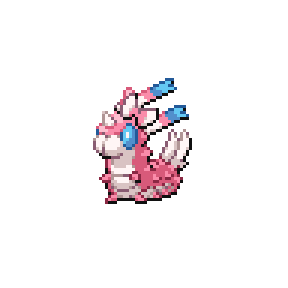
Sylcoon use their extendable feelers to traverse forests and to suspend themselves between branches. Their bodies become smoother than silk as they near their evolution.
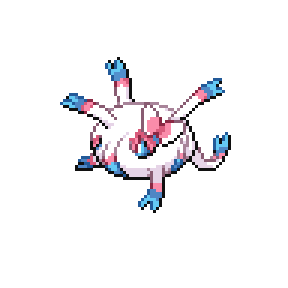
Sylfly release multicolored scales as their wings flutter, which induces a sense of calm on whoever they fall onto. They use their long feelers to sense fresh pollen and honey.
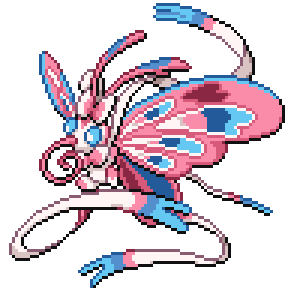
Sylscoon use their feelers to gather piles of leaves to hide within, though they will use them to swing to branches if need be. They will remember every hardship endured, even after having evolved.
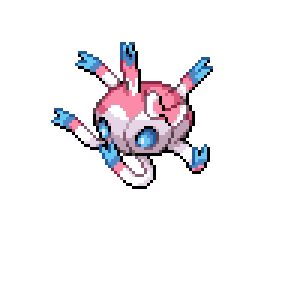
Tamed or untamed, Sylow are notoriously courageous, especially for the sake of others. Their loud yet soothing cries can even subdue Ursaring.
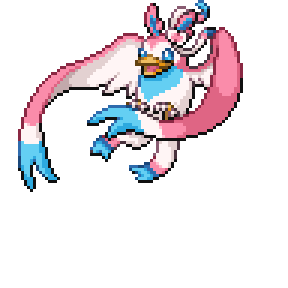
Twice a year, Sylgull flocks migrate by crossing overseas. Because the sight of a migrating flock is considered a romantic boon, many tourists will swarm locales to view them.
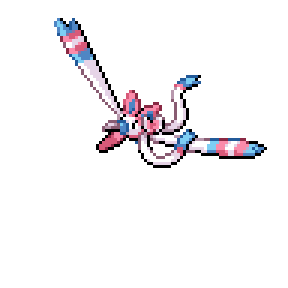
Although considered adorable by many, these Pokémon often entangle themselves in their own ribbony feelers as they chase them in circles. A domesticated Sylitty will hold its most prized toys and treasures tightly within its feelers' grasps.
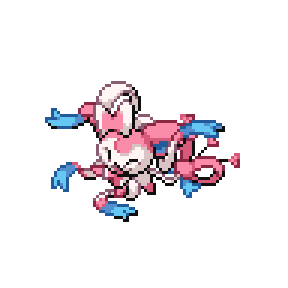
Through its feelers, it can sense the smallest shifts in the air, and supposedly it can even tell when its foes' muscles tense, which allows it to predict their movements. It delivers devastating kicking attacks when the opportunity presents itself.

Sylmel live in small herds near mountains, though many times their herds have been seen caring for other young Pokémon as well. They can release soothing fumes from the ports on their humps; just one Sylmel's fumes can subdue a Vigoroth.

Sylda are always swaying and shimmying as they move, seemingly dancing at all times. Unfortunately, their complicated movements cause them to trip over their own feelers constantly and fall on their faces.

Sylcash sleep in the mud at the bottoms of lakes and ponds. When they awaken, they violently thrash about to remove the mud from their beloved and vibrant fur. Their feeler-like whiskers are prehensile and strong enough to subdue a Gyarados.

These cheerful Pokémon emit pleasant tunes when they agitate the orbs within their throats. They often use their feelers to hang from objects or from other Pokémon.
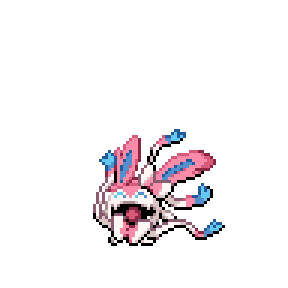
Sylecho sing as they let winds carry them about, their feelers swaying until used to anchor them elsewhere. They love to use their feelers to hang from their Trainers or their friends, singing their most pleasant and soothing tunes.

Its bright and cheerful colors invoke a sense of calm and trust in others, but this Pokémon is anything but kind. Its entire body is harder than rock to survive deep ocean pressure, and it will viciously rip into any foe or prey with its strong jaws.
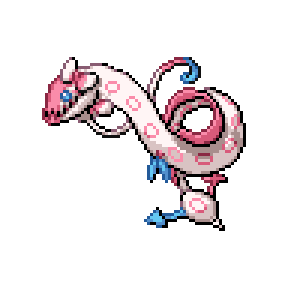
Schools of Sylamo tie their feelers together when on the move to prevent separation. They absorb electricity through their mouths and channel it through their feelers; a proper school of Sylamo could power a small city for a few days.
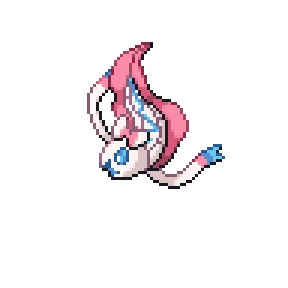
Syltross use their extendable feelers to hold prey still as they siphon their prey's electricity through their fangs. They can channel electricity through the palms of their forelimbs and through their feelers.

Wild Sylrelp nest within coral formations or among the branches of Corsola, their bright colors helping them to blend in. Schools of Sylrelp wrap their feelers together to avoid being swept away by sudden currents.
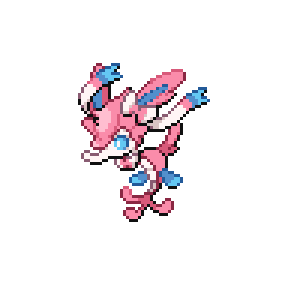
It spits a corrosive fluid to defend others and itself, though it can also spit a fluid that boosts healing and invokes calmness. Using its extendable, ribbonlike feelers, it keeps its young safe from threats and from being swept away by currents.

Many farming families keep Sylta nearby. Their warm fur comforts others, and they often wrap feelers around companions' hands as they trot alongside them.

To keep their bodies strong, they eat everything, including the bones, of their prey. Their long horns are strong enough to cleanly puncture rocks.

Despite their size, Nidowak are incredibly muscular and could crush cars with their tails. Their second skulls are harder than diamond and their long horns can cleanly puncture a solid block of steel.

Nidoeon channel and fire electrical bolts from either or all of their three venomous horns. They ground themselves using their tails if they ever accumulate too much electricity, and then discharge the excess.

Its three venomous horns deliver a potent, paralytic venom that can numb an entire adult human's arm within minutes of affliction. Its spiky fur stands on end when it has accumulated a strong static charge.
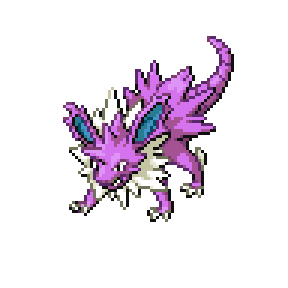
Nidolax eat any food, even if it has grown rotten or moldy. Their poisonous sweat is believed to be a byproduct of this and is being studied for any medical applications.

Nidodoom regularly clash to determine who the leader of the pack shall be, typically locking horns until one breaks even a little. To defend themselves, they can spew a burning, corrosive substance from their mouth.

Nidolax use their prehensile tails more than they use their arms, especially for securing and eating food. Their horns are incredibly venomous, which some believe is due to how these Pokémon freely devour rotten food.

Its large tail is cumbersome, yet very strong. Its claws are tough enough to cut into metal without chipping or dulling.

Its horn is harder than diamond, making it much stronger than its claws. Its vibrant quills secrete trace amounts of pain-inducing venom, so most dare not attack when they curl into a ball to defend themselves.
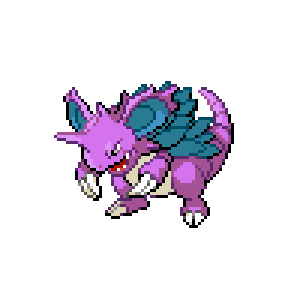
Nidoking have bodies of thick muscle that afford them immense strength, capable of snapping metal structures. The armor-like chitin of their bodies is extremely durable, making them difficult to dethrone as apex predators of their territory.
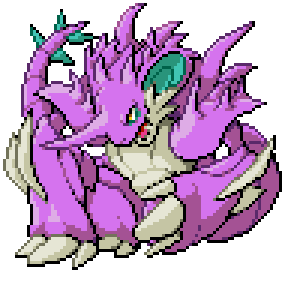
Its axe-like tusks are slick with a potent toxin that can even affect some Steel-type and Poison-type Pokémon. If neither its toxins nor its tusks can best a foe, it can rely on its powerful tail.
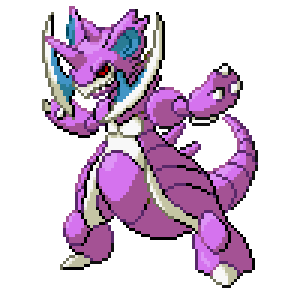
Nidorona scatter flammable, toxic scales from their wings when they flex and flap them. By clashing its limbs together, it can create sparks to ignite its scales. Its tail is strong enough for it to balance upon without faltering, even during battle.
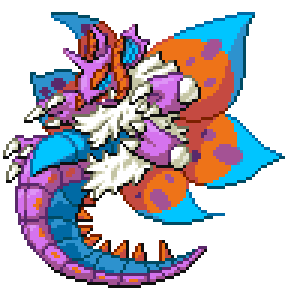
Nidoster can swing their arms like miniature wrecking balls capable of pulverizing solid rock, while their horn can pierce metal. Few prey escape once they clamp their arms down.

Kyotwo are often seen "surfing" atop ocean waves using their psychic powers and ability to control water. Some researchers continue to argue that they resemble Kyoew, though no solid proof has been provided yet.

Legends endure that this Pokémon contains the genetic structure of every aquatic Pokémon within its own DNA. There are few Kyoew that have been witnessed, and when witnessed they have oft been seen floating within large bubbles.

Within its belly is a potent flame sac that allows it to breathe flames and keep it warm within its ocean home. The fur on its neck flickers like glowing flames and the jets of water it releases are always scalding hot.

Kyown are very small fish Pokémon that resemble a specific ancient text character. They are often seen in schools of over 20 of their own kind, using small jets of water to propel themselves.
Hundreds, if not thousands, of smaller aquatic Pokémon flock around the titanic body of Kyolix as it travels through the seas. This Pokémon is rarely challenged due to its size, which allows for smaller Pokémon to seek shelter around it.

Its thick arms glow brighter as it fights, building energy that quickly surges across its entire body. The large horn of a Kyocross can pierce through steel and serves as a conduit to release its energy after it has built up enough.
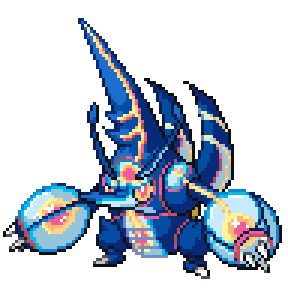
Kyomory are feared predators of ocean skies, with bodies harder than iron and feathers as sharp as blades. They will dive and cut through the waves to capture their prey and drag them to the air.
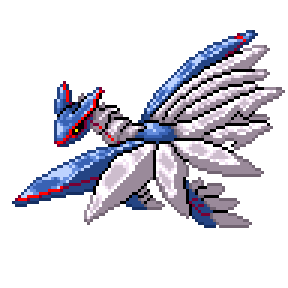
Wild Kyodra carry their glowing eggs between their small hands and will shoot any threats with precise bubble bullets using their long mouths. When their dorsal fin glows bright, they are preparing to release pure energy from their mouths.

Kyokou are often seen as living embodiments of storms, given their great powers of water and lightning. Despite the fact that many fear them at first, these Pokémon have often come to the aid of ships stuck in terrible storms.

Kyovoir commands the fiercest of ocean waters with the simplest of ease, a power that many have coveted and sought to abuse. To avoid such people, it lives in the deepest underwater cave and rarely leaves.

Kyoray have translucent underbellies that reveal the liquid in them that is always kept bubbling by the electricity generated by their orange organs. They spew jets of water and immediately release powerful electricity along the jets.

It resembles a Pokémon depicted in mythology as the ruler of the skies and summoner of storms. The latter is the nearest truth, though it only appears when ocean storms occur. It rises from the depths and flies amidst the torrents of rain.
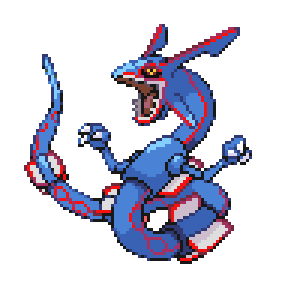
Kyopunny are often seen dancing atop the surfaces of lakes, ponds, or even the ocean itself. They can use their muscular ears to whip up small tidal waves to defend themselves.
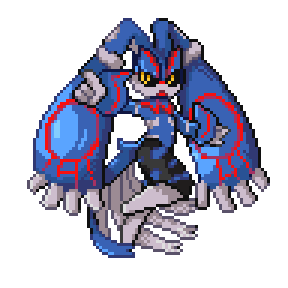
This deep sea predator emits a glow in the deepest depths that alert all when it is awake and on the hunt. Its tusks are sharp enough to slice open the toughest hulls of ships with but a passing cut.
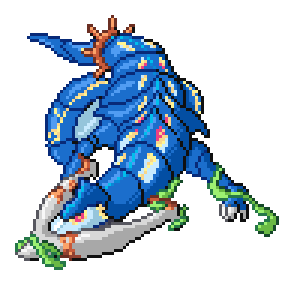
Wild Kyoxew keep their tusks sharp by grating them against the toughest underwater rocks they can find. These crushing depths they wander further hone their entire bodies, allowing them to grow stronger with every day.
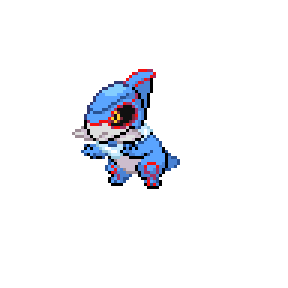
Kyoxure live within underwater caves or caves nearest to a large body of water. Their tusks are kept sharp by the fierce currents they will challenge each and every day.
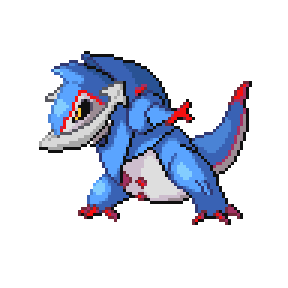
The orange toxin within their bodies is so potent that it can melt most things into a drinkable liquid that they will happily gorge themselves with. Their horns and their tail stingers can inject this toxin directly into their prey.
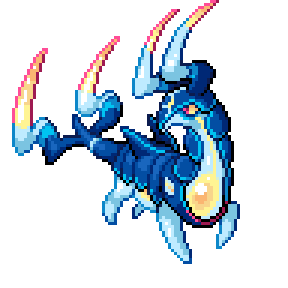
Kyople live deep within the ocean, with their nests made between rocky outcrops, within trenches, and inside of caves. They spit a highly durable thread that becomes sticky when exposed to water to form their nests and to slow foes.
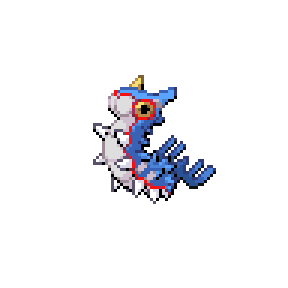
Grouros live deep underground within lakes of magma, living off a diet of volcanic rocks. If one were to enrage a Grouros, the nearest volcano will erupt with clouds of ash that crackle with red lightning.
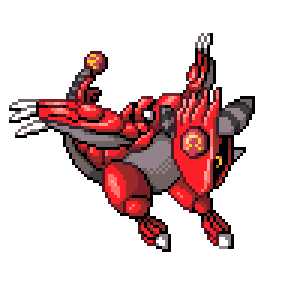
This large Pokémon swims within lakes of magma without issue thanks to its obsidian-hard body. It can release streams of burning hot energy from its long mouth and will often drink whatever it has melted with that energy to sustain itself.
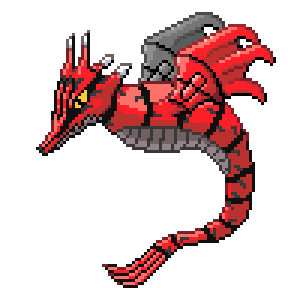
Its, literal, pit of a stomach glows with the magma-hot flames within its body. The spikes lining its body will glow when it prepares a breath attack that could instantly incinerate entire trees.
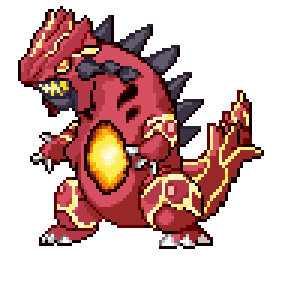
The robust body of a Grougron can endure direct exposure to magma, which is what they often rest within. Their bodies produce an energy as hot as magma that they can release during battle to empower their every attack.
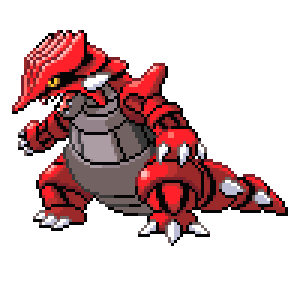
Grougon use their wings and their tails to create targeted tremors to overwhelm their opponents. A Grougon's wings can move so fast that they create powerful vibrations that could pulverize dirt and loose rock into grains of sand.
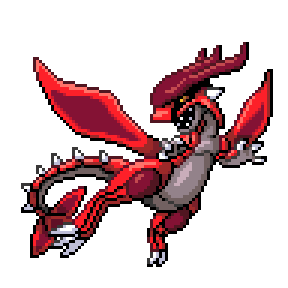
Very few Grouquaza have been found in the wild as of yet, and those that have been discovered were nested with their bodies wrapped around volcanos. Their bodies are brimming with a magma-hot energy that can melt metal instantly.
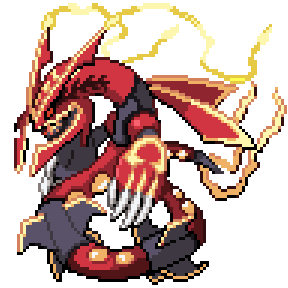
Magma courses through its veins like blood, setting parts of its form aglow with sheer heat. Its tusks are hot enough to melt diamond as they slice through. It rests deep within volcanic land, bathing in the hottest pools of magma it can find.
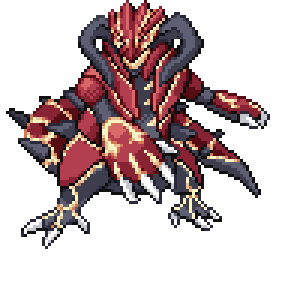
Grouxew live underground beneath volcanic areas, feeding on molten rock, sulfur, and rubies. Their tusks are forged in the heat of the magma they rest in, always melting only to be regrown better than before.
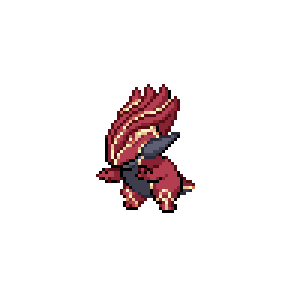
Grouxure rest deep within volcanoes, the sheer heat keeping their bodies and tusks refined into a form fit for any battle. When two Grouxure meet, a vicious battle that scars the land around them will ensue.

Grouple reside within volcanic regions and nest underground. They feed on flammable materials, ranging from vegetation to minerals like coal and sulfur. Though small, they can spit out powerful flames.

A Groudash's legs are strong enough to create small tremors when it stomps its hooves against the ground. The flames that sprout from the crevices along its body are as hot as magma.

Rayfree flies so high in the sky for such extended periods that its wings have become bathed in powerful sunlight. With every flap of its wings, it scatters many shining scales that fill those who hold them with a gentle warmth.

Renowned in the past and the present as a gallant warrior Pokémon, Raylade fights for the sake of others using psychic blades and harsh gales. It can move at incredible speeds by propelling itself with psychic energy and controlled wind currents.

Renowned in the past and the present as a gallant warrior Pokémon, Raylade fights for the sake of others, even at a risk to itself. It attacks with psychic blades, every slash churning the air into fierce razor winds all around it.

Rayray tend to live at or near high elevations, utilizing their powerful eyesight to scour for prey or would-be threats up to one mile away. They strike with terrifying speed and precision, loosing powerful lightning bolts before pouncing.
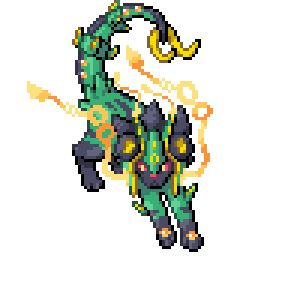
Despite its size and lack of wings, this Pokémon can fly through the sky at great heights, seemingly walking or prancing upon the air. It is said that it can quell the storms and strife with its mere presence, so there are some who revere it.

A Rayflame's scales are scalding hot, even months after being shed. They fly at high speeds through the sky and never stop for any form of weather.
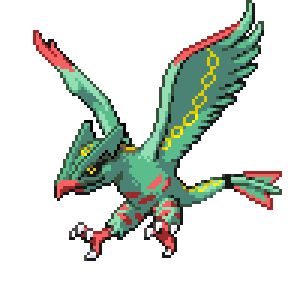
Raylucha is able to achieve speeds that put most standard airplanes to shame. It often clashes with other Dragon-type Pokémon and has been seen preying upon some of them after winning. It mostly ignores anything and anyone it deems weak.
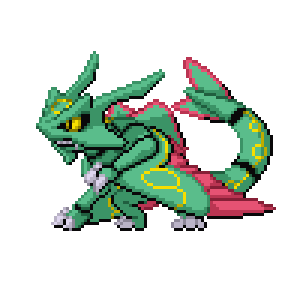
It has a voracious appetite for leaves, fruits, and vegetables. There are some stories that claim this Pokémon can grow nearly thrice as long before evolving.
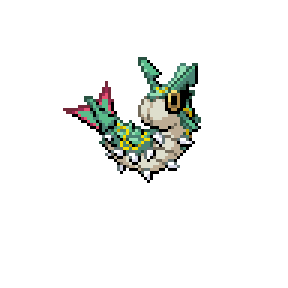
Rayizard's body is overflowing with energy, which it regulates through exerting itself; it achieves this by seeking out fights and by traveling far and high in the sky. Its flames burn hot enough that rain will sizzle and evaporate on contact.
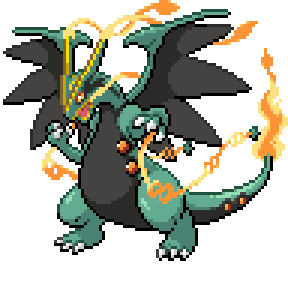
This Pokémon will let none, save for the very few it ever chooses, ride upon its back. It is able to walk upon the air itself, its majestic mane of flames casting an awe-inspiring visage as it trots through and beyond clouds.
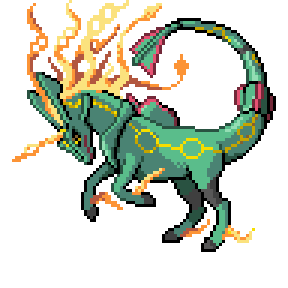
Dialdactyl are highly territorial and aggressive, which is thought to be due to having been poached in the past for their large, blue crystals. These crystals store and channel immense energy, especially while a Dialdactyl is agitated.

When thoroughly enraged, Dialdactyl are likely to fly into a dangerous and destructive rampage. Though they inevitably tire out due to rapidly exhausting their energy, Pokémon Rangers and Rangers still monitor their territories to avoid such incidents.
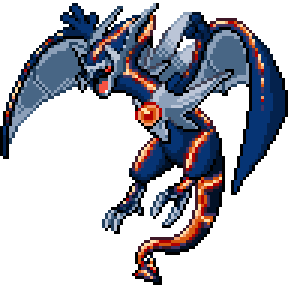
Dialcuno secure their food, notably opting to prefer hardy fruits and vegetables, by freezing them solid. The ice they create is remarkably dense even within seconds of forming, though they can control it and make it melt just as quickly.
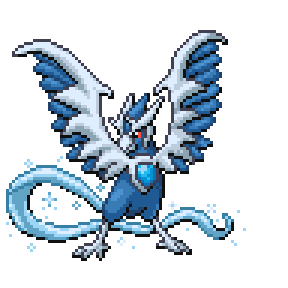
Those who peer into this Pokémon's flames will supposedly see their entire life as the flame flick about. The core upon Dialtres's chest contains immense energy that it can emit as a searing-hot ray of light to defend itself.

Dialreep's wool is remarkably durable even before being processed and is more electrically conductive than copper. Though they are considered docile and easy to tame, caring for them is considered difficult by many.
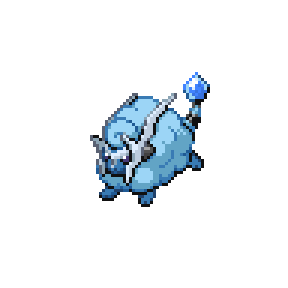
Dialffy have developed dense chest plating to better defend their young from threats. To dispatch foes, they can channel and discharge powerful electrical bolts from their metallic horns.
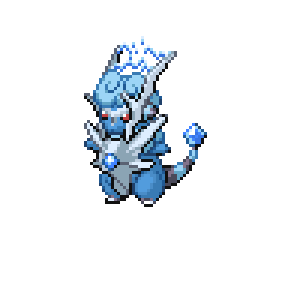
When it channels electricity, its three blue crystals emit light at varying brightness depending on how much electricity it channels. It can release electrical bolts from its horns or the sharp tips at the edges of its chest plate.
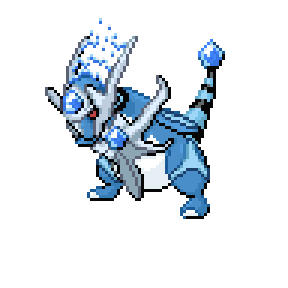
The leaves on its arms are sharper than most bladed, human-made weapons. It makes its home around the eldest tree within a forest or a jungle. Any who attempt to harm this tree will be quickly felled by its slashes or crushed by its tail.
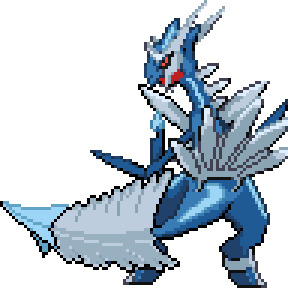
Dialvoir monitors the flow of time and will punish those who ever attempt to influence time itself. It is highly attuned to emotions, which allows it to easily identify malicious entities.

Dialgron are a long-lived species that favor nesting within deep caverns rich in minerals and ores. Their bodies are harder than tungsten and remarkably heavy, yet they can move quite well, which indicates they are quite strong as well.
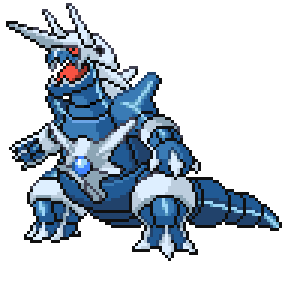
Their feelers are tougher than steel, yet softer than silk, and as free-flowing as fabric which makes them excellent for defense and offense. They seem to know if one has ever acted with malice and seem to resent those who have.
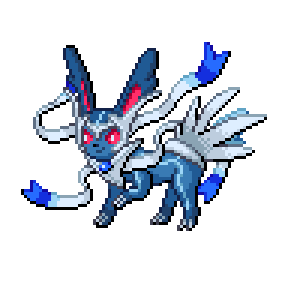
Dialrai can wield powers of nightmares and of time. Although not innately malevolent, this Pokémon has struck fear into many evildoers by showing them the evils that they would commit in the form of a lifelike nightmare.
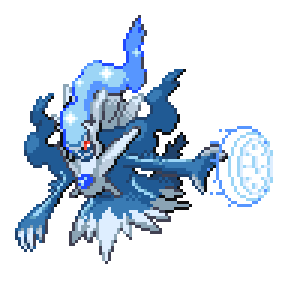
Dializard are notoriously combative, though they rarely display malice. They seem to fight merely to prove themselves or over territory. They are notorious for increasingly growing stronger during battle as time goes on, even while wounded.

A common feature of mythological stories claims Dialdash can run fast enough to traverse time. The gem-like part of its body glows brighter when it unleashes more of its powerful flames.
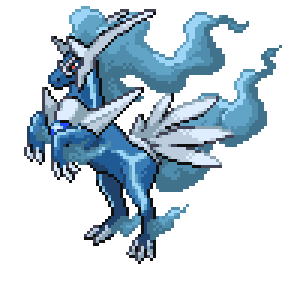
Dialer are considered to live long lives, with their shells growing as tough as tungsten as they near the peak of their lifespans. Despite the inherent weight of their own shells, which extends to their claws, they rarely struggle to move.
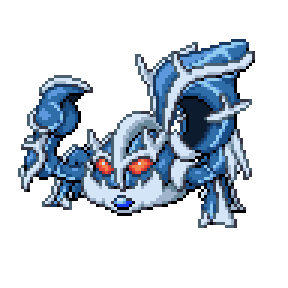
Commonly mistaken for large gems, Palkorb often try to avoid all others, yet ironically they will hunt down Sableye. Sudden impacts are enough to cause them to violently release their internal energy with explosive force.

Palktres flies through space itself, infinitely expanding upon the vastly-expanding void with the cosmic energy flowing from its wings. Its sharp cry can be heard across the cosmos and signals the imminent demise of a star.
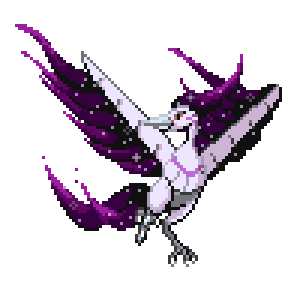
Palkvoir wield mystic powers that allow them to seemingly control gravity and to warp space itself. As a last resort, they will combine their powers to create a black hole in an effort to eradicate any threat that yet remains.
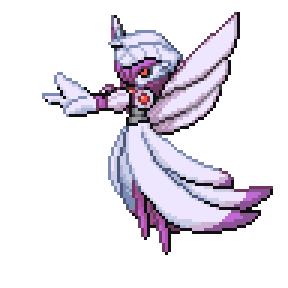
It is the result of a fusion between Palkia and Arceus, which is claimed to have awakened the innate power within Palkia. Some mythologies state this resembles a Palkia's "Origin Form" and that it can wield the forces of space with little effort.
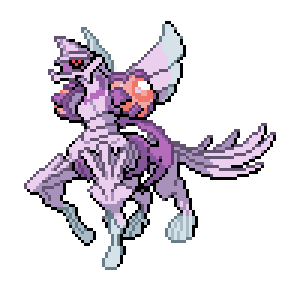
A Pokémon spoken of in some mythologies whose wings are claimed to have the power to rend space itself. These Pokémon are found in the furthest layers of the atmosphere, though some have been spotted deeper in space as well.
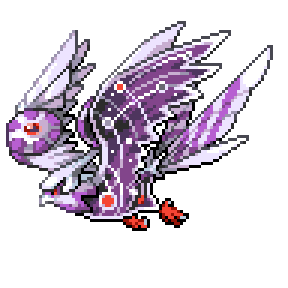
They are capable of wielding gravitational forces that go beyond the force needed to create a diamond. A Palkcie's two discs allow much more precise gravity control. Within the lower body is a gravitational hole that is unleashed as a last resort.
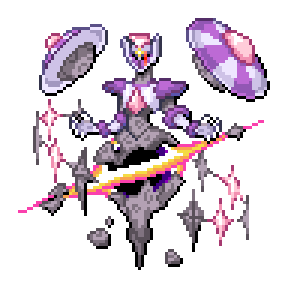
The breath of a Giracuno is so cold that it chills anyone to the bone in an instant. Their shadowy wings can expand to nearly twice their size before engulfing prey, and said prey will never be seen again save for a few bones of its size.

A Giravoir's body is so small that it combines its spectral and psychic powers to manifest its shadow as massive wings. These wings can strike with physical force and can quickly engulf foes in pitch-black darkness.
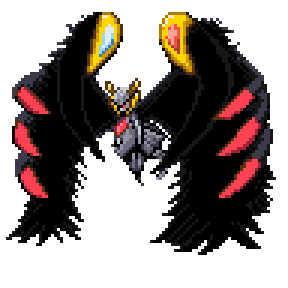
The inside of Girawile's giant jaws is a portal to a world that is the reverse of our own. Those sent to this "Distortion World" this way are said to be forever lost, left to the mercy of whatever else dwells there.

Giraceus's wings are also feelers that can each move individually to skewer and grab fruits or prey. The mandibles of its head are rather large and have great crushing power to break through most tough shells.
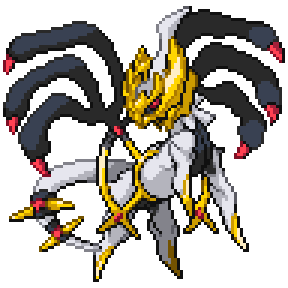
These nocturnal Pokémon feed on the life force of others, but only need to feed on trace amounts to survive. Their black scales are shed daily and have an anxiety-inducing effect on others.

Its red flames are meant to intimidate others. Their bodies are rather frail, so they often spend their time running and avoiding fights.
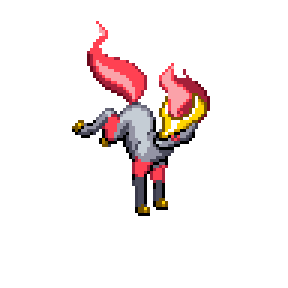
Regiwak wields a club made from a shard of Never-Melt Ice, a tungsten rod, and a Hard Stone. Its body is so dense with muscle that it is constantly weighed down and must exert itself with every move it makes.

Its body is covered in patches of moss due to how often it will exhaust itself and go immobile to recuperate. There are some enduring legends that claim the impact of its tail will give rise to new mountains.

These Pokémon are said to hold immense, destructive power within themselves, thus they lay dormant to contain their own power. A single flap of their mighty wings can create a fearsome gale force.

Regimortar are fueled by their intense inner flames and devour wood to fuel these flames. They batter foes with physical strikes using their left arms and blast them with intense fireballs launched by their right arms.

Regivoir communicate by flashing lights from the indents upon their mask-like faces. They often stand perfectly still as they rest, but are capable of unleashing devastating mystical powers when active.
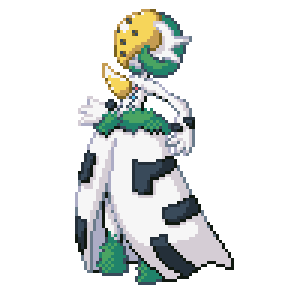
There are enduring legends that claim the back of this Pokémon once sustained an entire ecosystem while it hibernated for millennia. There are no traces that suggest this to be true, save for the lush patches of grass and moss that cling to its body.

Their soft, grass-like wings help them to blend in with the tree canopies they nest upon. Their many eyes emit shrill noises when they flash in various patterns, and serve as means for them to communicate with their kind.
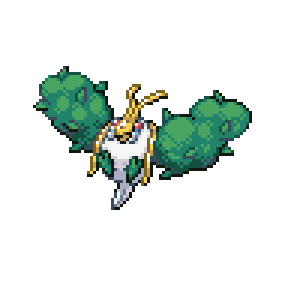
Their lush wings often grow flowers and fruits that will be scattered when they flap their wings. When their many eyes flash in patterns, they emit high-pitched melodies.

With their lower bodies in the visage of a flowing cape, these Pokémon crawl along forest floors and up the sides of trees in search of large leaves to feed upon. When asleep, their white antennae flick about like wisps of smoke.
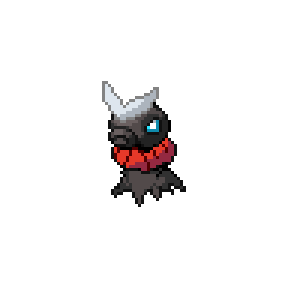
Darkfing float about with ease, their bodies hollow and full of a thick, white smog. Those who inhale its smog will be plagued with deep dreams filled with nightmares.
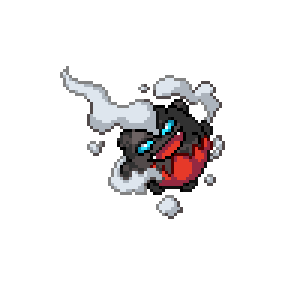
Their black smog is so thick that it often conceals their every movement. Those who breathe in too much of their smog will fall into a deep coma, which some have never returned from.
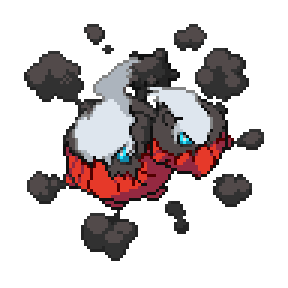
The black fur around its wings is reminiscent of abyssal tendrils oft seen within nightmares and horror stories. Its big, blue eyes glow faintly as it flies through the night sky.
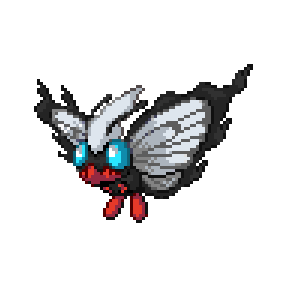
A Darkros's flowing white mane is incredibly soft, even more than silk, and is just as sought-after. However, these Pokémon are incredibly strong and very territorial, oft charging at anything that enters their territory.
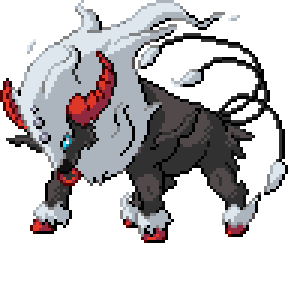
Darkeon loose bolts of black electricity from their spiky collars when threatened. Those struck by their Thunderbolts will oft remember the sensation for a long time and may even re-experience the moment within their dreams.
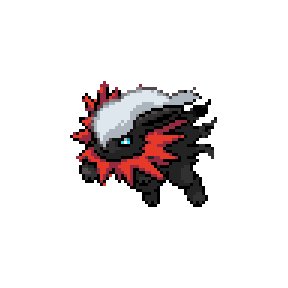
Darklosion's head and neck are veiled in a thick, hot plume of white smoke due to the "hellfire" claimed to be within them. Though there is no proof that these flames come from the underworld, they are hot enough to char solid rock in minutes.

Its large, red jaw conceals the many rows of razor-sharp teeth within its gaping maw. Wild Darkturn lurk in the deepest ocean depths, lightly illuminated by the blue bulbs upon their head-stalks.
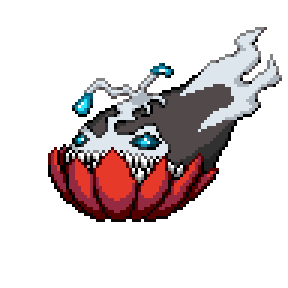
Their red orbs store electricity generated within their bodies. Their luxurious white manes often crackle with blue lightning discharged between their red orbs.
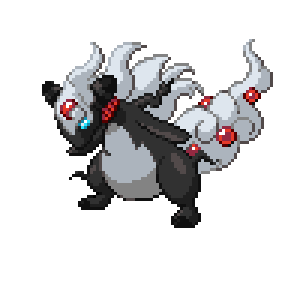
They scurry about within the cover of darkness. A swarm of Darktata will often appear like a moving wisp of white due to their flowing, white hair.
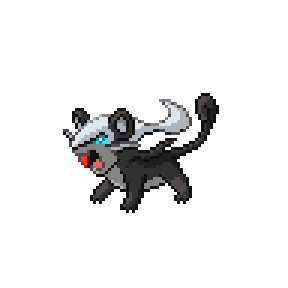
These Pokémon oft lurk within dark caves, only visible by their blue eyes and sanguine-red fangs. They will emerge only at night or during times of darkness to quickly find food to sink their strong fangs into.
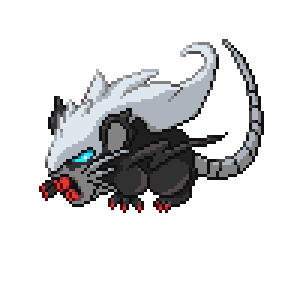
A Darktic casts a beautiful scene within the moonlight as it emerges from within the dark waters of the lake it makes its home within. A Darktic's feelers have a mystifying ability to purify nightmares and instill pleasant dreams.
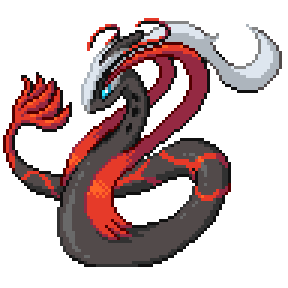
This Pokémon has often been called the "Black Crescent" due to its pitch-black wings, which remain dark even during the day. Its roar has displayed an odd influence over the consciousness of those who hear it, with some falling into a deep slumber.
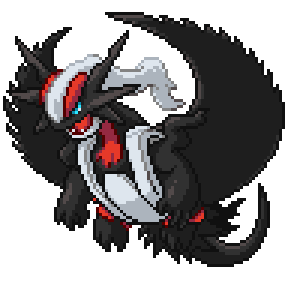
Its sanguine red tusks invoke fear in nearly all who ever see them. Its cry is infamous for the bone-chilling sensation it invokes in all who ever hear it.
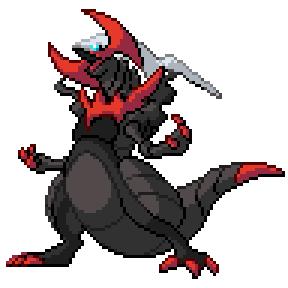
Its potent, dark energies drive it into an ever-growing rage that makes its muscles bulge and burn. Darktrum's jaws are so strong that it can lift a Steelix and flail it around like a weapon without losing its grip.

Darktrum's dark energies have overpowered its every sense, locking it into an unending nightmare that drives it berserk. Its tail is thicker and harder than a Steelix, and anything caught within the energies breathed from its maw is razed to ash.

Darkphox is equally revered and feared for its ability to induce slumber and invoke either dream or nightmare. Its true power, however, is that it can manifest dreams or nightmares into reality itself; it only uses this power when cornered, though.
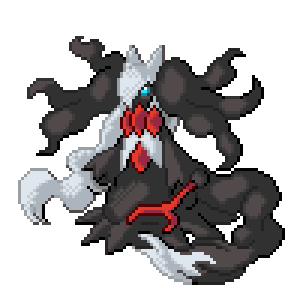
Those who peer into the crystals upon Darkcie's body will be met with visions of nightmares contained within them. Its veil is said to be able to drag its foes into a realm of unending nightmares, but none dare to incite such wrath from it.

These nocturnal Pokémon blend perfectly into the darkness due to their pitch-black bodies and the way their wings appear like flowing shadow. The pollen they oft are found transporting has decent soporific effects vital in some remedies.
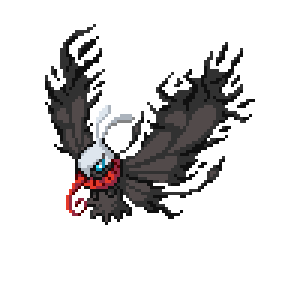
Genetula are capable of shooting expansive electric webs from the cannons upon their backs. Beware if you witness a Genetula dig the tips of its limbs into the ground, for it is a sign that it is about to fire a stream of electricity from its cannon.
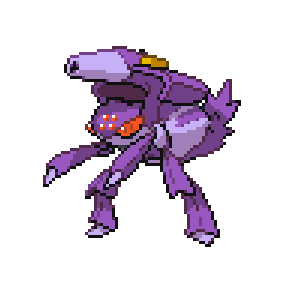
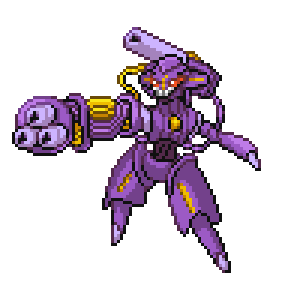
The cannon upon this Pokémon's right arm is actually an organic construct that it uses to fire bolts of psychic energy or nuts like bullets. Genexys are always thinking and adapting during battle, so they may use other materials instead of nuts.
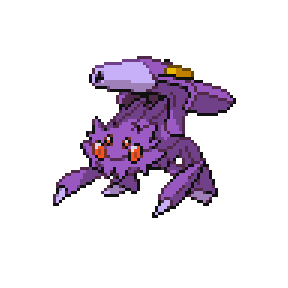
These bug Pokémon are incredibly small, thus the cannons upon their backs are actually very harmless. They shoot electric webs at enemies to startle them as they flee.
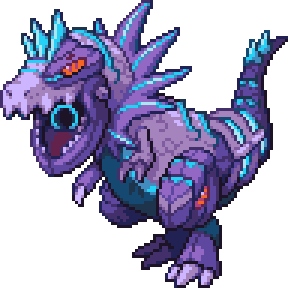
There are very few of these long-lived Pokémon in the wild and these few live around jungles near mountains. Their jaws are powerful enough to break boulders and the cannon-like organ in the backs of their mouths can channel their draconic energies.
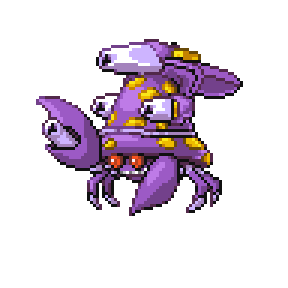
Genesect absorb sunlight to fuel their bodies and can condense the energy into beams loosed by their cannons. The areas around where their fired beams strike will often sprout with small mushrooms.
Its shell resembles a stone mentioned in some stories. It generates and stores such intense heat that it can melt obsidian.

Their flames shimmer like stars the happier they are. Because they are so weak for most of their lives, they typically only come out at night when the moon is visible.

Its shell resembles a stone depicted in some legends. Its body glows brighter with blue light from the intense flames and electricity brewing within itself.

Parts of their bodies glow a bright blue due to the electricity and solar energy stored within. They can loose bolts of lightning from the tips of their tails as they soar through the sky with their wings.

Zekvoir is drawn to those with fierce and powerful ideals and will gauge their worthiness based on their wills. Those few it has ever chosen were always protected by its potent lightning that could sunder lands in an instant.
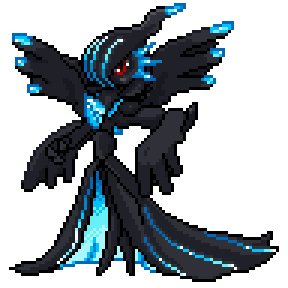
Its lower body is mostly a large, galvanic crystal that draws in and stores electricity; it can even absorb ambient electricity in the air. Reportedly, its electricity cannot be safely harnessed because it has too much power.
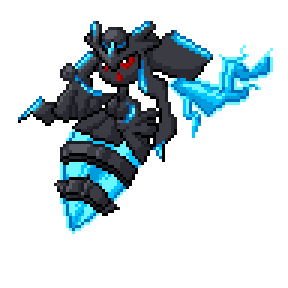
This brutal Pokémon captures prey with the giant set of pincers atop its head and freezes them solid before slamming them into the ground. Kyusir prefer to freeze anything they would eat before they crush their food up within their mouths.

Kyutwo is the result of genetic experiments based on samples of the Pokémon, Kyuew. Although some claim the experiments failed, this Pokémon has the power to instantly freeze anything within its path in mere seconds.
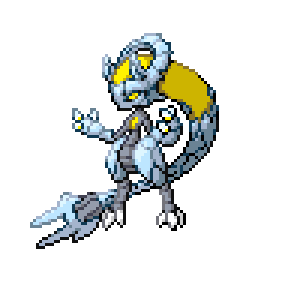
Kyumortar can wield the powers of ice and fire with remarkable precision via its cannon-like arms. From its right arm comes fire and from its left comes shards of solid ice that will freeze the area around where they strike.

The second head of a Kyuwile is how it will fight, defend, and even eat. Anything seized within the maw of its second head will be instantly flash-frozen and then crushed into a fine mist.
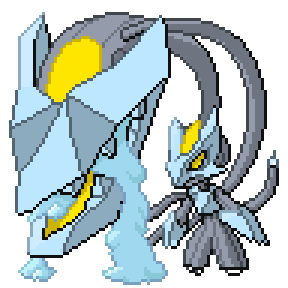
Kyutic live within the depths of arctic lakes, favoring solitude over anything else. It will emerge, clad in layers of solid ice and heralded by a flurry of snow, only when it senses a person with a kind heart and strong will.

Within itself roils powerful, freezing energy that has even frozen parts of its own body when said energy leaked out. Anything cut by its frigid tusks will feel most, if not all, warmth drain from them and may even see ice form around the wound.

This colossal Pokémon prefers to live atop cold mountains, though it is often forced to migrate due to mountain climbers mistaking it for a mountain. Some speculate it may actually have been born from the spirits of lost mountain explorers.

Few of these Pokémon have been found in the wild and they were each found lying in a beautiful field of flowers. Any who drew too near to their flower fields were met with their hidden, long vines clad in many poisonous thorns.

The blue rose upon its tail emits an intoxicating aroma that it uses to lure in prey, which it will swiftly finish off using its pincers. During battle, it uses its thorny tail to lash at foes like a whip, though each thorn also contains poison.

Most Roselade fight with the grace of dancers, always alternating which blade arm they attack with while deftly dodging their foes' attacks. Each swing of their blades scatters beautiful rose petals around them.

The many roses that grow upon its body feed off its own nutrients while it rests, which means it must gorge itself when it is active. Thankfully, the aroma of its roses lure in plenty of prey.

Wild Roseceus dance about in fields of flowers, scattering their many petals about. Many Bug-type Pokémon are often drawn to them due to the many flowers growing on their bodies and the pollen they contain.

These Pokémon hide themselves as weapons for humans, or some few sapient Pokémon, to use. A Rosedge secretes a non-deadly neurotoxin that makes one imagine the "sword" is bound to them, leaving them unaware that it is siphoning their life force.
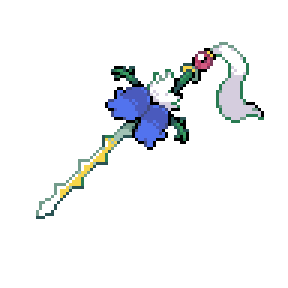
Rosetic are elusive, forest-dwelling Pokémon that avoid all others and only fight if necessary. Even just a single rose from a Rosetic is considered a sign of immense love and respect when given as a gift to another.

These Pokémon often serve as protectors of fields and forests, wielding a thorn-clad vine as a whip to assail foes from afar. Their whips contain a neurotoxin that quickly distorts the reality of the afflicted with all manner of hallucinations.

Wild Roseveon tend to their own gardens of flowers and may even tend to young Pokémon of other species as well. Those who threaten either their gardens or their families will be met with their thorn-clad whips.

It often rests entirely immobile while suspended in the air with its thorny vines anchored into nearby terrain to leech nutrients for itself. When its purple core glows, it is about to become active and will scout its territory for any intruders.
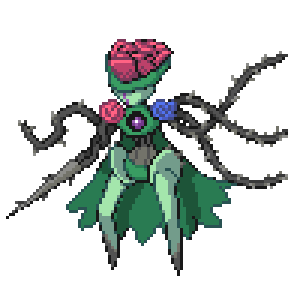
Their bodies retain the heat of their internal flames so well that they can easily drift into the air. Their cloudy fur is thick and heavy to help keep them from flying off too often, though they must shed some of it twice every year.
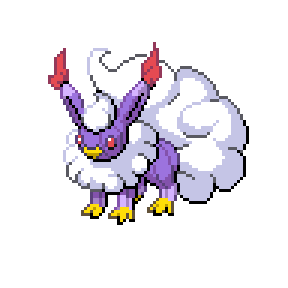
Drifbgon suck in air through their tails to fill their hollow, elastic bodies and drift about in the sky. They use their wings to help guide them when they release some of their air to launch themselves at foes.
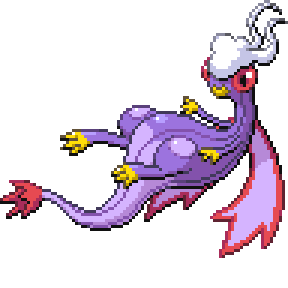
Its body is so light that it can carry many small Pokémon on its back, a sight seen often as it saves young Pokémon from danger. When a strong wind occurs, it uses its long feelers to keep itself from being carried away.

Lopveon are naturally very cautious, so they easily grow attached to those who treat them with kindness and care. Although the tips of its ears are clad in soft fur, they can use their ears to deliver rock-shattering strikes.

Loprorus fur is so naturally cold that it is used in the packaging and transit of many chilled and frozen goods. Protective by nature, Loprorus emit chilling energy from their red crystals to form solid ice to repel or block threats.
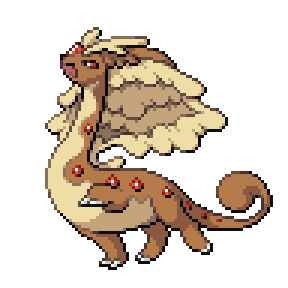
The bulbs at the ends of a Breveon's tail contain calming compounds, with flavors and scents influenced by the Breveon's diet. There are many renowned herbal beverages that are made by mixing one of these bulbs into boiling water.

By shaking its head and tail, it can scatter countless spores. These spores influence nearby plants, particularly flowers, and cause them to exude calming aromas.

Bancargo have long been thought to be born of greedy spirits that came to possess coin purses in hopes of acquiring even more riches. They are mischievous Pokémon that love to collect precious items within their shells.

This Pokémon was born from the longing spirit of an abandoned plush doll that had supposedly been modeled to resemble Arceus. What now appear to be zippers running across its body were once tears, and are said to allow one to peer into its very soul.

Banpunny are always searching for Trainers that have abandoned any of their Pokémon, seemingly possessed by a dreadful desire for revenge. To all other Trainers, they are incredibly shy and will often avoid them out of fear.
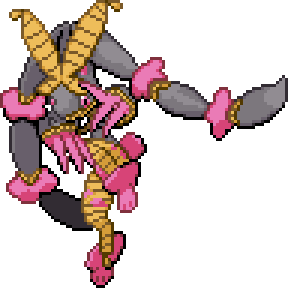
A Pokémon said to have been born from the selfish and wicked wishes inscribed upon its blue tags. Though supposedly having been born from wickedness, Banrachi only shows malice towards those it deems irredeemable.
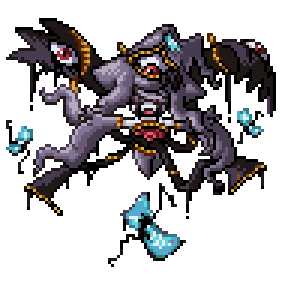
Their wings spin rapidly, and buzz quite loudly, when they are awake and flying about. They each prefer certain kinds of honey and sap and will protect the sources of such things with electrical bolts.
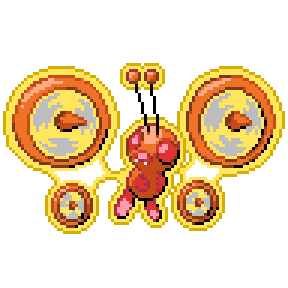
Its body is made of condensed electric plasma, making it very light and agile. Roeon love to feed on the electrical energy of devices and machines, so some consider it and its kind to be pests.
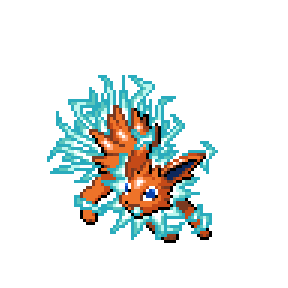
The eyes upon their shells are markings meant to fool others. They attach to boats to get around quicker, though they also try to sneak aboard to feed on electricity.

Even a small cut from its scythes can result in numbness that can last for over a day. It dips its scythes into water and releases electricity to weaken or knock out large batches of prey.
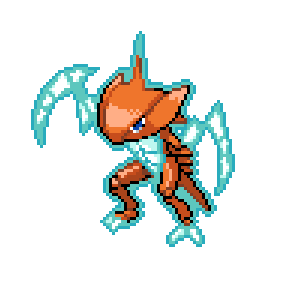
Its body resembles a fossil of certain Pokémon, which seems to mostly be for the sake of intimidating others. It can "swallow" prey whole, wrapping them in its plasma and siphoning them of any and all electricity before discarding them.

Roew are mischievous tricksters that appear and disappear in a flash. They love to disrupt devices such as cameras, which has delayed efforts to photograph them.
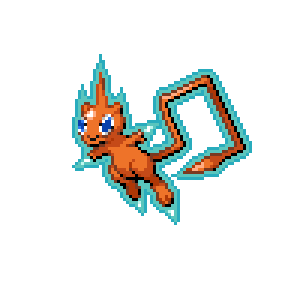
It spits balls of condensed, hot plasma at foes that explode with heat and electricity on impact. If angered, flames and electricity erupt violently from its back.

They leech electricity from machines, though they also tend to cause those machines to be fried in the process. If challenged, they release a torrent of superhot electricity from the backs of their necks.

Rogey are often considered nuisances because they will perch atop radio towers and antennae and they disrupt signals when they do. They can loose precise electrical jolts that can overload small generators.
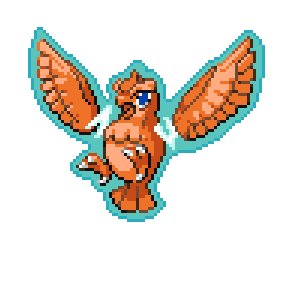
Rodos release strong Thunderbolts from their horns with great precision. They use their claws to cling to cave ceilings and drop on unsuspecting prey, then paralyze them with a shocking bite.
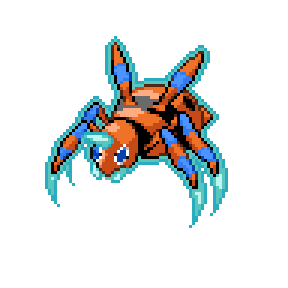
Wild Rotto perch atop electrical transmission towers, or along the cables, and absorb some of the electricity to fuel their own bodies. They become very territorial if they are not chased away within a week.
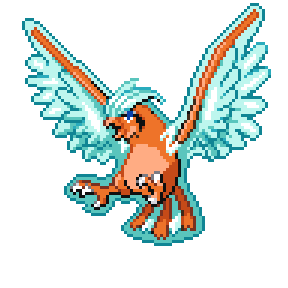
Although some find these Pokémon and their plasma bodies to be marvelous to view, Rogeot are constant dangers to electrical grids. They feed on electricity wherever they can, seemingly unaware, or just uncaring, of the effects on others.

They latch onto foes and prey with their claws and deliver strong jolts to down them. Their cries tend to sound as if they are giggling or chuckling at others, further enforced by how they stick their tongues out at others so often.
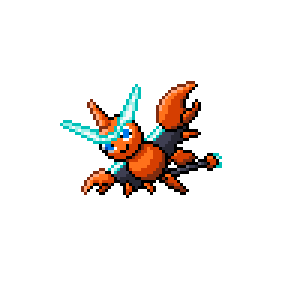
Its pincers can move so quick around it that it often looks as if it has four of them, but it only has two. It delivers powerful Bullet Punch attacks that deliver paralytic jolts with every blow.

Its body is made of plasma, yet often seems to be as hard as iron as well. It can move very fast by jetting electricity from its wings, and uses the momentum to deliver thunderous blows with its pincers.

Some people believe these Pokémon were the inspiration for some weapons depicted in some science-fiction media. They can release attacks with extreme precision and rarely miss.

Its horn-like antenna serves as means for it to communicate with others of its species. To release electricity, it rubs its cheeks quickly and lets jolts fly all about.
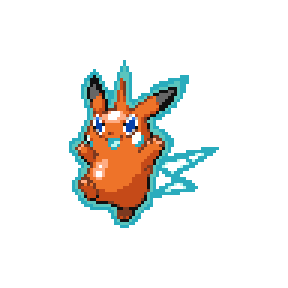
Their plasma wings shine with at least seven colors and release enough light to produce a warmth akin to sunlight. They defend themselves by spitting electrically-charged fireballs.

When they store too much electricity, they become aggressive and violently release their electricity. Once they have released enough, they return to being very friendly and docile.
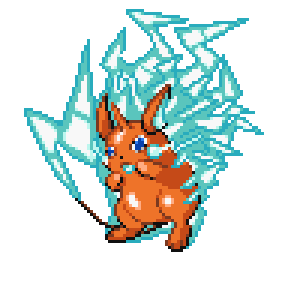
Romortar are filled with electricity and flames, which they will condense into balls and shoot them from their arms. They like to trick others as if they are going to attack them by emitting strong lights from their arms.
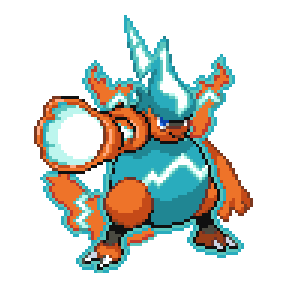
The tip of its tail is sharp enough to penetrate most materials, allowing it to connect to machines and absorb their energy. It perches high to swoop down and steal devices from passersby to feed.
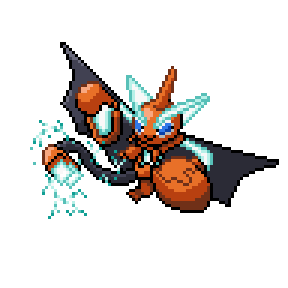
They prefer to avoid others and release powerful electricity to even avoid having records of them be obtained. Even if tamed and treated well, they rarely like to be perceived and may temporarily disable their Trainers' devices with electric surges.

It has molded its body of plasma into a form reminiscent of a wood chipper, though its blades can grind up small rocks and pieces of ore. It is very friendly and its kind are treasured in many professions.

Roidos are mischievous and playful, often headbutting others which also releases plenty of static electricity. When two Roidos play, they will often butt heads which releases large, although mostly harmless, electric bolts.
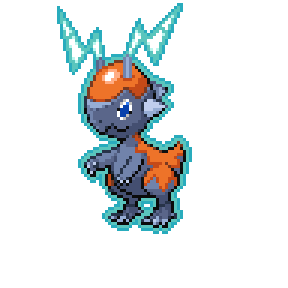
It is full of energy and loves to fight, be it playfully or otherwise. It holds enough electricity within itself that a full-power Headbutt can paralyze a large foe or release a localized EMP.
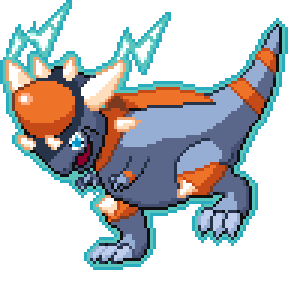
Its body is made of a powerful electric plasma that allows it to interact or interfere with nearly any machine or device. It is an ally to many Rangers due to how ready and willing it is to thwart poachers' efforts.
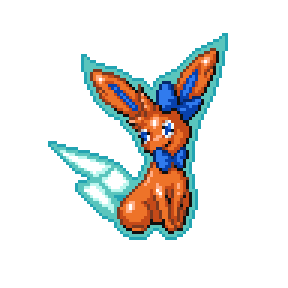
When Roquaza release their excess electricity, it tends to appear like clouds nearby are crackling with thunder. Some of these Pokémon love to fly near airplanes and jets, and have even helped avert crashes.

Roxys bodies are mostly made of plasma, which allows them to dart around at extreme speeds. They can use their slender arms to constrict prey before delivering a killer electric shock.
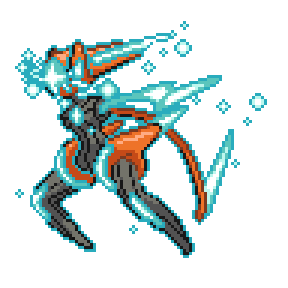
Their electrical surges at the tips of their tails change in volume and speed depending on their emotions. They are so electrically charged that a single touch from one claw can make one's hair instantly stand on-end.

Although they appear physically reminiscent of Zubat, their bodies are composed of plasma and they guide themselves with harmless electrical jolts. They emit a faint glow that often helps travelers to see better within dark caves.
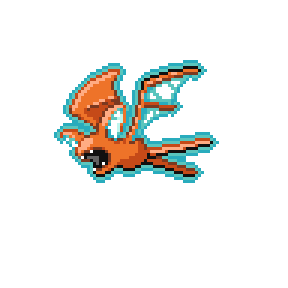
Their fangs can easily puncture most metals, which allows them to easily drain electricity from machines. When they overeat, their wings glow brighter and small sparks of electricity fly freely.
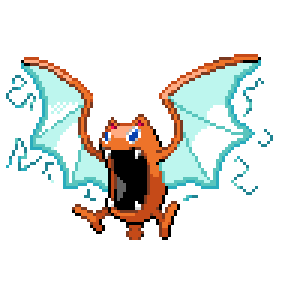
Its electricity is surging and flowing so quick that it runs hot enough to easily create flames. It is a rather mischievous Pokémon that will often start fights without intending to and then flee.
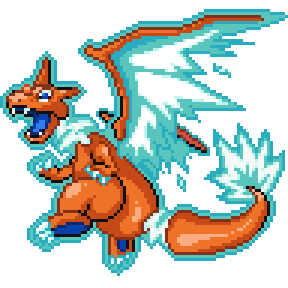
It can float, but seems to instead love rolling around along the ground. If it spins quickly in place, it can generate enough electricity to release a localized EMP.
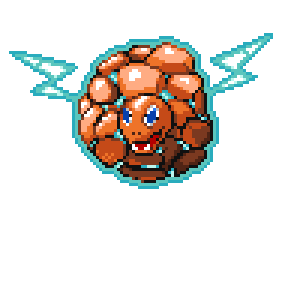
A Reunidos's body is mostly made of a dense plasma that can easily conduct electrical currents. They use their psychic powers to control their own bodies and to subdue their opponents.

Its "shoulders" are lesser heads that have their own brains, further expanding its psychic powers. The liquid surrounding its main body is a special form of solid plasma that is always electrically charged.

Supposedly, the gelatinous body protects the core of this Pokémon. This gel can absorb most attacks with minimal impact to its shape or stature. Its axe-like tusks are are made of heavily compressed plasma and exude weak psychic energies.

Supposedly, the first Clefgia was discovered within a crater, though it remains debated if it was drawn to the crater or if it was what created the crater. Clefgia becomes most active on moonlit nights, though it also seems to become stronger.

Clefark's long hair appears as if it is the very cosmos itself due to their powers of illusion. They seem to feed on moonlight and, thus, are only active at night.
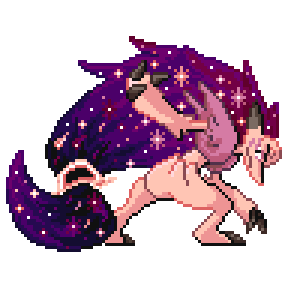
They use their small wings to help them skip rather far as they trot along the land. Their flames have a mystifying effect of calming foes even as they are burned by the heat.

Wild Whimsidra often drift in the air near water, exhaling air through their mouths to help them direct their own movements. They can also spit cotton spores, though this will often cause them to slowly descend if they do so for too long.

Whimsisaur are beloved by families due to their extremely soft and cushiony masses of cotton spores. They are very scared of strong winds and rain, to the point a tamed Whimsisaur may flee into its Poké Ball.

Beneath their thick, lower cotton are slender roots that make up their nervous systems. They must routinely pluck the ever-growing cotton upon their heads, which they often use to leave markers for lost Pokémon and travelers alike.

Krookoveon travels through desert sand with its eyes and nostrils above ground, constantly searching for new prey. It uses its feelers to ensnare its targets as it breaches the sand and clamps its powerful jaws down upon them.

It resembles ancient rulers of particular civilizations, save for its massive and rotund body. It hoards gold, gems, and other precious materials and can even "eat" them to keep them safe within itself.

These Pokémon were the unyielding servants of ancient pharaohs, said to have the power to peer into the souls of others. Though their ancient masters have long passed, they continue to guard their tombs from thieves to this day.

These Pokémon are born from abandoned pots and planters of ancient civilizations. They guard their homes with their ghostly powers and will often try to drag their foes into their bodies using their singular, shadowy hand.

Cofalax store gold and gems within themselves by swallowing them, though they have no means to digest them. They seem to feed on the life force of others grabbed by their shadowy hands.

People claim that these Pokémon are born from ancient spirits, who now guard ancient ruins and burial sites. Their shadowy limbs siphon malice and greed from those they touch, helping them to achieve a true sense of calm.

This dark, phantasmal Pokémon is supposedly bound to our plane by the ancient artifact of an ancient civilization around its neck. Its many shadowy hands are constantly grasping to claim the lives of any who intrude upon its domain.
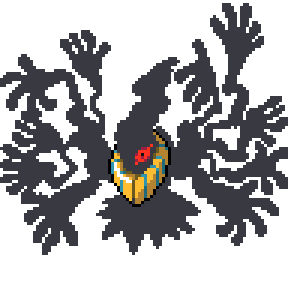
These Pokémon guard the graves and tombs of their masters, no matter how long ago they may have passed. They dart around at rapid speeds and strike at foes with their shadowy limbs.
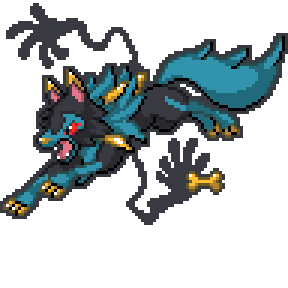
The wrappings around its body are feelers it can control that seem to have musical notes etched upon them. Whether these notes are the same songs they sometimes sing is unknown, for none have been allowed to study them.

Many believe the sound of a Cofaetta's trumpet to be a harbinger of unfortunate times, if not outright doom. They use their bandage-like feelers to batter wicked people and their foes while dancing around them.

Cofamo-o guard ancient ruins and the treasures said to lay within them, wrapping would-be thieves in their bandage-like feelers. These feelers siphon their life force until their ghostly hand-like tail can drag them down into the underworld.

Cofacie reside within the depths of tombs, using their shadowy limbs to repel invaders. Some depictions of some past civilizations bear a resemblance to these Pokémon, with them as the loyal companions of some ancient rulers.
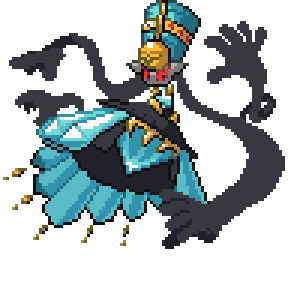
These Pokémon love to use electricity and puffs of their flames to roast nuts and berries before eating them. The spikes along their backs often exude an intense heat that deters assailants.

The spiky fur along a Galvanlosion's back will crackle with electricity as it prepares to spew flames from its mouth. The webbing it can spew from its mouth is capable of channeling its flames without burning for many hours.

These Bug-type Pokémon carry a hive made of silk webbing atop their backs, where their young will typically be restlessly crawling inside of. They typically sleep in caves, their slimy bodies helping them to stick to the ceiling.

Galvanvoir will only reveal their bug-like legs around their trusted Trainers. Using their multiple upper limbs, they weave their webbing into accessories for their friends. These accessories glow with a harmless electricity flowing through them.
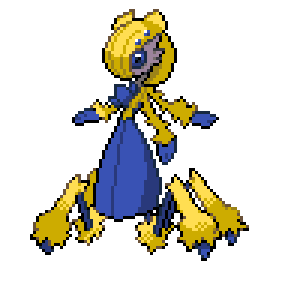
Wild Galvanvoir conceal their lower limbs beneath their skirt-like fur to avoid ridicule and scorn. They value loyalty and kindness before all else and will use their electric webs to protect any and all of their friends.

Wild Galvanlade fight using electric threads that flow from their elbows and by jabbing at foes with their large, lower limbs. By weaving together their electric webbing, they can craft defensive webs that repel many attacks.

Galvanwile are playful Bug-type Pokémon who use the large leg-like horns sprouting from their heads to move around. Their fur is charged with static electricity, which often startles most people and Pokémon when they first meet.

Their vines are strong enough to let them hang from cave ceilings. They fire steel spikes at foes or prey below, and will drop onto them with a Body Slam to finish them off.

Ferrocuno use their large, heavy tails to pin down opponents before skewering them with their loosed, metal feathers. The seeds that sometimes fall from between their feathers are cold to the touch.
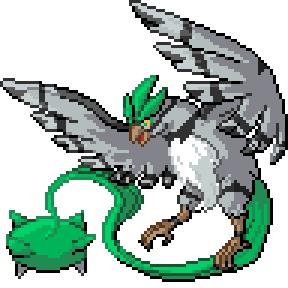
Wild Ferroflora often crawl along cave ceilings like Aipom on jungle gyms. In battle, they dig their metal claws into their opponent and strike them with a strong Headbutt.

Using its long vines tipped with iron barbs, it can swiftly maneuver through forests or hang from branches. It will grab fruits and nuts from trees with its vines and crush them up before eating them in one bite.
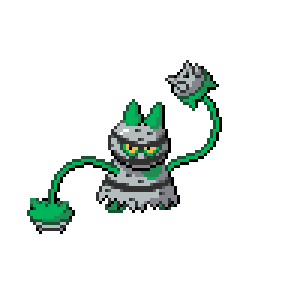
Ferroray uses its three, prehensile tails to secure its prey and to hang from cave ceilings or branches. It delivers powerful zaps with each physical strike it lands and flings electrified steel spikes at distant foes.

Ferroray prowl within caves and forests, using their claws and prehensile tails to stay off the ground so they may better ambush their prey. Their eyes can see through anything at a decent range, which allows them to easily track prey.

Wild Ferrogon rain down steel spikes upon their prey and at those who intrude upon their territory. A Ferrogon has many long vines with spiked, steel bulbs at their tips that can be used to viciously batter others.
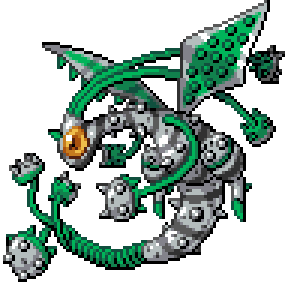
It is a bemusedly playful Pokémon that startles travelers by lowering itself from the cave ceilings it hangs from. It stabs its thin appendages into places rich in nutrients and directly absorbs them.

Ferroloom swing their tails to fling metal spikes at targets from a distance and utilize their stretchy arms to keep said foes at a distance. The caps on their heads are harder than steel, and they utilize them as shields during battle.
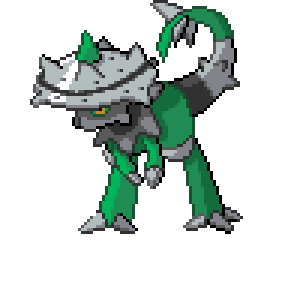
Their bodies are covered in a layer of a waxy substance that they shed every few days, though it reforms almost instantly. The flames on their heads grow brightest right before, and during, the shedding process.

Litreep are constantly molting their wax-like coats, which are equally always being gathered and used in various crafts by humans. Sometimes, however, the shed coats are filled with their excess electricity, so caution is always maintained.
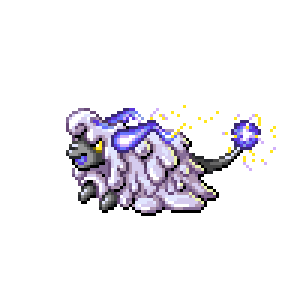
It has a vast intellect so long as the flame upon its head continues to burn. It appears to feed on emotions to keep its flame going, especially the emotions of those on the verge of death.

Their waxy feathers are often found near their nests, glowing faintly like small candles that can light the way. If a Trainer ever spots one, it is advised to not follow it for it may attempt to feed on your life force while misguiding them.
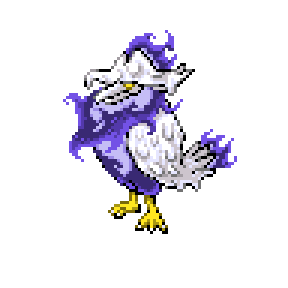
Litveon serve as guides for those lost in the dark of night, though one must beware lingering too long lest their vitality be siphoned. These Pokémon display no malice and seem to only wish to help, blissfully unaware of the danger they can pose.

Litkin spend many hours grooming their wax-like fur to remove any debris that gets caught, eating any flammable materials they find. They harmlessly siphon trace amounts of life force from others to sustain their vibrant flames.

Litdash leech off the life force of all who ride upon them without first gaining their trust or respect. Their bodies are like wax that is always being shed, yet this "wax" never depletes and never fully hardens.

It waves its flame around while lazing near rivers and streams, attracting many other Pokémon smaller than it. Though it seems to have long forgotten why it does this, it still serves as a guiding light for many Trainers at night.

These dark Pokémon have oft been spotted flocking toward those who are nearing their natural ends. Some stories claim that by warding away these Pokémon, you may even be able to ward away death for a time.

Chandelfree are drawn to anguished souls, which will noticeably start to feel better after a Chandelfree feeds upon their negative emotions. Their ghostly flames often serve as guides to lost forest travelers that feel consumed with fear.
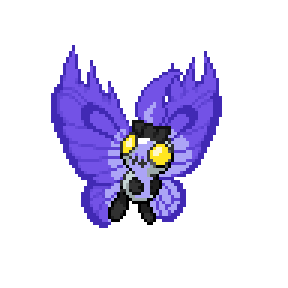
A Chandeldos's body glows with what is claimed to be the souls of the departed who have lost their ways. Similarly, it is said that these Pokémon fly into a ferocious rage due to the many feelings of regret and grief held by these souls.
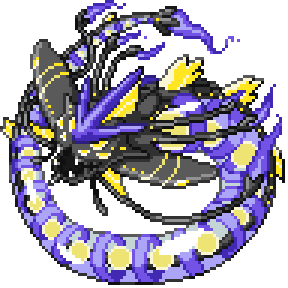
Their fur is soft yet translucent, giving view to their luxurious dark flames that burn within them. They warm the body and the soul of those they trust by cuddling up with them, making them valued companions for many.
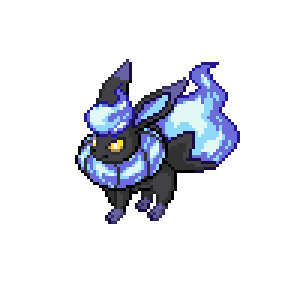
The fusion of a Chandelure and a Typhlosion has awakened a form depicted in old records that spoke of a Typhlosion whose flames carried the light of the underworld. It has a laid-back attitude even though its flames are vastly intense to the touch.
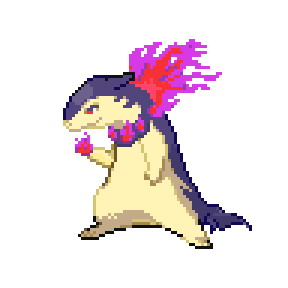
Their transparent wings glow with an otherworldly radiance as they soar through the skies. The flames upon Chandelkrow' heads grow whenever they find a new grave, as if they claim even just a piece of the souls of the departed.
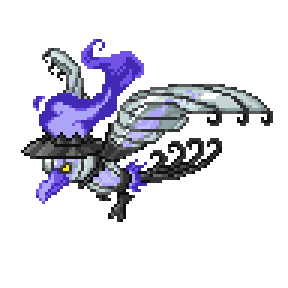
The flames of a Chandelcune supposedly cleanse the souls of the departed of all their sins. They are very selective of who they even draw near to and very few allow themselves to be tamed.
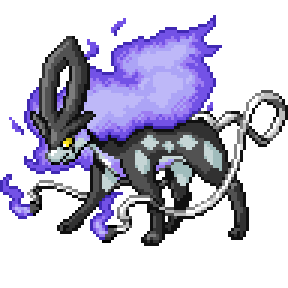
Its spectral flames grow in size and intensity with every victory, as if feeding upon the souls of the defeated. These flames can become so hot that they will burn a hole through solid steel in seconds.

The glass-like feathers of Chandelkrow are often used in the making of glass panes, especially those of religious sites. This is likely due to a legend that claims their feathers can ward off evil spirits.
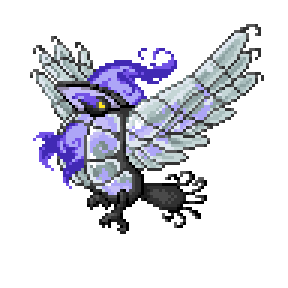
Their spectral flames glow brightest at night whilst they wander through the desert in search of lost travelers or lost Pokémon. A cut from their claws invokes a bone-chilling sensation, as if the wounded individual's warmth is being drawn away.
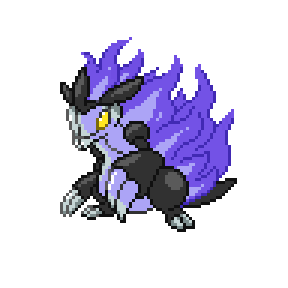
They are keenly aware when the end of a life draws near and appear to be compelled to track down the source. Though their appearance near such a time has led many to see them as omens, other reports claim they have also prevented unnecessary death.
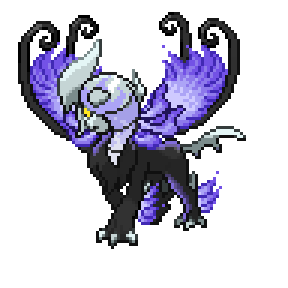
Each of the spherical parts of its body glow, starting from the rear to the front, when it prepares to unleash a torrent of flames from its maw. The sight of a Chandelquaza flying through the night sky is often considered an omen to many.
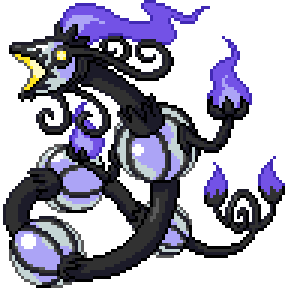
Within its flames are glimmers of light that are reminiscent of stars. Some stories claim these "stars" are long lost souls. The flames of a Chandelkia can burn so hot they distort space around them.
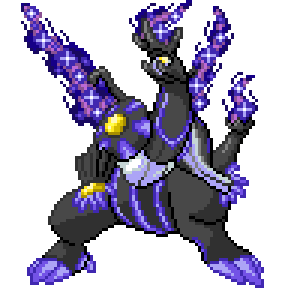
A Chandelxorus's flames burn brighter with every victory in battle. Being cut by its axe-like tusks will both burn the flesh and feel as if it chills the bone.
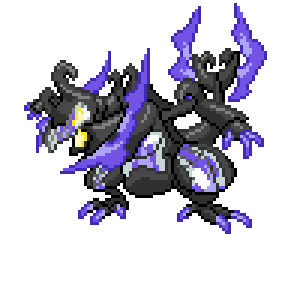
The wispy furs of a Chandelpix glow faintly with an otherworldly light the longer they grow. Stories claim that within each tail is a wicked soul that has been sentenced to being burned for eternity, or at least until it has reduced to nothingness.

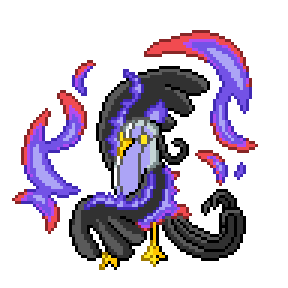
Wild Chandelcorio are often seen dancing at night near graveyards whenever fresh flowers or candles have been left earlier that day. Every graceful movement of their wings sends feather-like flames around.
Its body of rock has been hollowed by its intense, purple flames. From its arms, it can release torrents of fearsome fire and launch flaming rocks like cannonballs.
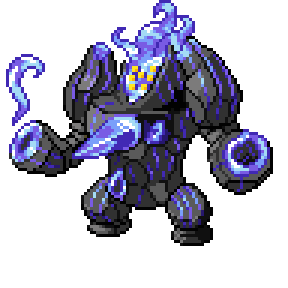
The swift movements and wicked flames of a Chandelroc often paint a picture of doom for its opponents. Their finishing move is oft to bury their opponent in a tomb of rocks and set them ablaze with a blast of fire.
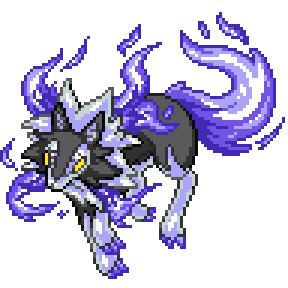
Chandeletta are often drawn to graveyards during new burials; supposedly, they are drawn by the emotions of those attending the burials. In respect of the deceased, they perform passionate dances accompanied by beautiful songs and spectral flames.

Spectral flames swirl within the glass-like shells of these Pokémon, occasionally bursting out across parts of their bodies. These flames burn not only the body, but the soul itself until all that remains is a hollow, roasted shell to be fed upon.
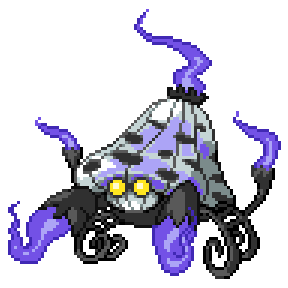
Chandelphox are drawn to resting sites, typically seen at night dancing about while commanding many will-o'-wisps around with their staves. They display no inherent malice, though their flames grow stronger when near others.

The crystalline body of a Chandelcie shimmers with the lights of myriad evil souls burning within its ghostly flames. Its sparkling veil serves also as extendable feelers that will purge impurities from living souls with a gentle grace.
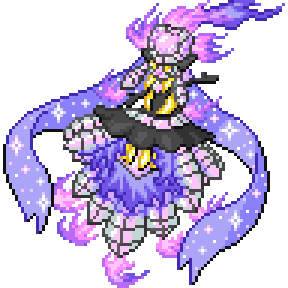
A Chandeldash's hind wheels spin ablaze with ghastly flames as it runs across the night sky. Some stories would have people believe that these Pokémon guide lost spirits with their flames, but there is no proof to support such claims.

Its tusks are sharp enough to cut through a sheet of steel as if it were paper. It wields one of its shed tusks as a weapon; when thrown, this shed tusk will return to it like a boomerang.
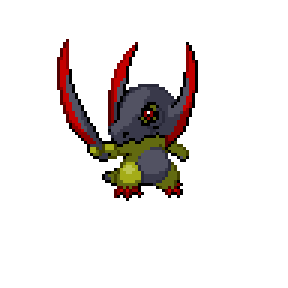
Haxros are covered in a thick plating that protects them from many physical threats. They swing their bulky bodies into foes and use the momentum to swing the axe-like horns upon their head.
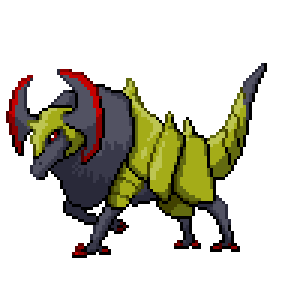
Its legs have grown strong to support the weight of its steel shell. Each of its blade-like tusks can cut through a solid tree with ease, so shed tusks of this Pokémon have oft been used as weapons throughout the past.

Even a small cut from the axe-like tusks of these Pokémon will burn as if on fire until the wound heals. They mark their territories with physical gashes or with scorch marks made with their flames.
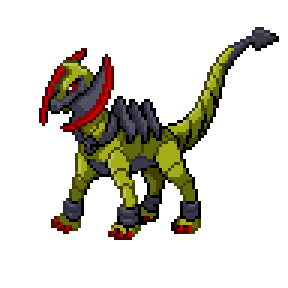
Haxlade fight with every part of their body, as every part of their body has effectively formed into a weapon. The blades upon their arms are their best weapons, however, and they are able to cleanly slice through multiple layers of steel with ease.

Haxcario never fight those they think to be weaker than they are, which they measure by the aura and will that they sense. They wreathe the blades upon their arms in their own aura to inflict damage that is said to go beyond the physical senses.
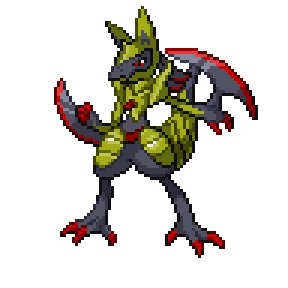
Haxgon will only fight with worthy opponents, using their blade-like tails to perform swift thrusting strikes and wide sweeping slashes. Their wings are sharp enough to cut through solid rock, which also serves to mark their territory.
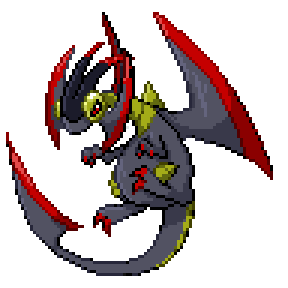
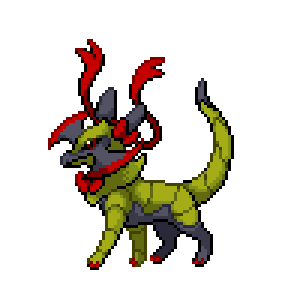
Although it walks on all limbs, it can stand on its hind limbs even during battle. It does this to better deliver attacks with its tusks and to reach its favorite foods using its red feelers.
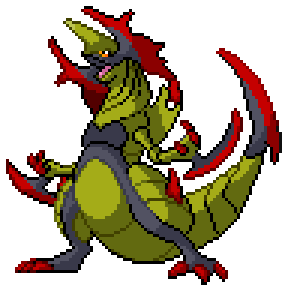
Every battle Haxorus has ever fought has honed nearly every part of its body into a deadly weapon. Its territory is marked with many different marks left by its myriad blades.
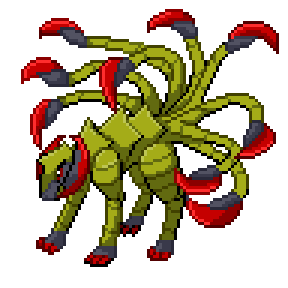
Haxtales are often feared by humans as much as they are revered by humans. These guardian-like Pokémon wield a combination of mystical powers and their many axe-like tails to protect their territory, but they never seek conflict.
These artificial Pokémon served as the airborne sentries of their creators that could fly without rest for years. Their cores absorb sunlight and turn it into energy, which is why they are always overflowing with burning-hot energy.
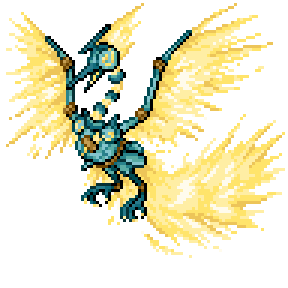
It resembles some statues often found within ancient ruins, especially when it goes immobile to rest and recharge. Its physical blows pack enough power to send a truck flying in a single strike.
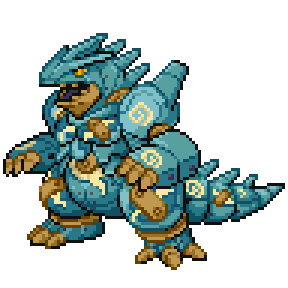
The flower upon the backs of these ancient, artificial Pokémon can absorb and store vast quantities of solar energy. They tend to live near lush forests and will unleash fearsome Solar Beams at anything that threatens them or their forest homes.

These ancient Pokémon are always seen dragging what appears to be an Ancient Vase along with them wherever they go. It is actually an overgrown horn that generates the energy that fuels them, though they can also release it like beams of light.

There are a few legends claiming it was made to protect all forms of life; such legends are partly supported by how vigilantly it saves and protects others. A strange yet potent energy courses through it, which it can wield in myriad ways.

Golusect appear to carry Relic Vases atop their backs, though they are actually a shell that protects the core that gives them energy. They can withdraw inside of these shells to hide within the ruins that oft serve as their homes.

Most theories about Goludash suggest they were likely used as mounts by the ancient people who created them. Yet the humanoid-half of their body suggests they may have been autonomous cavalry, instead.
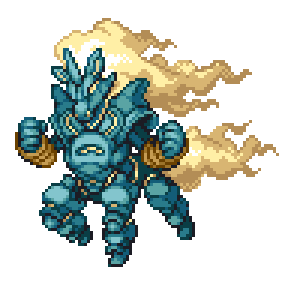
They use flames to form skull-like helmets out of clay and soil, though the bones they wield in their hands are from prey. They can commonly be seen waving this bone around like a wand, balls of fire prancing about in tune to their movements.
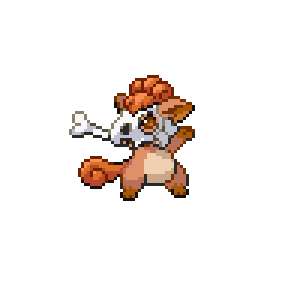
It ignites its own tusks to intimidate others. Its fur is said to be so soft and warm that some long to acquire a Vulxew of their own.
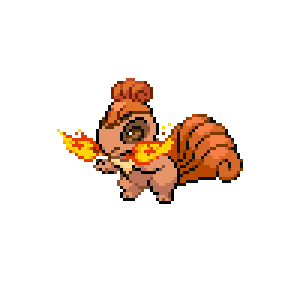
It can eject and control its internal organs like slender feelers, both to deal heavy blows to its aggressors and to ensnare its prey. A tamed Pyukuveon will wrap at least one of its organs around its Trainer while walking with them.
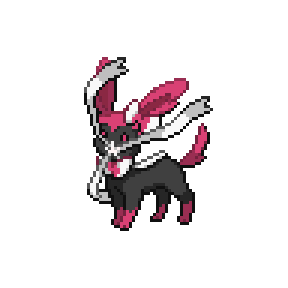
Klefew are infamous tricksters that love to collect keys, even ones that were in use at the time of acquisition. They tend to be so elusive that these keys will be lost for years before they might turn up again.

Talonfree scatter a hot powder from their wings as they fly through forests and fields of flowers searching for sap and pollen, respectively. To defend themselves, they quickly flutter their wings to ignite and scatter even more of this powder.
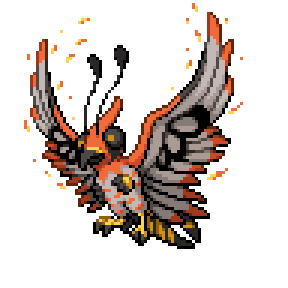
A Talondos's beak is like a stinger with how sharp and poisonous it is. Its webbing is highly combustible, being used as flaming bombs of silk or to scorch foes caught within its webs.
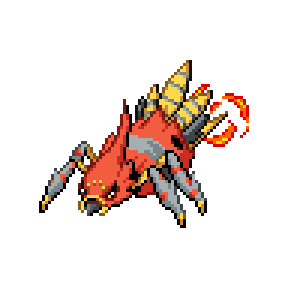
Scorching flames erupt from its feathers during battle, and they grow even stronger the longer a battle draws on. Each of its feathers glows with heat, the sight of which makes it popular with many Trainers.
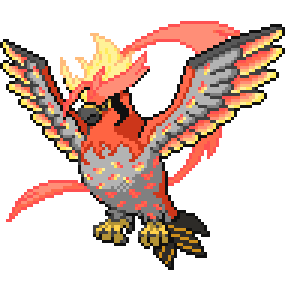
It flaps its strong wings to scatter scorching embers to overwhelm its prey. It is never satisfied after a meal and will constantly search for more food and prey to keep its flames from petering out.

During battle, it swings its hefty wings between its flurries of kicking attacks, scattering scorching embers at its foe. It uses its lower talons to pick up and carry away prey and to gouge enemies with every Blaze Kick it unleashes.

Talonthorn cling to cave ceilings with their strong claws and watch for prey to pass beneath them. When a Talonthorn spots worthwhile prey, it will engulf itself in fire and throw itself down upon its target.
Talonmander are friendly Pokémon whose emotions show through the flames upon their tails. When they get excited, they let loose showers of sparks from between their feathers while hopping from foot to foot.
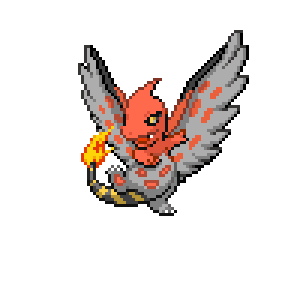
Talonmeleon grow increasingly excited and agitated the longer a battle draws on; as their emotions flare up, so too do their tail flames. At the pinnacle of its flame's intensity, it vents showers of hot sparks from between its feathers.
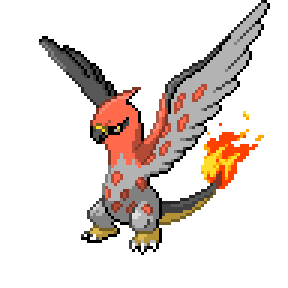
Talonizard constantly searches for stronger foes to overcome as it flies through the sky. It overwhelms prey and foes with showers of hot embers scattered from its wings in tandem with streams of fire spewed from its beak.

It spits compressed, scalding bubbles at bird Pokémon so it may easily prey upon them. If it ever strikes a stronger target and earns its ire, this Pokémon will hide within its shell.
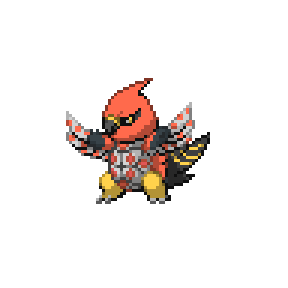
In battle, powerful flames erupt from its body to test the mettle of its opponent. Using its wings, it can move quickly while bombarding its target with fireballs and scalding water jets.

Supposedly, the seen body of this Pokémon is the shed shell of a bug Pokémon being inhabited by its true body. Its shadowy arms can serve as wings that can carry it for miles without needing to rest.
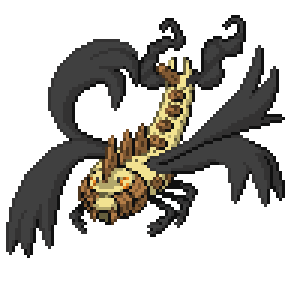
This Ghost-type Pokémon conceals its true form with the wreckage of old, rusted gears held together with its own powers. The gears are too rusted to turn but the cores within them still have enough power to defend Mimiklang from many attacks.
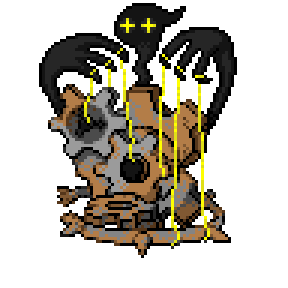
This small spirit came to possess a hand-carved teacup decorated with finger paint. The cup seems well-worn and like it was taken care of with love, which many believe is what drew the spirit to inhabit it.

Mimisect wear traffic cones so that they may blend in within cities in hopes of meeting, and being accepted by, others. Unfortunately, they cause so much trouble that they are considered to be pests by many.

Volcabone wield their own shed horns, favoring whichever one is the sturdiest. Oddly, even after being shed their horns continue to grow until a wing-like mass of scales sprouts from them. These scales are burning hot, even when scattered around.

The weapon it wields is organic, grown from parts of its own body that have been shed and woven together itself. A Volcawak will often dance, and fight, while twirling its weapon around, which scatters many hot scales around itself in the process.

This Pokémon is said to be that which heralds the dawn of a new day, rising from over the horizon as the sun takes to the sky. Each of its red-hot scales that it scatters about will burst into fireballs when it cries out.

When riled up, six large flames burst from their backs like wings that allow them to fly for short bursts. The scales they scatter in this state are able to explode when exposed to the flames they breathe.
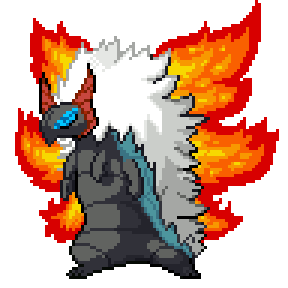
Volcarow feed on nectar and sap, so their nests are not far from flower fields. Every flap of their wings scatters hot scales, which seem to boost plant fertility and allow some plants to endure winter colds.
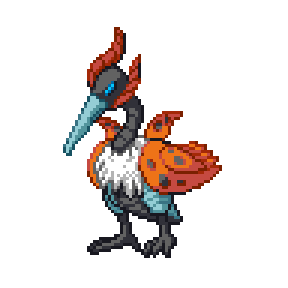
By curling up and spinning in place, it can scatter and ignite hundreds of its own ember scales, cladding itself and its surroundings in flames. A full-force physical strike from this Pokémon could easily crush a tank.

Its rapidly-beating wings scatter many hot scales that will explode into flames when it cries out. It can lift its opponents into the air and then throw them back down before bombarding them with crushing sonic booms.
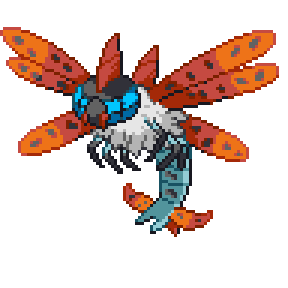
The trees that Volcacko nest upon or within are commonly marred with burn marks due to the burning scales scattered from their arm protrusions. Despite how small their protrusions are, Volcacko can glide quite far with them.

Volcavyle scatter ember scales whenever they swing either of their arms, which ignite when exposed to air. Though this makes them potent combatants, they prefer to cultivate the land and plants around them.

Volcavoir create spectrums of light to burn and disorient foes and would-be threats. When they spread their large wings, they also scatter countless ember scales; using psychic powers, they control and direct these ember scales during battle.

Through a combination of flame and psychic power, Volcavoir can perfectly recreate sunlight and even hone said light into damaging beams. Its remarkable abilities led those of the past to revere it like a deity of the sun itself.

Volcavoir command mystical powers that allow them to easily communicate and fight alongside other bug Pokémon. They bend mystical flames to their whim in the defense of their allies and their Trainers.

The large mouth within its belly contains flames that burn hotter than magma. Any prey it catches will be pulled into this mouth and liquified in seconds.

These large, Bug-type Pokémon exude a gentle warmth even when resting. Their wings can glow like flowing flames to scare away predators.

Volcaran can channel heat through their vibrant wings and mandibles; they char food within their mandibles moments before consuming it. Because they do not hibernate in winter, they rely on their venomous horns to ward off predators instead.

These bug Pokémon hibernate in summer due to the amount of heat they produce; when they hibernate, they become exponentially cooler. The growths on their backs tense and glow when they detect danger, as they will prepare to face it head-on.

It uses its wings to conjure sandstorms wreathed in intense flames. The scales scattered from its wings hum as they fall and can burst into fireballs when it cries out.
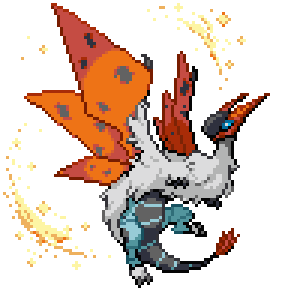
Volcaking exude such powerful heat that they live near colder climates and venture out primarily in winter. When enraged, a Volcaking will fly into a nigh-unstoppable rage that amplifies its heat approximately twofold.
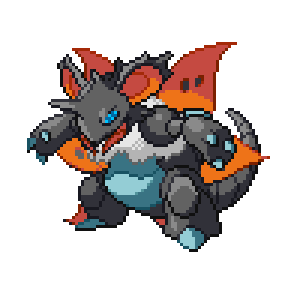
They crawl along the ground with the large legs that have grown from their backs like wings. Their long, lower bodies slither after them as they scurry quickly after prey.
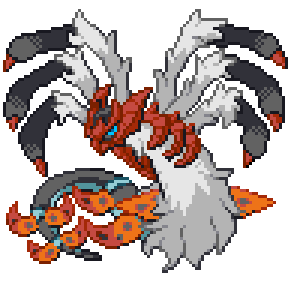
Volcaxorus spreads its large wings together with a plume of flaming scales when faced with a strong foe. Its mandibles are like the blades of an axe and it can spew intense streams of flame.
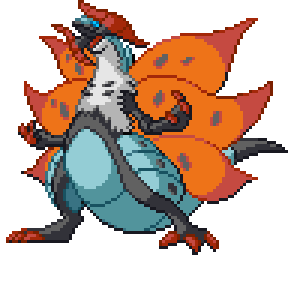
The fusion of two Volcarona gave rise to a paradoxical form some once depicted as being an ancient version of a Volcarona. Its body is now dense with muscles that help it to spew even more intense flames that can now melt rock.
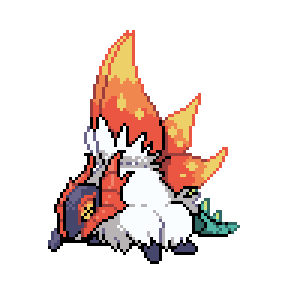
Volcasect defend themselves by shaking their bodies to scatter their ember scales about in conjunction with noxious spores. These spores are fungal and the resulting mushrooms glow with a warmth akin to sunlight.

Its wings shine bright as it flies high in the sky, bathing in the light and warmth of the sun. These bug Pokémon are said to bring bountiful harvests to the land below wherever they fly above.
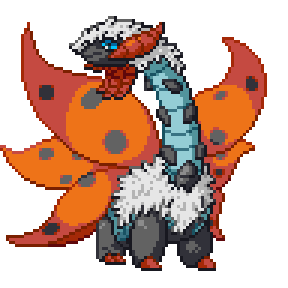
With every flap of its six wings, it scatters scales that instantly combust when it cries out. It will only allow those it deems worthy to ride upon its back, and very few have ever been granted this privilege.
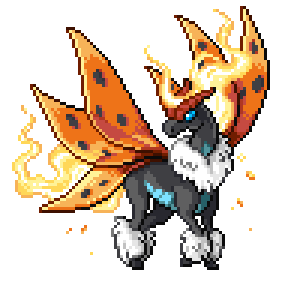
Deishrew are unable to see, so they sense for vibrations in the ground to guide themselves. If they cannot sense any vibrations, they curl up into balls to try and stay safe.
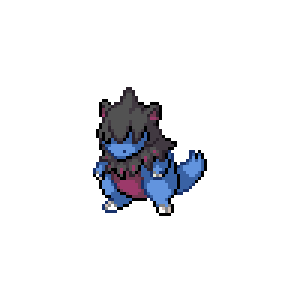
Their two heads struggle to cooperate and will even lash at one another with their respective feelers. Only during battle or when trying to eat will their heads work together, for the sole goal of dispatching their mutual foes.

The blue gas expelled by these Pokémon is a special toxin that is known to agitate Dragon-type Pokémon with great ease. Although this makes them be considered dangerous to some, others still research other possible uses for these gases.

Some stories claim that these three-headed Pokémon wield a dark, otherworldly power that allows them to cut into the very souls of others. They fight with extreme precision using their arm blades, always keeping track of any foes they face.
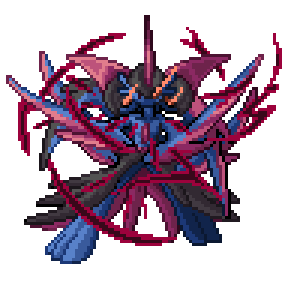
It uses its three heads to devour all food it can find and to thoroughly dispatch any foes. It hates to share, even the attention of its own Trainer, and lashes out at others with its many feelers to keep it all to itself.
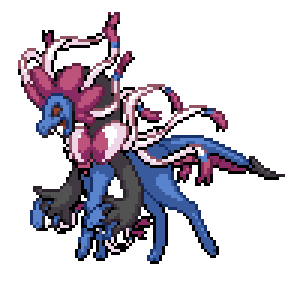
The three heads of these Pokémon are often seen arguing with each other because, strangely, they each seem to be more active during different times of the day. All three heads are fully alert during battle, which is when they display a fierce power.
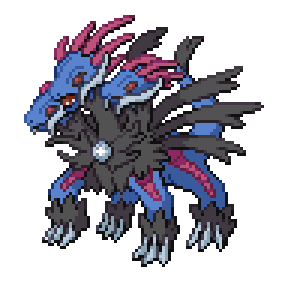
Their many appendages snap at passing people and Pokémon alike as if they were each small heads. It can summon and release flame from the tips of its appendages, or simply from its gaping maw, to incinerate foes.
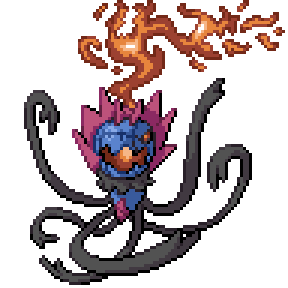
All three were once the same individual, though the smaller individuals are unable to think and merely follow the orders of the larger ones. Hytrum are voracious Pokémon that consume all in their paths and destroy all that dare try to bar them.
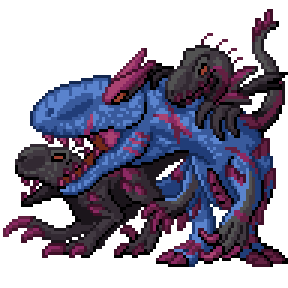
Its six back appendages can move as it wills them to, often being used to hold down foes before it blasts them with dark fire let loose by its three heads. It will only run in the direction that its central head is looking toward.

Ladra use their extrasensory abilities to observe a wide area around themselves underwater, allowing them to easily find or avoid other Pokémon. They sometimes will also save other Pokémon by spraying their attackers with ink.
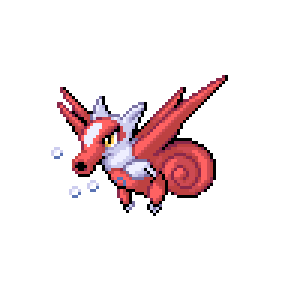
Laram propel themselves through the sky with blue flames released through their large tails. Their wings are sturdy and allow them to easily cut through the wind, creating a potent slipstream in their wake.

Compassionate by nature, these Pokémon use their telepathic capabilities to sense for any individuals in trouble. If they sense any such individuals, Laveon will quickly dart toward them and attempt to provide aid.

Laram release violet, lustrous flames from their tails to achieve extreme speeds within the air. They have often been witnessed descending to purge those filled with malice using their mighty flames.

Ninelade can wrap any part of its body in mystical flames and can even form flame blades with its psychic powers. Its long cape of lush fur grows longer and hotter with age and is seen as a symbol of respect by many.

A long-lived Ninexew will have tusks so sharp they could cut through a tree like paper and fur so golden it is compared to sunlight. Only those trusted by a Ninexew are allowed to ever touch even one of its nine tails.
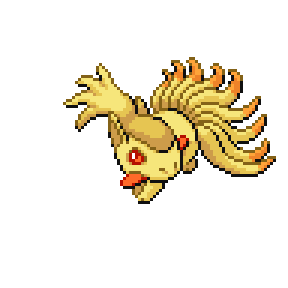
Within Ninedo is a large heat sac, which serves to keep it warm in the cold depths of the ocean. Its heat sac also boils water it inhales and produces steam, which it can expel from the tips of its tails to achieve great speeds.

Its fur bristles and it snorts puffs of flame whenever it thrashes about in rage, oft caused by the smallest of matters. Though it boasts power bordering upon the mystic while calm, it displays vastly less intelligence while raging.

Deopom favor using their tails to hold themselves up, to the point their other limbs are underdeveloped. They use their telekinetic power to pick berries, but toss away ones they do not like.

Deown can change their shape to mimic various text-based characters. Some scientists have made attempts to communicate with them.

Deozor crush their prey within their left pincers and lash foes with their right tendrils. It is said that their cores come from meteorites and must be replaced if they are ever damaged.
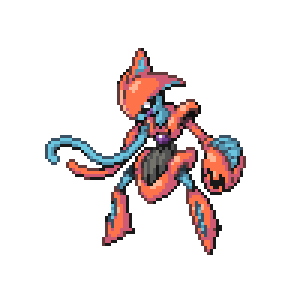
Deoraid propel themselves through water by spinning their two tails rapidly. They can expel water and condensed psychic energy from their mouths to ward off predators or to strike down bird Pokémon.
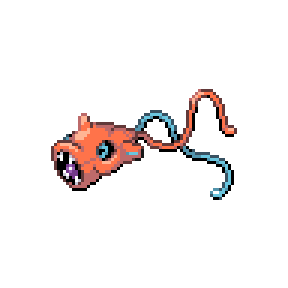
An experiment in Pokémon fusion gave form to this Pokémon, whose monstrous left arm is a lasting reminder of what was done to it. Its lab coat came from one of the scientists when it escaped with a canister containing a piece of its own DNA.
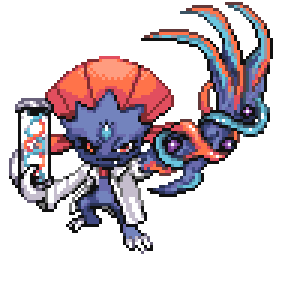
Its bloated body can repel most physical strikes as if it were elastic. Its dual tongues are coated in a sticky substance that allows it to gather multiple foods at once with them.
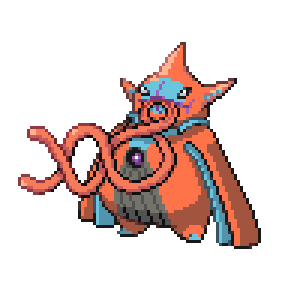
Deoswine conceal their heads beneath the mass of tangled tendrils that make up most of their body weight. This helps them intimidate opponents they would otherwise be unable to beat, even with their powerful tusks.

Some believe that its flower is of alien origin, while others argue that the Pokémon itself is not of our world. It is very adaptable and has remarkable regenerative abilities; even its flower can regenerate so long as the crystalline core is intact.
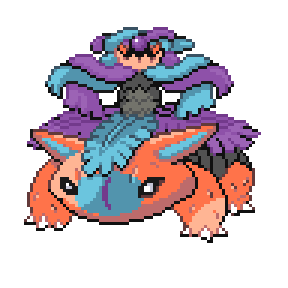
These Pokémon carefully observe their surrounding with their singular eye as they drag themselves along the seafloor. They can easily entangle prey and other enemies within their myriad tendrils.

Its amorphous body can expand and split in the form of a massive set of jaws. It will use its psychic abilities to pull prey within this massive maw and swallow them whole.

Deoray use their x-ray vision to track prey and their psychic powers to capture them. They create condensed balls of plasma within their four tails and fling them at foes.

A Deoklang's rings resemble the theorized structure of atomic particles. When it opens its central core, it releases powerful psychic energy in a sudden, destructive burst.

It has an amorphous body that can configure itself for various scenarios. It fights elegantly with its tendrils, each one assuming various forms to overwhelm its foes or to defend itself and others.

Deoquaza have been difficult for humans to observe due to them living in the deeper reaches of space. At least three observations showed that they seem to live within hollow asteroids floating in space.

Deorai combine their psychic powers with their sinister powers to create expansive Dark Voids that cast foes into nightmares. Their amorphous bodies allow them to mimic nightmares and strike fear into the hearts of their enemies.
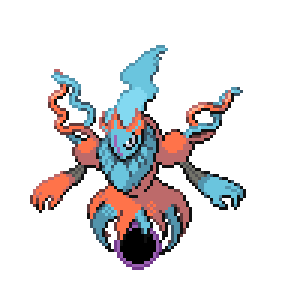
These odd Pokémon drift in space, often within the orbit of our planet, with their multiple eyes watching anything that drifts near. Their large, purple cores glow brightly with flames that sparkle like the cosmos.
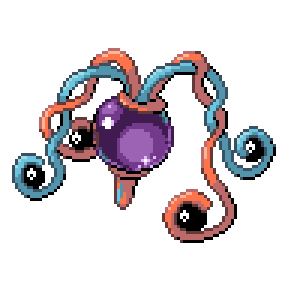
Deorona wield their psychic powers in tandem with their powerful flames to create sun-like orbs upon their backs. Although these orbs look like miniature suns, they mostly just help Deorona better direct their powers.

The near-innumerable tails of this Pokémon can transform in order to defend or to attack. Its chest core glows faintly with the flames flowing inside its body.

Deoape are rather aggressive and will beat opponents into submission with their strong, flexible arms. They quickly tire themselves out, though, and their gem-like bodies glow brighter as a sign of them overheating.

Deodude were initially found near or within craters, leading many to assume they originate from outer space. Their limbs can assume different forms to aid them during battle and will quickly regenerate damage so long as their cores are unscathed.

Jivoir are said to have keen senses for the true intents of people and Pokémon they come across. When a Jivoir deems someone worthy of its trust, it will form a strong bond with them and do its best to fulfill their heartfelt desires.

The rough purple crystals of these Pokémon twinkle when hit by light, as if they contain countless stars. When they fly through the night sky, the moonlight caught by their crystals will be cast like streaks behind them.

It is rumored that those who peer inside of Jiwile's massive jaws will see a realm where all dreams come true. But the truth is that within its jaws is a star-clad space where all that awaits is a lifeless vacuum.

Jietta's songs are said to fill pure-hearted listeners with childlike joy, while those with wicked hearts will simply be lulled into a deep slumber. It only awakens every few hundred years, so its songs are mostly known only through legends.

Jietta will only awaken on nights when the moon shines brightest and the stars are all alight in the night sky. It will sing and dance within the moonlight as though it were a spotlight, enthralling Pokémon and humans alike with its performance.

Because Ninchic primarily live underground, they are nearly blind. They have developed the ability to sense heat in their surroundings, so they may spit fire to help guide themselves.
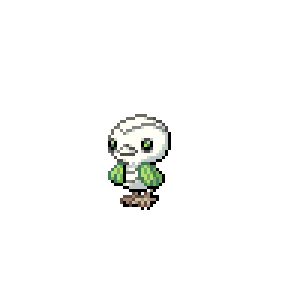
Ninkoth make their nests at the roots of trees, though they spend most of their lives digging out their nests in between sleeping and eating. They use their whisker-like antennae to probe for food; notably, they have a preference for mushrooms.

Bishrew use their claws to dig up rocks and chip away at trees so they can build dams along rivers and streams. They use their large tails to help pack these pieces together with clumps of mud.

Rioreep are sensitive to the feelings of others, as they can sense their very auras with ease. The wool is said to be able to change color based on the emotions of the auras they are most often exposed to.

Rioffy protects itself using its aura, projecting power around itself or simply avoiding those it senses. Its wool is rather tough to work with for the average spinner, so it is only entrusted to those who demonstrate proficiency in the craft.
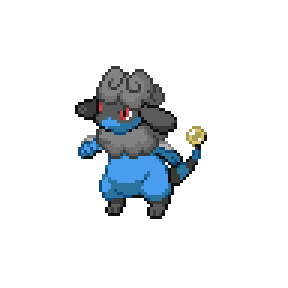
The fin upon its head is a sensory organ that can detect the auras of others within at least a one-mile radius. It can stand on its hind legs and harness its own aura with its forelegs; by harnessing its aura, it can manipulate water near itself.
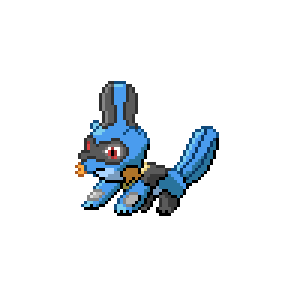
It can sense the auras of others and may even experience shifts in its bodily hues if exposed to powerful emotions for long enough. Cautious by nature, Rioeon always observes others before acting, even if it senses a kind soul.

Its giant jaws came to be when one of its sensory horns transformed; like its other horn, these jaws detect auras. Its jaws react to new auras, snapping at those it feels may be a threat; though its jaws react this way, Riowile is friendly.

It can sense the auras of others and will point toward those it senses to be in distress. By utilizing its magnetism, it can propel itself in short bursts; its Tackle attacks tend to be strong enough to shatter large rocks.
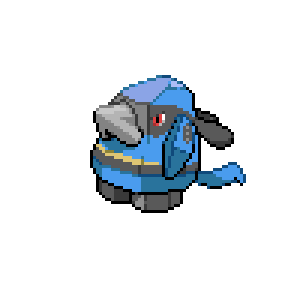
Slachic sleep away most of their days, but they can move in sudden, rapid bursts if awoken. If a Slachic is awoken early, it will spit out fireballs to cover its escape.
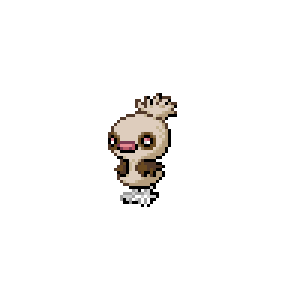
Despite their bulky bodies, Slapass are able to hang from rocks and tree branches without tiring, even as they sleep. Because most objects they hang from will break before they awaken, they inevitably come crashing down and thrash about violently.
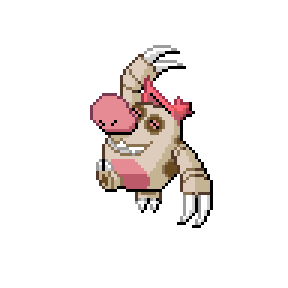
It is an incredibly lazy Pokémon that will sooner use its long feelers to retrieve food before moving its body. Those who witness and hear it yawn are inherently compelled to yawn and soon feel tired.

Slakoth remain asleep for such long periods of time that moss regularly begins to grow upon them. The moss growing upon these Pokémon is rich with enough nutrients that they can sustain themselves on this moss and nothing else.

Vigoroth are so full of energy when they are awake that they are always moving at least one part of their bodies. Their constant physical actions, including their fervent beating of their paws upon their chests, keep their muscles well developed.

Although small, Wailchic can inhale nearly two gallons of water; they only inhale that much when they plan to walk on land. Though they typically walk along the seabed, their legs are developed enough to be used for swimming.

It spouts water from its nostrils whenever it surfaces and as a playful act with friends. Although often outgoingly playful, Waileon is shy for a period of time before and after resting, changing its hues to avoid being perceived.

Shicko are often found near trees that have been struck with lightning more than once or near wooden power poles. Their fur crackles and stands on end if they sense danger; they use their electricity to emit a bright flash and then attempt to flee.
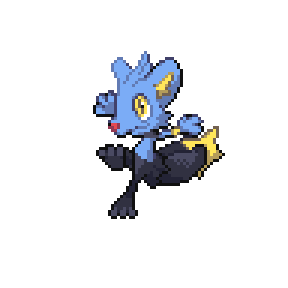
Its feathers are densely lined together, so any movements cause them to build up static charges. If it feels threatened, it will flex and spread its wings to release electricity as a blinding flash before it flees.
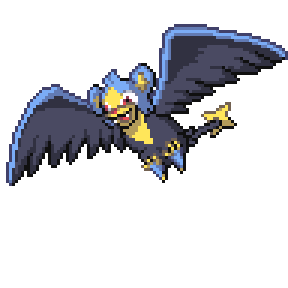
The yellow organ at the tip of its tail is where it channels most of its electricity. Lucko fights primarily by emitting bright flashes and then swinging its electrically charged tail into its foes.

Luwile release electricity through the yellow fangs of their large jaws. They electrify prey caught within their jaws to subdue them and release dazzling, bright flashes from these fangs to stun predators.

Lukoth rest at high elevations where they are exposed to plenty of air so that the air friction builds a static charge across their fur. Their sharp claws and potent electrical jolts make them fierce predators when they are awake and active.
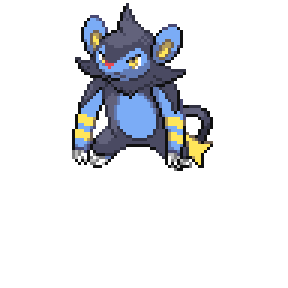
Jigglyling communicate with one another through various chirps and songs. To the chagrin of people and Pokémon alike, however, their songs are infamous for making anyone drowsy.

This Pokémon can use the heat of its internal flame sac to inflate its chest to the point that physical blows bounce off. It can expel this heat to alter its trajectory and to burn any would-be threats.

Their shells are as hard as a slab of solid steel. Arpod hang from cave ceilings using sticky threads with the strength of metal when refined. Their bodies grow too heavy to hang by these threads as they near their evolution.
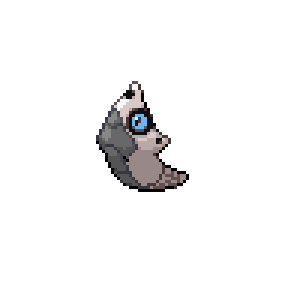
Ardle have an acute sense of smell capable of locating trace amounts of raw ores, so they are favored by miners. They secrete a corrosive toxin from their horns that can melt metal flakes into a slurry for them to consume.
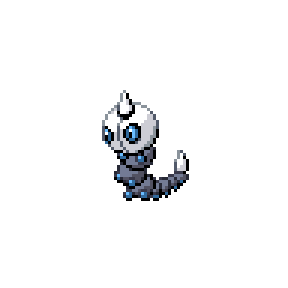
Its venomous stingers are made of steel and can cleanly puncture trees. Its wings are as hard as iron, yet are so light that they can move as quick as propellers.
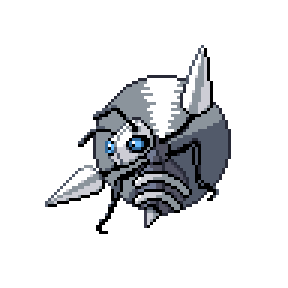
Arnium have steel-hard bodies and use their stout, strong legs to crush up pieces of ore and mineral chunks into a dust to consume. Their petals exude a metallic odor that grows sharper as they near their evolution.
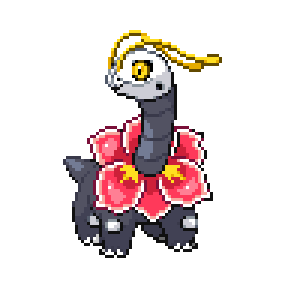
Arba communicate by drumming their iron-hard, albeit hollow, bellies with their six legs. They secrete an aromatic fluid from where their legs join their bodies, which helps to keep themselves clean.
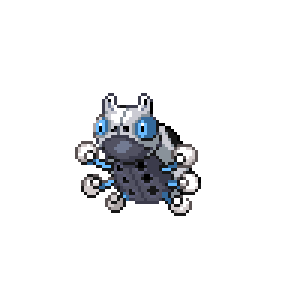
Archic prey on Steel-type Pokémon, particularly on Aron. They clad themselves in fire and forcefully charge at their prey to subdue them. They will melt down ore and consume that if they cannot find prey.

Arpass's entire body is covered in a metallic layer, with a rocky layer directly underneath. Its red horn has a magnetic field, which can cause permanent damage to electronic devices that come too close.

Arveon have a sense of smell for minerals and ores, and some can use their feelers like dowsing rods to find fresh water. They are efficient at mining for minerals and ores to feed on.

Wild Arile are often found within ore-rich mines, with all but the tops of their heads burrowed within the rock. They remain docile so long as miners toss them the occasional chunk of ore.
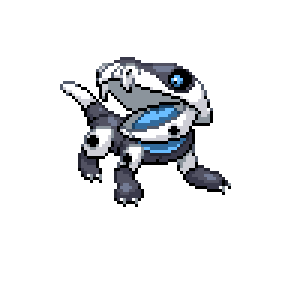
Their metal bodies develop the more minerals, ores, and metals they eat. Their strong jaws can easily chew through solid rock and through some foes.

These tiny Pokémon typically hide within the walls, ceilings, and floors of caves. If they see they feel they have been spotted, they will dash away quickly and have proven to have good jumping abilities despite their metal bodies.

Armeleon feed on metal ores to develop their metallic bodies, though they favor copper most of all. Their flames progressively grow more blue as a result, which also serves to show their likely age.

Arple secrete a corrosive liquid that can melt through most raw ores, which is how they form their nests. Arple feed on ore, be it solid pieces or the slurry made when they melt it; each Arple seems to favor specific ore.
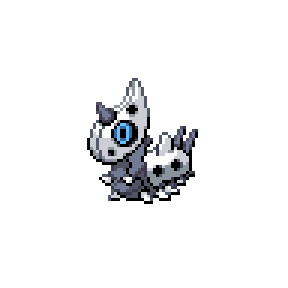
Ardot attach themselves to cave ceilings with the stem-like tops of their heads, absorbing minerals from within the rock. They grow heavier the more they absorb, until they eventually fall; when they fall like this, they often leave small craters.

Despite its metallic fur and iron, mask-like plating, this Pokémon is able to move silently due to its soft paws. It is drawn to shiny objects, though it only cares to collect them if they are metallic.
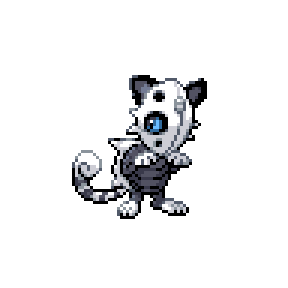
Arta feed on minerals and drink up metals and ores that they melt using their flames. Their bodies are tough even though they are considered weak.

It moves by rocking itself back and forth until it builds enough momentum to lunge forward. A Lairpod will keep the tungsten head of its shell honed by headbutting solid rock or something else made of metal.

The corrosive toxin that Lairdle produce and spew can melt down some metals and most raw ores. Although most forges filter out the toxins to use the liquefied metals, some have discovered ways to refine the toxic slurry.

It defends itself and its young with headbutts delivered via its steel head. It will not back down from fighting one of its own kind over territory. To placate enemies, it can release a soothing, albeit metallic, scent from its petals.

Lairnaw feed on metal and ore to keep their steel bodies strong; some Lairnaw teethe on chunks of ore for most of their lives. They drag themselves against hard materials to keep their bodies free of rust.
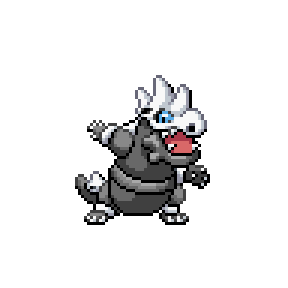
Caves near lakes, ponds, or rivers often ring with the sounds of two Lairligatr clashing over territory. Their imposing jaws are each lined with two rows of iron fangs that can shred pieces of refined metal with ease.

Its feelers become rigid during battle or when it feels agitated, which turns them into sharp weapons as well. It can cut out, or off, pieces of ore and gemstones, which are also what it eats; many quarries are privy to having at least one Lairveon.

They defend their territories with their metallic claws and their large jaws. They have a keen sense of smell for ores and precious metals, making them common allies to miners.
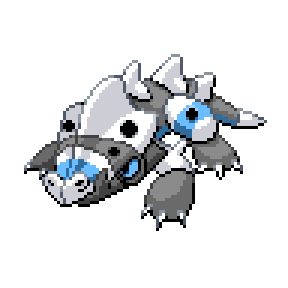
They defend their territory with strong headbutts and their iron-clad bites. They typically live near caves that are rich in minerals and, or, raw ores.

Lairtrum will bash their iron heads together to compete for territory, until one finally collapses. Their jaws are strong enough to allow them to eat large chunks of rock and metal.
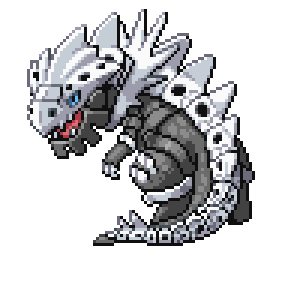
Lairish are small Pokémon often found near steel mills and mines, where they feast upon the shavings and scraps of metals and ores. Their iron-hard heads protect them from harming themselves when they run into others, which happens often.
Lairedo are territorial and solitary hunters that prefer to feed on metal over the minerals and rocks. When multiple Lairedo clash, the sounds of their metal bodies ramming against each other can reach from some of the deepest ocean depths.
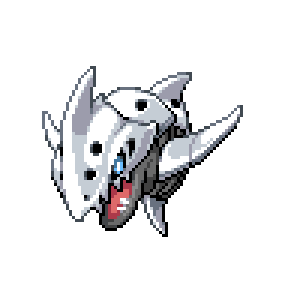
Lairth have steel bodies that have grown sturdier as they subsist on minerals and metal ores. Even their furs are more akin to thin, metallic needles. Upon their heads is a coin-like feature, which they polish daily.

Its steel whiskers serve as radars for even the smallest of vibrations around them. When it meets another of its kind, the two of them will clash with Headbutt and Iron Tail attacks, the sounds of which that can ring out for miles.

Lairta's flames lick out from between the cracks of the metallic plates lining their heads and backs. They use their developing legs and hooves to crush rocks and ores before eating them.

The steel plates lining their heads and backs are incredibly flame-resistant, though constantly hot to the touch. Their hot hooves have developed metallic plating due to the many ores they have come into contact with.
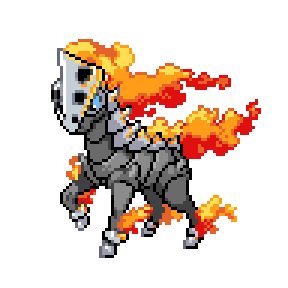
Wild Trapmie burrow within desert sands or within ancient ruins. They use their gem-like uvula to lure all manner of prey into their awaiting maws before clamping shut around them.

The small face-like pattern upon the lesser half of these Pokémon is used to lull their prey into a false sense of security. They capture prey within the large maws of their body's larger half and dissolve them within using a corrosive fluid.

The large, mouth-like marking along a Trapdos's abdomen is used to scare away foes much stronger than they are. They often burrow under desert sands and use their abdomen's stinger to immobilize their prey.

Trapom use their frail-seeming appearances to deceive their prey while keeping their tails hidden in the sand or the ground. When their prey draws near, they swiftly lash at them with the maws upon their tails.
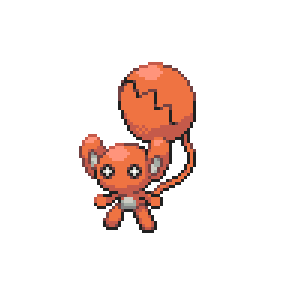
They will burrow most of their bodies with desert sands, their heads resting above to watch for, and lure in, prey. When prey draws near, they will emerge and engulf them within the large maw upon their bellies.
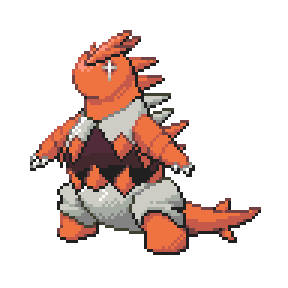
Trapom will store nuts within its two maws to use while hunting prey or in battle. It can throw these nuts with great force or will throw all of them at once to cover its escape. If it cannot find nuts, it will use rocks instead.

Trapsaur burrow themselves within sand, save for their formations of succulents on their backs. Their succulents are poisonous, causing paralysis and extreme pain in minutes; victims of their poison become nothing more than simple prey for them.
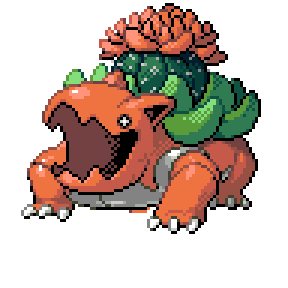
Trapod scurry quickly enough that they can move well in sand. If not for their antennae protruding from the sand as they move, they would go entirely unnoticed. They surface to pounce upon weak prey but will quickly flee if met with resistance.
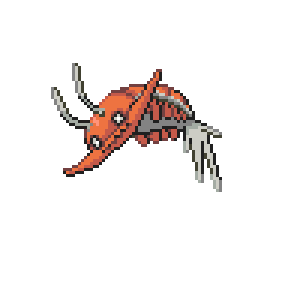
Trapdot capture prey by ambushing them, either by emerging from the sand or by leaping off rock formations; they are too slow to catch prey otherwise. Trapdot can safely consume any part of cacti, which is how they stay hydrated.

Trapin swallow their meals whole, so they often swallow plenty of other debris in the process. Their stomach fluids are potent enough that they can digest nearly anything, even scrap metal; whatever they cannot digest, they will spit out.

Trapot can compress their bodies so much that they can conceal themselves within sand like small mounds. When prey draws near to a Trapot, it will quickly expand itself and swallow the prey whole in one movement.
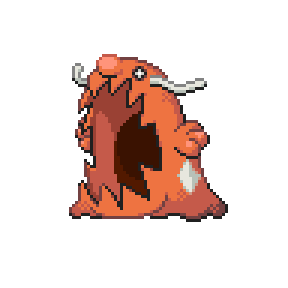
Vibraveon create pleasing sounds by rubbing their wings together. They can create disorienting sonic waves to quell or deter potential threats, as well.
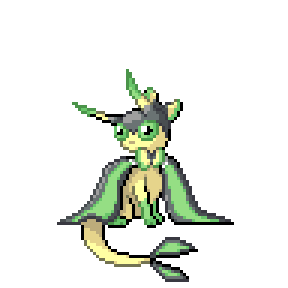
The shells on their backs are said to be full of nutrients gained from bathing in sunlight. These shells are harder than diamonds, so nothing has yet been able to break through them.
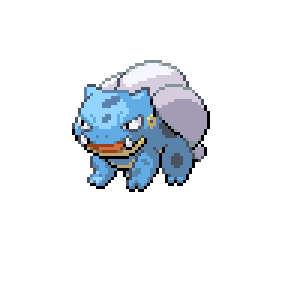
The shell of its head has grown to encase the leaves of the bulb upon its back, protecting it but also restraining its growth. It must always move when awake to ensure that its legs can support its shell and bulb.
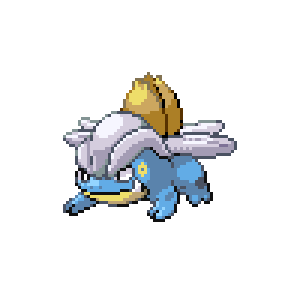
Basaur longingly stare at the sky, hoping to someday fly amidst the clouds. Although bird Pokémon love to land upon its large flower, it will shake them off and snap at them.

Bamander will tap friends and loved ones with their hard heads, though if they get too excited they may strike them with a Headbutt. They love to roast their foods with their flames before eating, even if the food was already cooked.
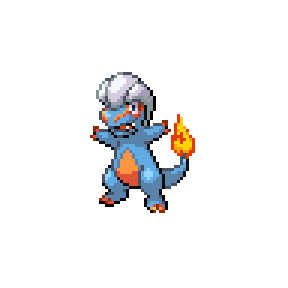
As if to show off its powerful wings, this Pokémon will eagerly engage in aerial battles. It has proven to be a problem for aerial craft, as it has also tried to fight with planes and jets.

It uses its strong jaws to break open coconuts, which seem to be its favored food. It spends much of its days attempting to climb tall palm trees to get closer to the sky above; this may be why its head is so tough, as this protects it from falls.

Shelsaur need not eat nor drink to thrive; they need only to sit and bathe in sunlight and rain. They only move if they feel they are not being bathed in enough of either.
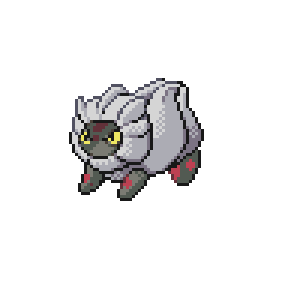
The flower bulbs upon their backs struggle to grow due to the shells encasing their leaves and much of the bulbs themselves. The petals of these flower bulbs grow more vibrant as they near their evolution.

It needs only sunlight to sustain itself, but it moves very slow to conserve some of its nutrients for its evolution. Most of its central body is protected by a hard shell that it can withdraw its legs into.

It generates the energy it needs to live by always moving its legs, even while asleep. Its internal flames remain strong as long as it has energy; if its hard body ever cools, it is a sign that it is in poor health.

The rear halves of Klados contain a large spool of a metallic silk-like thread produced within their bodies. The precise tips of their legs are used to weave this thread into various shapes, traps, and tools.
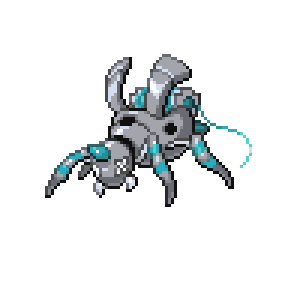
Zochic can transform into others to hide themselves. Due to their abilities, their soft fur and feathers, and their ambient warmth, these Pokémon are popular with children.
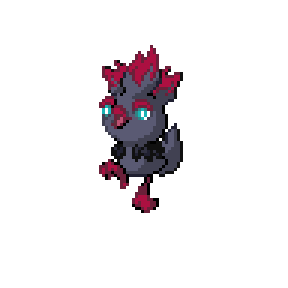
Zowile conceal their second sets of jaws using their illusion-based powers so they do not frighten their friends. To defend themselves or others they care about, they will not hesitate to unveil these jaws.

Zolup produces a hallucinogenic fluid within its body, which it spits out as bubbles. Zolup can spit out bubbles with enough force and speed to damage rocks and trees, though it typically relies on induced hallucinations to dispatch foes.

Using its feelers, it can create an illusion of large Pokémon or large objects to protect itself or others. It will use its powers to prevent or stop fights between others, be they humans or Pokémon.
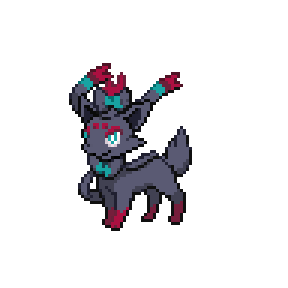
Zoskit secrete a special, sweet syrup from the tips of their heads. Many report that prolonged aromatic exposure and outright consumption of this syrup relaxes the mind but also alters sensory perception; despite this, some still use it in baking.
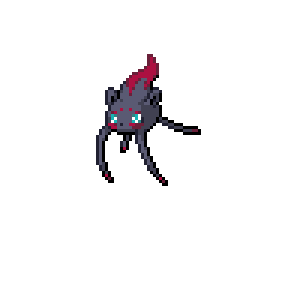
The flame on its tail reflects its emotions. The mane of fur around a Charvee's neck is warm but will stand up like bristles when it is scared or angry.
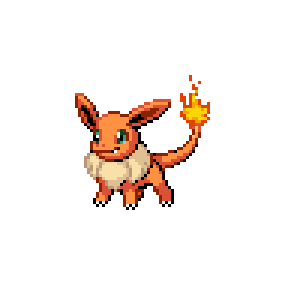
Chareep wool is rife with static electricity generated with each move they make. Their life forces are indicated by their tail flames, so it is easy for farmers and ranch hands to tell if one of their Chareep is ill.

Using its keen sense of smell and its flames, Charnub forages for small plants and dries them out before consuming them. It prefers dried plants, as they help keep its flames strong despite rain and snow.

It uses its own tail flame to roast food before eating it. Its tail flame reacts to its emotions, so angering it can cause it to burn food which will make it even more angry.
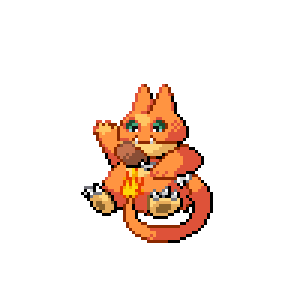
Charinder shoot down other bird Pokémon with fireballs to prey upon them or to simply remove them from their territories. Their tail flames scatter small sparks when they are excited but spit small fireballs about when agitated.

It is known to many as the "Singing Comet" due to how fast it can fly, trailed by searing embers and bellowing beautiful melodies. It can expand much of its body by inhaling and then release the inhaled air to adjust its trajectory.
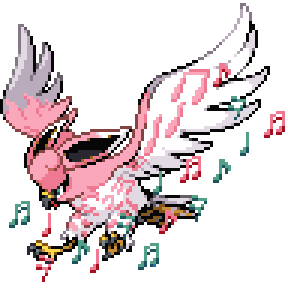
Wigglyinder feathers are considered a symbol of luxury and wealth due to how sublimely soft they are. Freshly shed feathers are so warm that they can melt snow due to how hot the flame sacs of these Pokémon typically get.

Bubone open their bulbs during spring and summer to absorb even more sunlight; thus, they are vastly more energetic during these times as well. The plant stalks they wield are said to be of the same origin as those wielded by Farfetch'd.
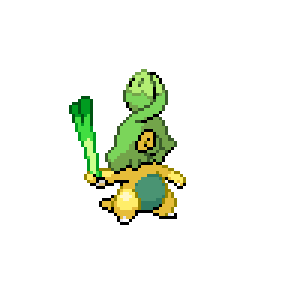
When Buchic open their buds, they scatter many flammable spores, which they may ignite if they feel cornered. They do not need to eat, as they absorb sunlight. To drink water, they perch beside a river and dip their beaks into the water.
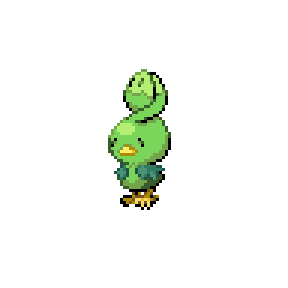
Bukip only open their buds when they are exposed to plenty of moisture; lying in deep enough water or mud fits the requirements. They emit earthy scents from their red fins, and from their blue fins, they emit the scent of water.

The large buds of Buwile conceal frighteningly powerful jaws with vividly colored insides. The bright colors of their jaws allow them to appear as flowers when opened, easily luring in prey that is quickly swallowed whole.

During spring and summer, the two large buds of these Pokémon open and release colorful, soothing pollen used by many Pokémon and humans. During winter, they seal their buds to better endure the intense cold.
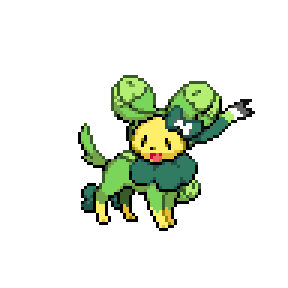
When Bukoth are asleep, the buds upon their heads remain partly open and release soporific pollen as thick as a fine mist. When they awaken, their buds open the rest of the way and release an aromatic scent rather than soporific pollen.

When its bud is open, it exudes a powerful, metallic odor that deters most would-be predators. During winter, it keeps its bud shut and takes shelter underground, feeding on minerals and whatever water it can find.
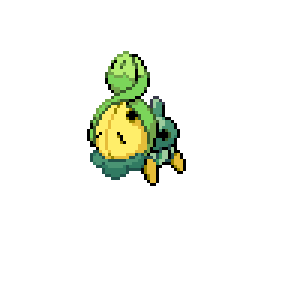
Buple open the small buds on their heads to attract mates and to communicate with their kind. Because the scent of their open buds also attracts bird Pokémon, they have developed venomous horns.
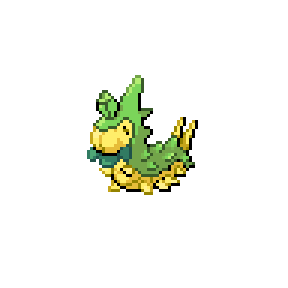
Small and meek, Budot are quick to flee at the first sign of danger, such as a loud noise. In spring, they exude a pleasant, nutty fragrance, and their stems partly sprout. In winter, they become inactive and hide; they often hide within trees.
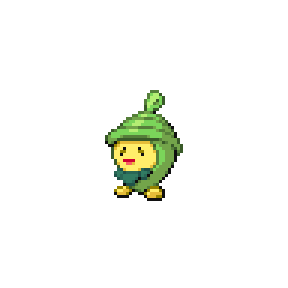
Its sweat carries a strong, floral scent, making it an effective component in perfumes and colognes. Every season, even winter, Buhita is always training; in winter, however, its bud closes tightly, and its sweat's scent becomes much duller.

The flower upon this Pokémon's rear contains a strong-smelling pollen that attracts many bug Pokémon. When startled, its flower will fully pop open and scatter countless Cotton Spores before it skitters away.
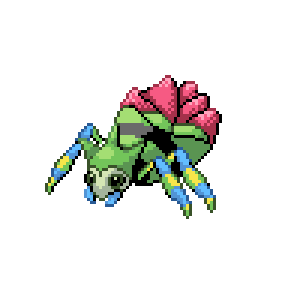
Rosekip roses emit scents that differ between individuals; diet and environment influence these scents. When they submerge their bodies and tails in water, the scents from their roses consistently are mixed with the odor of fresh rain.
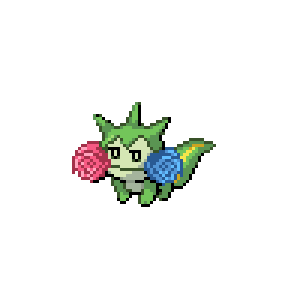
From its two flowers, it scatters an aromatic pollen that can cause the colors of nearby vegetation to gradually change; the color change is never permanent. It can change its bodily colors at will, though its flowers never change color.

Roseon absorb water through their flowers rather than drink water, and they are often seen during rain. Their flowers exude metallic odors that strengthen with water absorption, especially when they have recently fed on rich minerals.

Roselia exude intoxicatingly powerful scents from their flowers depending on the seasons; in winter, their scents are at their weakest. When they shake their flowers, they scatter noxious pollen that induces non-lethal allergic reactions in anyone.
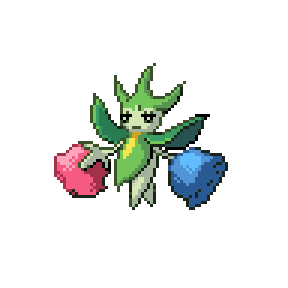
It utilizes its own internal flames and its inherently light body to drift through the air, though it takes shelter on windy days. Its body can expand a decent bit, to the point that it sometimes has been mistaken for a balloon by small children.

Driflveon are known for being so light that a strong breeze will lift them into the air. They use their feelers to anchor themselves on whatever they can, though they favor holding onto the hands of their Trainers.

Driflon are light and capable of floating in the air at all times except when they have recently eaten. They eat minerals and rocks, which takes time for them to digest and helps keep them from being suddenly blown away.
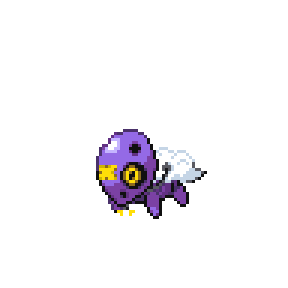
No matter their age, Driflelia enjoy playing with human children and young Pokémon. By rubbing their balloon-like limbs together, they release sweet, floral scents and produce static electricity, the latter of which they use to surprise friends.
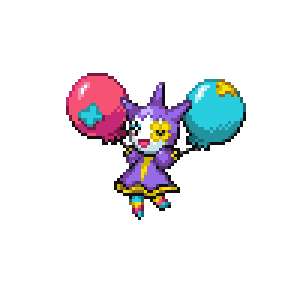
Driflzagoon have such light bodies that they often wrap their tails around heavy objects to avoid being blown away by the wind. They are overly curious, so they will even risk venturing out during a storm to explore.
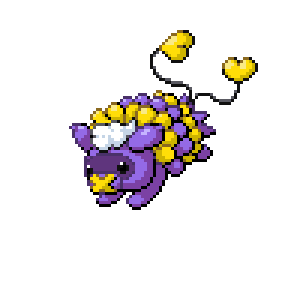
It has an extremely light body filled with a special gas that allows it to fly. Because it does not need to flap its wings to fly, it uses them to adjust its trajectory. By contracting and extending its two tails, it controls its elevation.
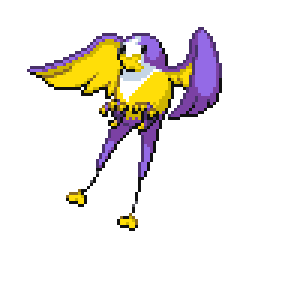
Bunveon unfurl their soft feelers the less nervous or scared they feel. A well-cared-for Bunveon bounces with every step, its feelers fluttering around as it moves through the air; this is a sight beloved by many.

Shroomchic can safely consume soil, favoring rich, damp, and composted soil the most. They also eat dry pieces of wood, which both provides them with nutrients and fuels their internal flames.

POKNEMAE nest within humid caves and forests, feeding on the damp soil and rich minerals they find. When Shroomon shake their bodies, they scatter fungal spores that cause iron-hard mushrooms to grow; when cooked, these mushrooms become very tender.

Shroomelia are inherently timid and keep to themselves most of the time. They nest within damp, warm areas and feed on damp, composted soil and moss. By clashing the spherical fungi upon their arms together, they scatter thick pollen around themselves.
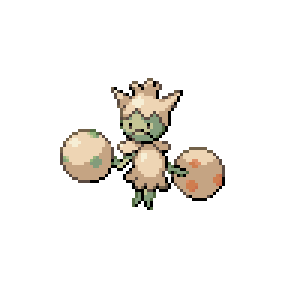
The gelatinous bubble that surrounds a Solosea allows it to survive outside of water in any environment. Though it can shoot bubbles of this gel to defend itself, it must rest within water to regenerate the gel.

They use their gelatinous bubbles to protect their meeker bodies. They and their bubbles react to various evolution stones in different ways.
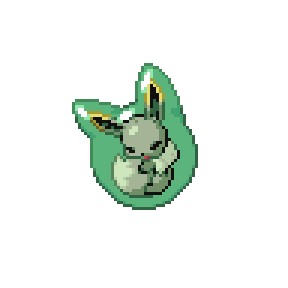
The bubble of special fluid atop a Soloquil's back is rather dense, offering protection against the elements and some attacks. In battle, this liquid will often bubble as if boiling due to the growing flames within its body.

Most of their bodies are made of a sticky, thick liquid that makes it easy for them to fit into tight spaces to hide and rest. They will spew this same liquid onto their foes to hold them in place.

The layer of special fluid along its body allows it to endure nearly any environment while reinforcing its already-powerful trunk. It displays a surprising telekinetic ability, which it often utilizes to acquire fruits from tall trees.

Soloperl only open their shells when prey draws near. They can protect their cores with a special gel, the same gel that they can expand and control to quickly drag prey in.
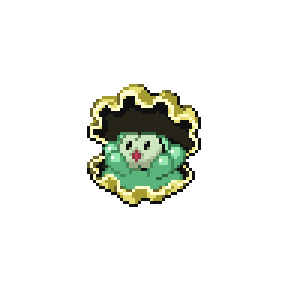
Wild Solotail regularly use their own cores as bait for prey. When prey draws near, they will use their special gel to swallow it whole and dissolve it.

Using their psychic powers, they pull in and store rocks and hard nuts within their barrel-like mouths to later shoot at foes using jets of water. Their gelatinous tentacles are incredibly sticky, which allows them to easily hold onto their foes.

Its main body has divided parts of itself to use as relays to expand the range of its psychic powers. With these organic relays, it can better control the mass of special gel that protects it and utilize it better in battle.

Cottoneon are renowned for the variety of colors they can change to when exposed to combinations of pressure and temperature. They use their long tongues to drink water and avoid getting close to it, for their cotton grows too heavy when wet.

Cottonwile use their maw-like appendages to store food and to make themselves look fiercer than they truly are. Their maws are incredibly absorbent and quickly grow heavy when wet, so they take care to keep them away from any liquids.

Cottonx have remarkably light bodies despite their thick, cotton-like fur. Their fur is a powerful electrical conductor and very absorbant of fluids. When their fur is wet they struggle to release their own electricity, so they hide during rain.

When Cottonpede sense vibrations via their feelers, they go still, drop to the ground, and tuck in their small feet to disguise themselves as small shrubs. To keep from being blown away by strong winds, Cottonpede dig their feet into a hard surface.
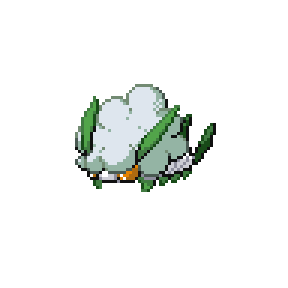
It puffs out, tears off, and throws its cotton to protect itself or others. Many believe Cottontump is drawn to those in pain and offers them comfort because it, too, is frail and wishes not for others to suffer like it has.

These desert Pokémon have evolved to be able to hide their own heads within remains, with their lower bodies submerged in the sands. When prey draws near, they grab hold of a bone and use it like a club to pummel them into submission.

It spins the leaf upon its head to spread the aroma of the tree shoots around its neck. This aroma is oddly soothing, though the tree shoots themselves are very bitter.
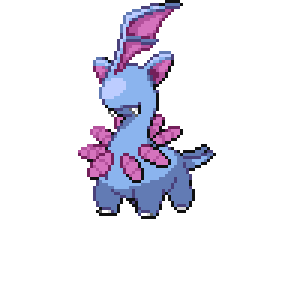
Its glowing bulbs emit a low humming noise which seems to serve as a means of echolocation. Its fangs can deliver electric jolts that are generated by, and stored within, its bulbs.
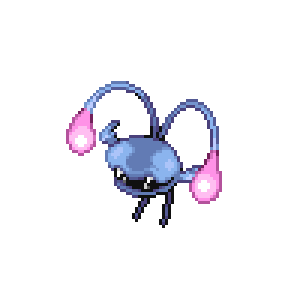
They use echolocation to navigate, though they can also track other sounds thanks to their large ears. They primarily feed on poisonous plants and mushrooms, which seem to affect the vibrancy of their purple spots.

Zuzone emit ultrasonic waves to find their way, due to their lack of conventional sensory organs. What may appear to be ears on their heads are actually antennae that they use to control their magnetic fields and electrical energies.

It uses sonic waves and its tongue to navigate. It can mimic the cries of other Pokémon, though only after being around them long enough to hear and learn their cries.
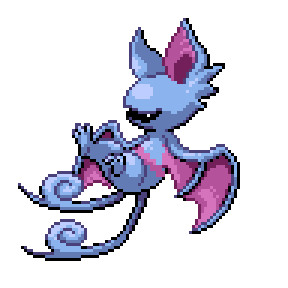
It uses its vines and echolocation to navigate through forests and caves, respectively. The health of its bulb affects the vibrancy of its purple spots and the potency of the venom it delivers through its fangs.

The plasma enveloping their bodies is dense and poisonous, offering protection and a potent weapon. They attach themselves to foes, sink their fangs into them, and drain their blood to sustain themselves.
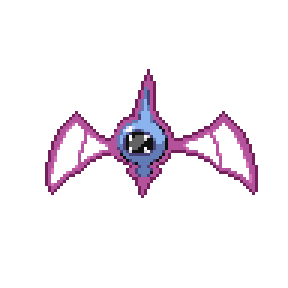
Zusaur with bright spots are incredibly venomous. They can capture foes whole and easily inject them with venom before tossing them away. They are herbivores that favor poisonous plants and poisonous mushrooms.
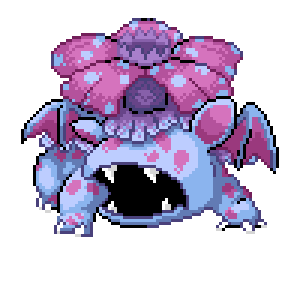
Their vibrant tusks secrete an agonizing venom whose only cure is derived from the selfsame venom. Using ultrasonic waves, they can keep track of their surroundings. They will spread their wings and screech loudly to disorient foes.

The membrane covering its eyes allows it to detect the heat of others; it can easily stalk prey, even in darkness. It burrows through the ground or through sand and then ensnares its prey with its ribbon-like appendages before biting down.

These Pokémon are often revered in some areas due to their golden masks and bright red manes. They guard others and their own territories with fearsome strength.

Yalax swallow and store gold coins within ancient tombs, feeding on the lingering spiritual energies that cling to them. They release a bone-chilling screech if anyone dares to touch their golden masks.

The masks upon their tails are said to have come from, and resemble, their past Trainers. Their wings emit a melancholic tune as they fly through desert skies.
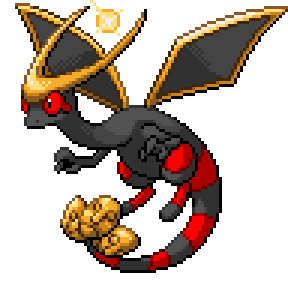
Found within ancient ruins, these Pokémon feed on the emotions of those who step upon their amorphous form. They need little to sustain themselves, but if one tries to take their golden mask, they will siphon all they can.

These fuzzy Pokémon are so soft and warm that many Trainers and their children will cuddle with them when they sleep. Amusingly, they also produce a gentle amount of static electricity that results in very chaotic bedhead the next morning.

These timid Pokémon can curl up into a ball crackling with electricity and propelling themselves with flames. Although they typically do so in order to flee from their foes, there are plenty who will ram their foes like fireballs.

The jagged fur covering a Jolosion's entire body is constantly crackling with static electricity. This fur is also incredibly warm and treasured by a good number of collectors.

These tiny Pokémon often use their slimy bodies to cling to other Pokémon in order to get around. They carry a ball of silk webbing atop their backs, which is filled with crushed up nuts to feed on during their journeys.

Jolwile are docile Pokémon with a leg-like horn atop their heads, which is clad in fur that is charged with static electricity. They often weave their electric threads into playful shapes using their four small limbs.

Using their ribbon-like organs, Jolveon deliver precise electric shocks. They display an uncanny capability to deliver electric shocks where their opponents are weakest.

Ferrolax lay belly-down in nutrient-rich areas, absorbing said nutrients through their tough barbs. To defend themselves, they will use Body Slam attacks that skewer and crush their foes.

Its iron-hard barbs protect it from most attacks, though it sometimes stores food on them. It rests in nutrient-rich areas and passively absorbs some of those nutrients as it sleeps.
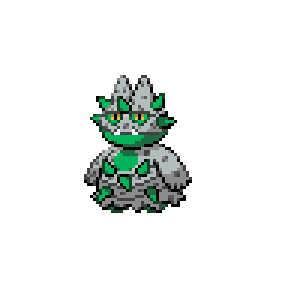
Ferroray deliver devastating, electrically-charged strikes with their mace-like tails to swiftly dispatch their foes. They are capable of seeing through most objects, so their foes and prey rarely ever manage to escape them.

Ferroray dig their claws into cave walls to absorb minerals within the rock and rely on hunting to acquire other nutrients. Due to their X-ray vision, they typically hunt at night to better catch prey unaware.

Ferroxio primarily discharge electricity from their spikes, so they typically fight by throwing themselves at their foes and by swinging their tails. They can absorb nutrients and minerals from the ground via their claws.

Axetress defend themselves with their steel shells and their sharp tusks. When their tusks break, they will tightly shut their shells and wait for them to regrow.

Its small tusks pick up vibrations and sonic waves with ease. It performs echolocation to find its way and to keep track of any of its foes.
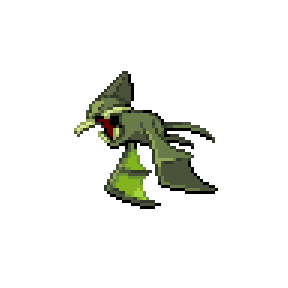
It can cut through most obstacles using its tusks in tandem with its Rapid Spin attacks. Even if its tusks break, they will regrow within a day's time and can still use its steel shell like a wrecking ball.

Fraxveon use their tusks to break open nuts and cut open fruits they grab and hold with their feelers. This keeps their tusks honed and provides them, and their friends and allies, with plenty of sustenance.

Many people believe these Pokémon were created by an ancient, yet vastly unknown, civilization to serve as companions for all. They will comfort and protect their Trainers and the weak with their lives.

Not only are their wings too small to fly for long, but their feathers are also often stuck together with honey. They expel puffs of intense heat to defend themselves from the Bug-type Pokémon who had collected or made the honey they gorge upon.

Fletchcko communicate with each other via beautiful chirps and by waving their wings around in various patterns. They are small, so they can only fly or glide for so long; because of this, they always climb atop tree branches and take off from them.

It is a bundle of energy that loves to run around. It will get back up no matter how often it trips. It loves to perch upon the shoulder or arm of its beloved Trainer and chirp singsongy tunes.

Fletcheon are amiable by nature, though they are quick to be startled. When taken by surprise, they can quickly shift their colors to blend in, save for the zigzag patterns wrapped around their midsections.

When Fletchkoth are awake, they cry out to one another using beautiful chirps to make sure they have not gone too far from their flocks. In spring, they gather to mate; a pair of Fletchkoth mates will share their food together and alternate sleep cycles.

Fletchmander communicate with one another by striking various poses using their wings and flame-lit tails. When they get excited, their bodies heat up and their tail flames dance wildly.
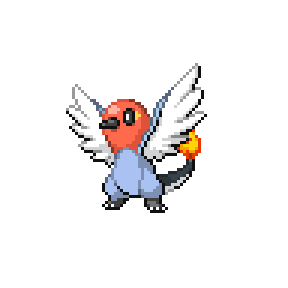
When it swings its tail, it scatters embers from the feathers upon the tail's tip; it communicates with others of its kind by waving its tail while emitting myriad chirps. Its claws burn hot when it gets excited or agitated.

It swiftly maneuvers within its forest home by flying from tree to tree in zigzag patterns, using its claws to cling to each tree. Although it primarily searches for fresh fruits within the trees, it is easily distracted as long as it is not hungry.
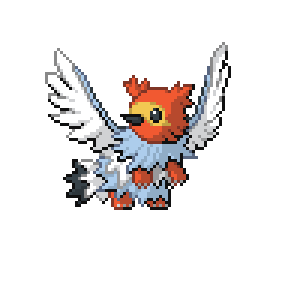
It can swim at great speeds thanks to how smooth its shell is and how strong its wings are. Using its beak, it can compress bubbles and spit them out like bullets.

Fletchursa hunt Bug-type Pokémon and track them to their nests. They expel flames to drive their prey out from their nests to capture and feed on them. They are especially partial to Beedrill and the honey they make.

Fletchbusken use their developed legs to deliver strong kicks and to launch themselves into the air. Their wings are developed enough to let them glide for hours before needing to rest.

It spits fire to intimidate and deter others and changes colors in the midst of the resulting chaos to hide and sneak away. It uses its beak to crack open nuts and to break into hard fruits, both of which are its favorite kinds of foods.
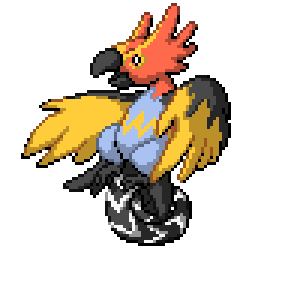
The sight of herds of wild Fletchveon gliding through the air at sunrise and sunset is treasured by many. Their feathers remain warm even after being shed and have a calming effect on those who hold them.
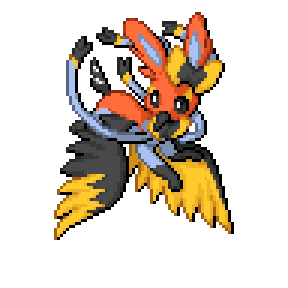
Its internal flame sac grows increasingly hotter during battle, though this has been recently discovered to be the case whenever it is agitated. It fights with kicking attacks that utilize its tough claws and by spitting embers at its opponent.
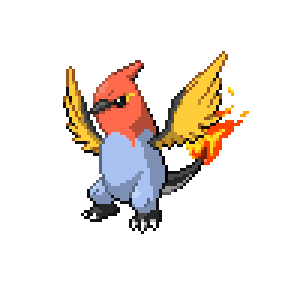
Though their wings are small, they can soar through the air with ease for long periods of time. Flocks of Fletchtle will fly as fast as they can toward water and then skip across the surface using their own shells as a means of playing.

The red horns of these bug Pokémon are very hot and can even expel a fluid that they ignite with sparks made by smacking their bone club around. They wear the skulls of their prey to then hit their club against to always be able to create sparks.
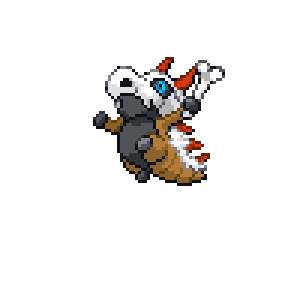
It wields one of its shed horns, which can still secrete a flammable liquid and can be ignited by striking it like a match. It will set this shed horn ablaze and throw it like a javelin to strike down distant foes or aerial prey.
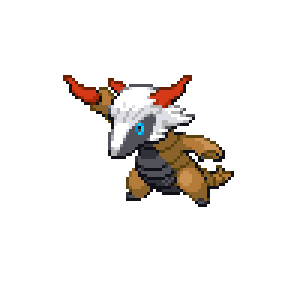
When these bug Pokémon curl up, their muscles become so tense that they can withstand and even repel some physical blows. They prefer arid heat, so they are often found within deserts. They drink juice from fruits and cacti rather than consume water.

When it curls up, its muscles bulk out and tense up to a remarkable degree. Even while curled up, it can shoot out flames from its red horns. It can withstand intense heat, so it may even clad itself in flames as it charges at an enemy.
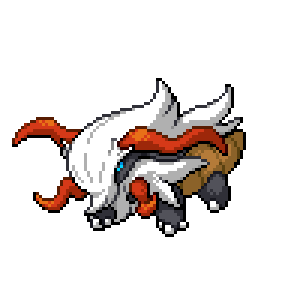
Larvtile absorbs sunlight through its large, bushy tail and metabolizes it; the resulting energy from this process can be turned into flames. The blue orbs along Larvtile's back glow whenever it spits out fire.

Wild Larvceus will often curl upon their bodies enough that mostly just their white fur is visible. Due to the warmth they emit, many smaller Bug-type Pokémon are often drawn to them.

These small and numerous bug Pokémon primarily live underground in volcanic regions, especially where sulfur is plentiful. They consume sulfur on a regular basis, which seems to have imbued their red spikes and horns with toxic properties.

As if it were not enough that its horn can pierce basalt without chipping, each strike from it delivers a horrible venom as well. Larvrino venom effectively burns living tissue within minutes of contact; antivenoms have proven difficult to develop.

Its red organs channel heat through them; it can channel enough heat to ignite pieces of its white fur. To fend off threats, it will ignite clumps of its fur and throw them.
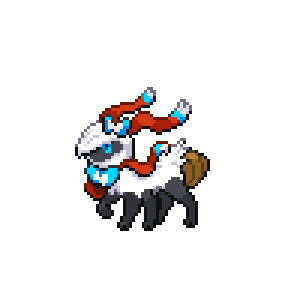
Larveon shoot flames from their long horns to overwhelm their targets and to knock down food from trees. Every month, Larveon shed tufts of their warm, white fur that many find comforting to hold.

Its horn and spikes glow red-hot whenever it releases flames, which it can only release from these same parts. Its horns and spikes carry upon them toxic scales that chemically burn the flesh of anything that touches them.
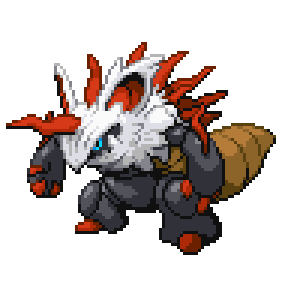
It captures prey, which is typically Magikarp or Feebas, whole and siphons them of their blood to sustain itself. Its rock-hard horn contains a dangerous venom that could fell a Gyarados days after being stabbed.
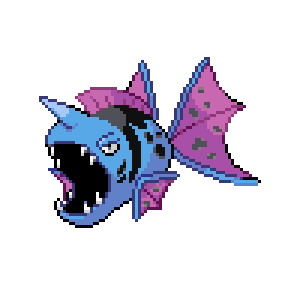
Its head wings also function as pincers. It cannot close its mouth, so debris can easily fall within. It can often be found under trees, using its pincer-like wings to shake loose fruits and berries to fall into its mouth.
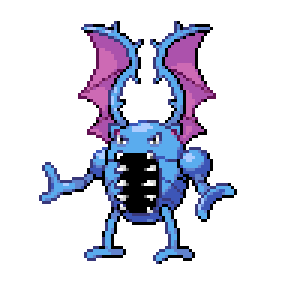
Golgey can navigate dark environs, such as caves, with incredible ease despite a lack of organic night vision. They deliver a numbing venom through their talons, which makes it easier for them to drain prey of their blood.
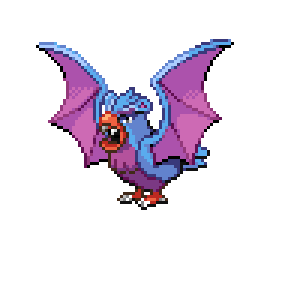
It hangs upside down from tall perches when it sleeps and when it searches for fresh prey. Its talons are strong enough to penetrate thick hides and deliver a potent venom as it drags its prey back to its nest.
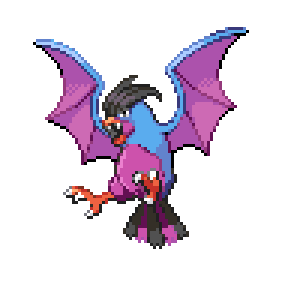
Golturn flap their fins almost as if they were wings, though they are able to glide in the air for a time when they leap out of water. Their glowing bulbs allow them to navigate deep water and their gaping mouths catch many small prey.

Their sharp and tough beaks are lined with small, sharp fangs that they use to drain the blood of their prey. The vibrancy of their feathers is an indicator of how old they are and of how potent their venom has become.
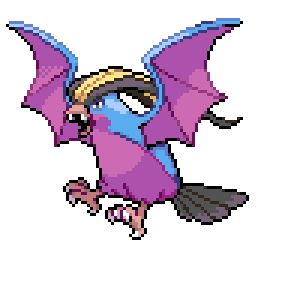
It hunts smaller prey that it can easily grab whole with its gaping maw so as to drain their blood. Its fangs deliver a numbing venom and the pollen loosed from its bulb is poisonous to most.
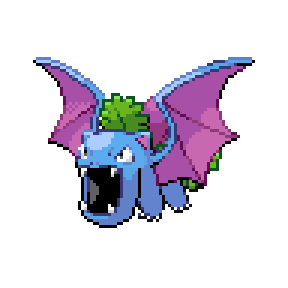
Using electrical currents and their own magnetic fields, Golzone fly around ad high speeds. They feed on any prey caught within their gaping maws by siphoning any electrical energy within them, even those of the brain.

It can fling bolts and blades of its dense, poisonous plasma at foes. Its fangs contain a paralytic venom that makes it easier to drain their prey of their blood.
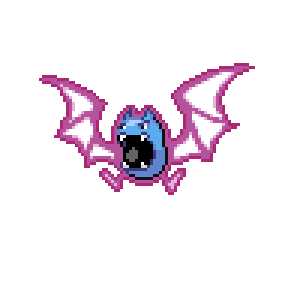
Found only near bodies of water surrounded by mud, Stundos will bury their head in the surface mud near the edges. The moment any prey steps upon their head, they use their overwhelming strength to drag them into the water.

It rolls to move but also to smooth out its rough, crystalline half. It lingers near galvanic crystals to leech electricity from them, which is what it sustains itself with. When angered, it "explodes" with blinding light.

Wild Sablode are infamous among miners and quarry workers. These Pokémon eat their way through rock to find and eat precious stones, often falling asleep within their tunnels. Many times miners have struck them and been met with a devastating shock.

It spits out compressed fireballs and uses its claws to dig for raw gems, which is what it eats. Its red crystal glows with fire when it is riled up.

It lugs around a massive crystal by wielding the crystal with its psychic power; this inadvertently hones its psychic powers ever further. The crystal grows smaller over time as Sablts nibbles away at it.
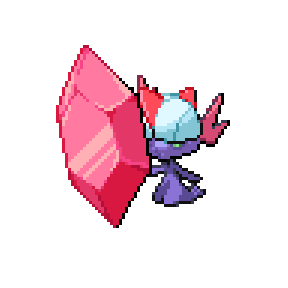
Sablia's three crystals serve as foci for its psychic powers, through which it can expand its perception of its surroundings. Though it feeds on crystals and gems, it will never eat the three crystals it is always seen with.

Sablpass were once hunted due to their noses of solid gold and their uncanny ability to easily locate precious minerals. Only in recent years have their numbers been restored, so they are still considered a species to be protected.
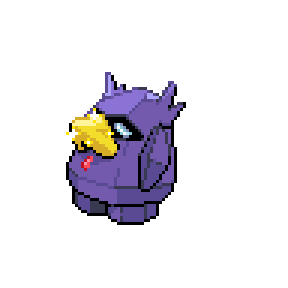
Its tusks are caked in the pieces of gems and crystals that it has cut through with them. It digs through caves and the ground itself in search of more precious stones to feed upon.

Even if they come across a gem their tusks break against, they will still gnaw on them endlessly until either their teeth break or the gem breaks. Their tusks regrow clad in gem-like crystals that match many of the gems they eat.

Sablxure feed entirely on precious stones and crystals. They use their tusks to carve pieces from larger formations that they come upon whilst digging through the ground.
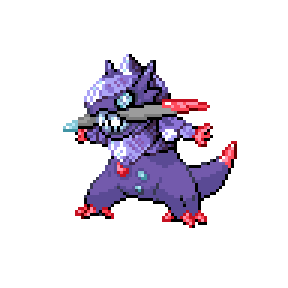
Sablpede are the primary predators of Carpede and also often fight with them for territory due to both species' desire to feed on precious minerals. Their feet are sharp and strong, allowing them to quickly burrow through hard rock.
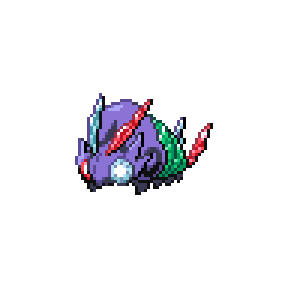
Sablie is very possessive of the precious minerals lining the cave it resides in, potentially because it feeds on such minerals. It breathes a freezing air upon solid rock and solid gems before attempting to bite into them.

Sablsect consume mushrooms as their sole food, though they are particular about the color of these mushrooms as if color alone affects the taste. Oddly, the mushrooms consumed affect the growth and colors of the crystals upon them.
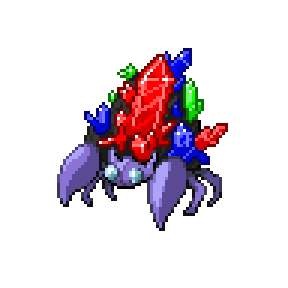
Sablow are infamous among quarry workers, as these Pokémon will not hesitate to steal precious gems. They often clash with Zubat as they fly through caves in search of gems to eat.
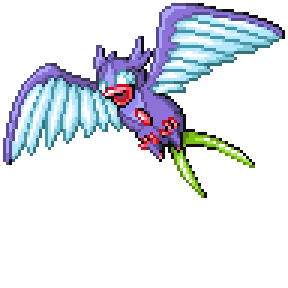
Sablitty cannot resist the allure of anything that shines or glimmers, pouncing upon such items in order to claim them. Wild Sablitty use their tails' claws to chip away at large gemstones to feed on the pieces, which also keeps said claws sharp.
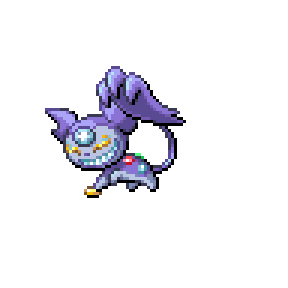
Using their feelers, Veniorb remain keenly aware of all else around them. If anything touches their feelers, they explosively release electrical energy all about.

Venitini frequently challenge foes they believe they can take down with their venomous fangs. Their fangs are shed along with their scales every night. Their venom becomes more potent when their fangs grow back.
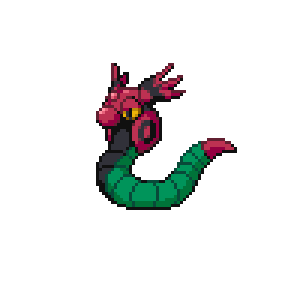
They use the glow of their crystal orbs to lure prey and pounce to neutralize them with their venomous fangs. They coil upon themselves and launch themselves like springs to catch others off guard.
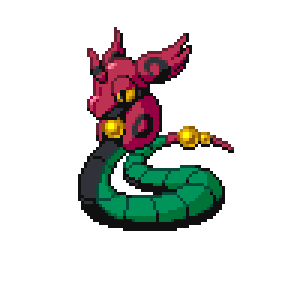
The feelers upon their heads can sense the slightest changes in the air, so they are keenly aware of when the weather is about to change. They scatter poisonous scales from their wings as they fly.

These small Bug Pokémon are so often trampled that they have developed irritable temperaments as a result. They will rapidly bite enemies with their poisonous mandibles, though the poison is only capable of inciting an itch.

The feelers on its head allow it to sense vibrations in the air, as do its legs keenly sense vibrations through the ground. When it curls up in a ball, its hide becomes so tense that it can repel most physical attacks.

Venicko rely on the feelers on their heads and tails to sense vibrations in the air, which alert them to potential predators. They nest upon and within tall trees, which they can scale thanks to the small hooks on their hands and feet.

The feeler on its tail is how it senses its surroundings; this feeler often twitches or rocks side to side like a metronome. It quickly reacts to an unknown presence by spitting weak fireballs at the source.
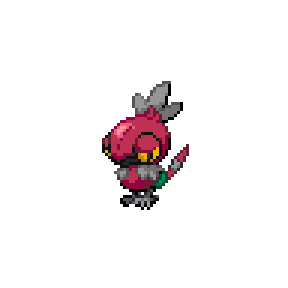
Venion are clad in an armor-like chitin harder than iron, which grows even harder the more minerals they consume. The feelers on their heads sense and react to vibrations, be they in the ground or in the air.
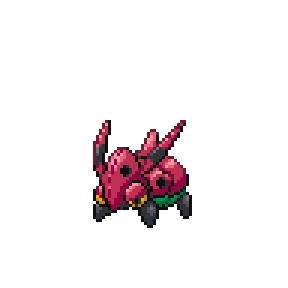
Venimander use their many claws to hold onto foes and inject them with a burning venom via a bite. The feelers upon their heads move in ways correlative to their feelings; their feelers twitch when curious or tense up when agitated, for example.
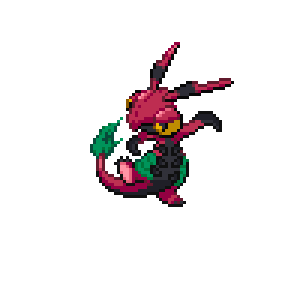
A Venielia's flowers conceal venomous stingers at their centers and layers of irritant pollen within their petals. The chitin lining their bodies is harder than tree bark, but it grows even tougher as they near evolution.
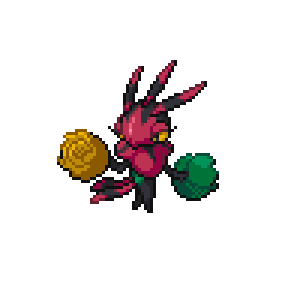
Venish communicate among themselves by clicking together their long feelers. They feed on the nutrients of plants by burrowing near them. Their antennae secrete a venom, making it dangerous to try and remove them.

By utilizing the feelers on its rear and its head, it can sense the slightest changes in the air and adjust its flight trajectory accordingly. It eats twice its body weight daily, growing heavier as it draws closer to its evolution.
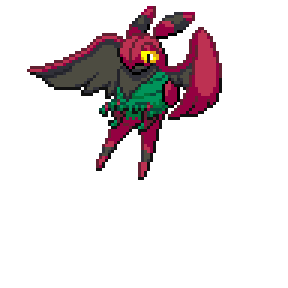
The twin tips of its tail secrete a potent venom that is also highly flammable. Its claws secrete a weaker variant of this venom, though their claws are strong enough that this weaker venom rarely serves a purpose.
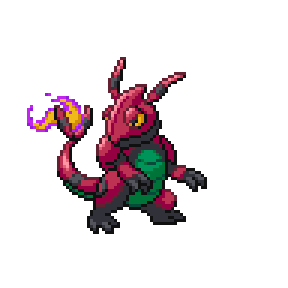
The shell on its back is remarkably dense, which is seemingly why its body is so fit and muscular. The feelers on its head, and upon its shell, allow it to sense nearby movement.
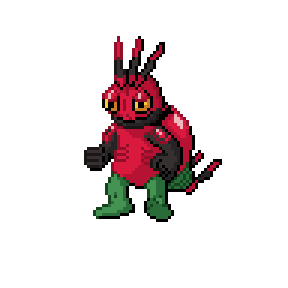
By clacking its claws together, this Pokémon gets a better sense of its surroundings through echolocation and its tall feelers. It uses its claws to dig a burrow near streams and rivers.
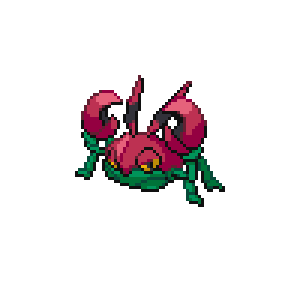
It is usually motionless unless attacked or unless it spots prey. When it moves, it generates static electricity which it can store and later loose as Thunderbolts; this electricity dissipates as it lies still.

Even when resting, it is curled upon itself like a wheel with its venomous spikes primed. It seems to only uncurl when it sheds its old skin and scales.
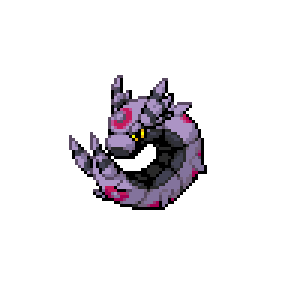
By curling upon itself, it can repel most attacks and deliver forceful counterattacks by rolling into enemies. It stores vast energy for its evolution, and its crystal orbs glow brightest on the eve of its evolution.
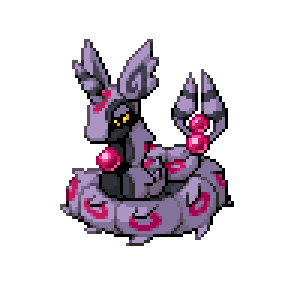
Despite how small their wings seem, they can fly high and for long times. They crash down onto foes by curling upon themselves like a giant, spiked wheel.
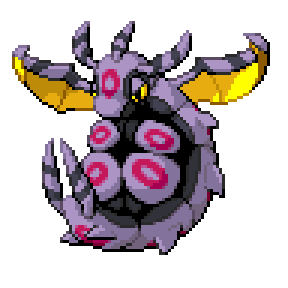
It loves to curl up like a wheel and roll down mountains or hills, albeit with minimal regard for others. It will also curl up to defend itself with its venomous spikes.
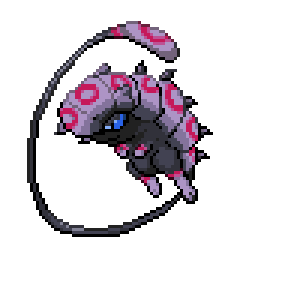
Their bulbous abdomens are surprisingly sturdy due to the amount of loose silk webbing they store within themselves. Whirlidos can curl upon their large bodies and roll along walls and ceilings due to many small hooks lining their bodies.
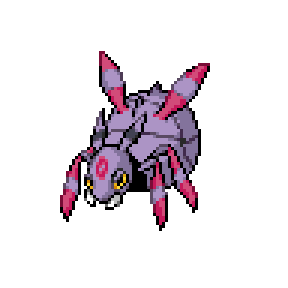
What appears to be an awkwardly-shaped body is a shell that it can withdraw inside of to protect itself. While withdrawn, it can spin at high speeds to move about and to ram into foes.
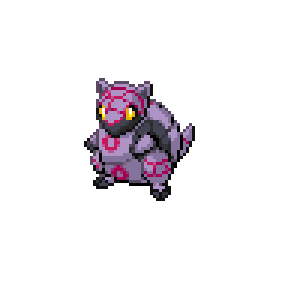
Whirlivyle prefer to wait for prey rather than hunt prey down; they lie in wait by clinging to the sides of trees. When potential prey draws near, they drop onto them with their bulky bodies and quickly slash at them with Leaf Blade attacks.
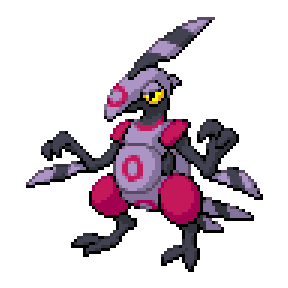
Their tail flames grow stronger the more they curl their tails up. Using flames or a corrosive toxin, they reduce their prey into a slurry that they can more easily consume.
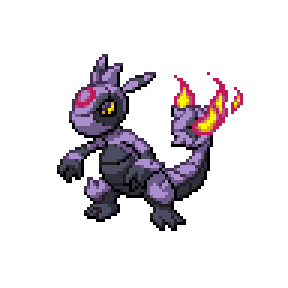
Scolitini are highly aggressive despite their small stature, digging many small claws into foes and injecting venom to fell them. Their vibrant colors grow more defined with every shedding cycle.

The horn upon its head is rather sharp and contains its most potent venom. The orb between the pronged tips of its tail is always glowing with a sinister purple light.

It flies around its territory at staggering speeds, brutally fighting off any intruders no matter their size. It skewers most foes upon the venomous, pronged tips of its tail.

The large horn upon their heads is strong enough to clash with a Honedge without suffering damage. The purple silk webbing they can spin and weave is soaked thoroughly with a paralytic toxin that quickly immobilizes their prey and foes.

It has many small legs that allow it to crawl along nearly any surface at rapid speeds like a slithering serpent. It will often hang down from above prey and use their large frills with a face-like pattern to scare them stiff before lunging at them.
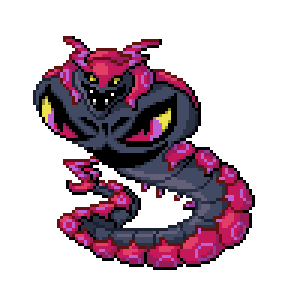
Scolishrew roll up into balls to protect themselves, yet also to deliver their deadliest attacks. While rolled up, they can best deliver deep strikes with their venomous horns by spinning into their foes.

Scolitile fell their targets with precise slashes using their toxic claws. Anything that does not succumb to their slashes is beaten down with strikes from their heavy tails.

The colorful spikes on its forearms carry and deliver a potent neurotoxin that borders on being an amnestic in high doses. Despite its bulky body, it can move rather well thanks to its noteworthy psychic power.
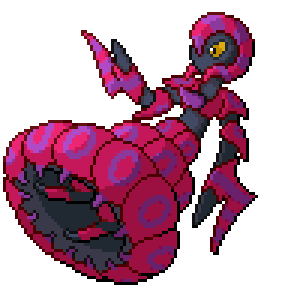
Scoliceus are highly aggressive and territorial Bug-type Pokémon that charge down their opponents with startling speed. They secrete a potent poison from their tails as they swing them around with enough force to crack a tree.
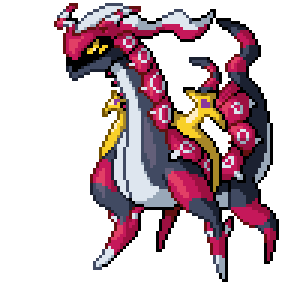
The sharp tips of its limbs and tail secrete a potent toxin. The wings of this Bug-type Pokémon emit an eerie tune as they scatter poisonous scales whenever flapped.
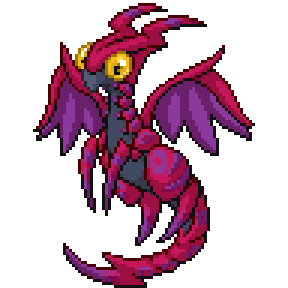
This bipedal bug Pokémon uses its psychic abilities to entrance its opponents before slashing at them with its large claws. It often assumes an intimidating stance to deter aggressors and conserve its own strength.

These highly aggressive Pokémon will use their claws and their flames to create a path in pursuit of their foe or their prey. Their tail flames peter out as they tire, so they will rely on their burning venom to defend themselves as they recover.
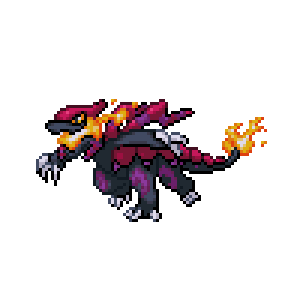
The tips of its tail secrete a flammable venom, which it uses to fling toxic fireballs at foes. With its four strong legs and muscular body, it can grapple with a Machamp on equal footing.

A corrosive toxin is secreted from within its largest claw, which it oft uses to melt down plants and berries into a quickly-consumed slurry. It can swing this oversized claw with enough force to shatter a tree.
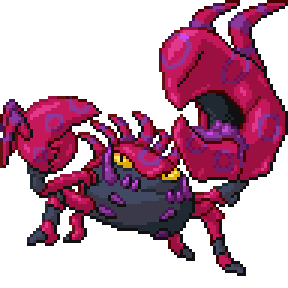
Though it has a large mouth, it can only breathe out small flames; it loves to hold large foods in its mouth and roast them with these flames. It fans out its tail feathers when agitated and bites at the air to intimidate others.

It loves to teethe on hard objects, though its jaws become stronger with age, and so it will inevitably break whatever it once teethed on. It loves to test itself against Dragon-type Pokémon, no matter how much stronger they may be.

These small Pokémon don the upper halves of a large fossil's skull, even though it often throws them off-balance. These skulls are actually large enough to also serve as a home for them to curl up into and remain safe as they rest.

Tyranros's three tails can each shatter boulders, and their jaws are strong enough to keep any prey from escaping. Due to how prone they are to rampaging, most consider them catch on sight to prevent irreversible damage to nature.

These floating Pokémon brandish the snowflake symbol upon their chests as a show of dominance amongst their kind. The longer-lived a Snofing is, the more complex the structure of this snowflake will be.

Supposedly, the face within a core of a Snomie is the true form of this Pokémon and everything else is just a shell. Only the rear star can spin, which creates a force of air that spreads the cold air breathed out from the face within the core.

The hut-like shell upon a Snoras's back will provide shelter for its passengers as it traverses the frigid northern seas. It has no need to hide within itself because its body consists of thick fat and muscle.

Snovee are the small, adorable scavengers that dwell within boreal forests. These Pokémon have unusually chaotic genetic sequences that seem to be tempered purely by the cold of their own bodies.
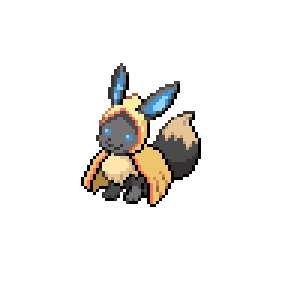
Snoreon's tail flickers and shifts like an active flame, even though it is made entirely of ice and snow. The fur around its neck and atop its hooded head are cool when it is calm but will become hot, and even glow orange, when agitated.
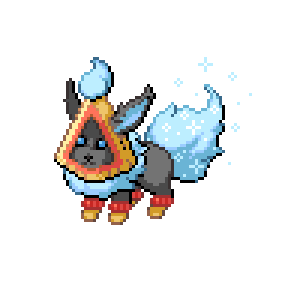
The pair of orbs that dangle from the hood of a Snoeon glow with a faintly purple-pink color when they use their psychic powers. Their black fur is surprisingly cool to the touch, no matter the environment they may be within.
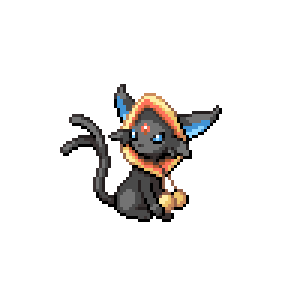
Snoveon are the favored companions of Pokémon Rangers that survey and protect cold mountain areas. This is because wild Snoveon will brave the harshest blizzards to find lost Trainers and guide them to safety with their feelers.

Groups of at least 5 Snotle often waddle along the snowy shores of frozen lakes. They will often play amongst themselves by withdrawing in their shells and bumping against one another.

Snota's blue flames are frigid cold to those it does not trust, but comfortably warm to those it does trust. It breathes steam out of its nostrils as it runs so it avoids overheating due to the thick coat covering its body.

Plumes of fresh, soft snow rise and fall from across this Pokémon's body, often casting a veil around themselves as they trot across fields of snow. The coat of fur draped across their bodies is remarkably warm to the touch for their trusted Trainer.
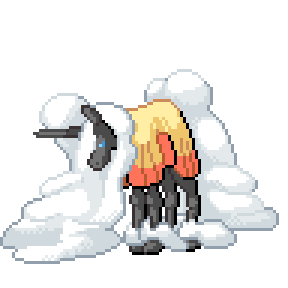
Snoby inhabit cold shores and freezing waters, with seaweed, moss, and whatever berries they can find serving as their diet. They tend to live in groups of at least five or up to seven, with the largest serving as the group's leader.
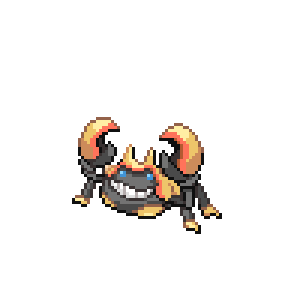
Habitats of Glaorb are commonly denoted with warning signs, as these Pokémon roll around with no regard for others. If they collide with anything at all, they discharge electricity and release a frigid energy that can even freeze electricity solid.

These Pokémon are known for two things: their voracious appetites and their explosive tempers. They fire powerful Thunder Bolts from their central horns at prey, then freeze them solid and gobble them up, sometimes whole.

These water-dwelling Pokémon typically prefer colder climates, but the chilling gas they can release is capable of chilling water without freezing it. Glaking use their powerful horns to break apart large debris in the water, such as ice and rocks.

Internally, a Glareon has a flame pouch that is always producing fire and warming its insides. Externally, its blue fur exudes a bone-chilling cold that prevents its own internal heat from melting its icy body.
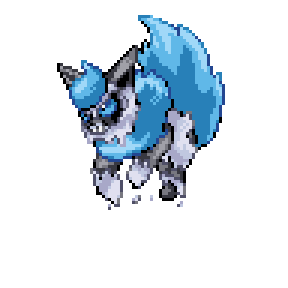
The dark-furred body of a Glaeon is covered in a dense, hard shell made of solid ice. It combines its psychic powers with its ability to produce a fast-cooling mist to protect its Trainer by freezing their foes solid.
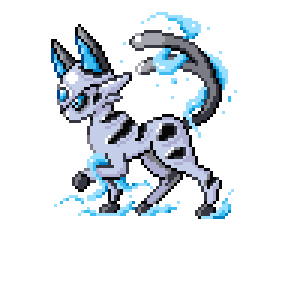
Glazor's dual mouths that serve like its hands can exude air so cold it will swiftly chill and freeze molten metal. It will use this ability to freeze raw ores and fruits before instantly crushing them within these mouths.
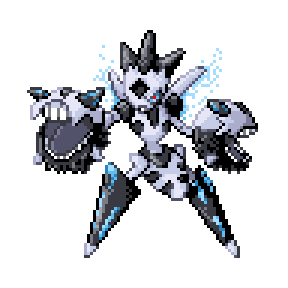
Glamega release freezing winds from their fluttering wings and from their large mouths. They can launch shockwaves from their wings that carry these frigid winds, which can freeze a sizeable area upon impact.
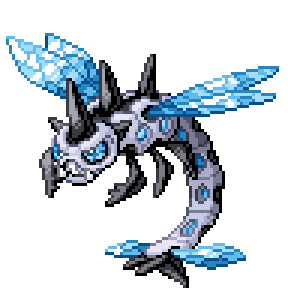
Glalade can exude frigid air from their blade-like arms to freeze moisture around them and form razor-sharp blades of ice. They will oft freeze the ground around them to make their movements more agile and add more momentum to their strikes.
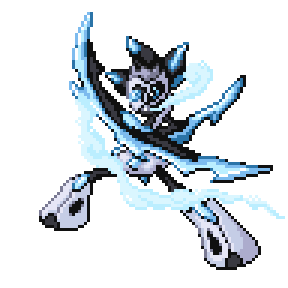
Glagron often cover their own heads and claws in thick layers of solid ice. Their bodies are harder than iron and can become so cold that one will risk frostbite by touching them.

These abnormal Pokémon are capable of releasing freezing air or sweltering heat from their spike-like wings. They have been spotted in blistering hot climates and frigid cold climates, often seen acting as the local apex predator in some cases.

Glaeye's claws are clad in many layers of solid ice to further reinforce them, allowing them to easily cut through solid rock in search of minerals to eat. It maintains the ice on its body with a freezing gas it produces within its gut.
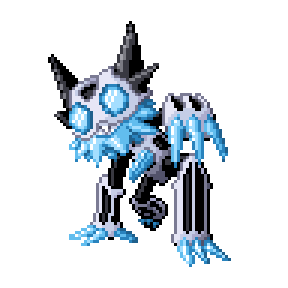
Glaeye exudes a freezing gas from its maw when confronted by a strong foe, typically veiling its surroundings in a cold mist. Its den within a mineral-rich cave is constantly filled with a chilling mist to keep out intruders.
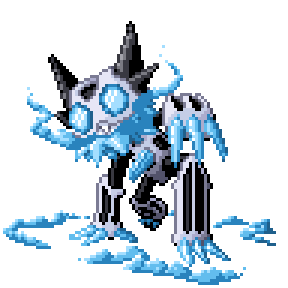
Glaodor disguise themselves as larger versions of the snowmen often made by humans. When prey draws near, they will pull them into their frigid bodies that are filled with toxic fumes.

The blue flames of a Gladash are so cold that anyone who tries to ride them without befriending them first will be frozen solid. The vent-like ports along their torsos exude hot steam as they gallop across snowfields.

The gases of its body can instantly freeze water and may even freeze moisture in the air. Those who look directly into its third eye will oft be frozen in place with fear.

Researchers believe these Pokémon are somehow able to live off the weak cosmic radiation of our sun and our moon. They then spin quickly as they release freezing cold air from the purple ports along their bodies, creating powerful Blizzards.

Froseon are the rarely-seen denizens of frozen lakes, as they often live deep under the ice. When they emerge, it is often because they sense danger nearby and will hunt it down and freeze the source of it solid.

Frosreon's body can exude a chilling mist that is so cold that it burns. It often wanders through thick blizzards in search of lost Trainers and, if treated with kindness, will curl up with them and warm them with its thick, warm fur.

Frosew is a particularly festive Pokémon that seems to only appear during winter and disappears by the time of a new year. It often loves to play small pranks on humans and Pokémon alike, audibly giggling as it flies about.

Oddgela rest during the day, hiding as shrubs and bushes thanks to the many leaves upon their bodies. They become active at night, harnessing moonlight as energy that helps them to grow.
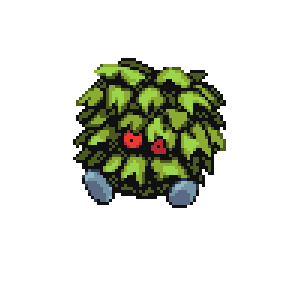
It trims its tail leaves with the large, sharp leaf atop its head to ensure its balance is not thrown into disarray. Since its leaves grow with moonlight, it must trim them every morning.

These odd-faced Pokémon spread their leafy wings at night to absorb the moonlight that helps them grow. They can spit seeds and weak poisons to defend themselves.
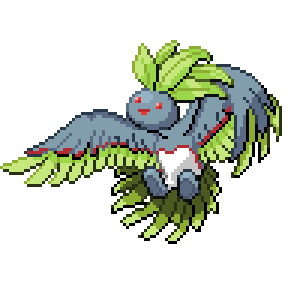
Oddkip can oddly filter nutrients out of mud, which they absorb to nourish themselves, so they will sometimes scoop mud in their mouths and eventually spit it out. Their leafy tails can lift rocks when they fully plant their feet into the ground.
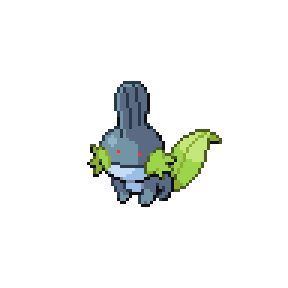
Oddferno are sapient Pokémon that swing through jungles and forests upon vines, wielding tools or weapons fashioned from stone and wood. They have displayed a capacity to use human-made tools as well.
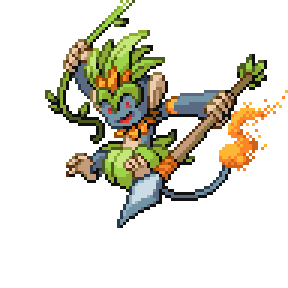
Oddile live in the dampest marshes, with all but the tops of their heads and their leafy tails submerged in mud during the day. At night, when the moon is shining and their leaves can feed on the moonlight, they arise and wander about with glee.
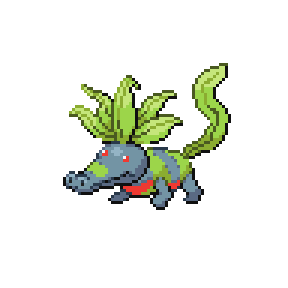
Oddpede move rather slowly during the day, yet move quickly at night because they mainly metabolize moonlight. Their leaves contain deadly toxins yet serve well in many medicinal remedies.
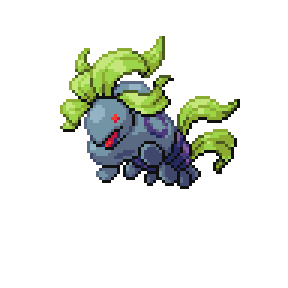
It moves around like a wheel, though this often causes it to shed its many leaves. It takes but two nights for its leaves to regrow, and the toxins within them seem to grow more potent with each regrowth.
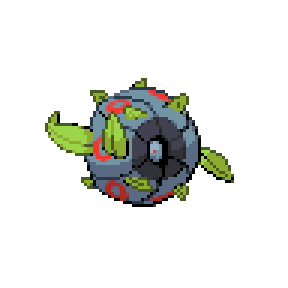
These peaceful and docile Pokémon rest during the day by burrowing their long bodies in rich soil, leaving only their horns and leaves to protrude. Their toxins produced in their leaves leak out as a potent venom from their horns.
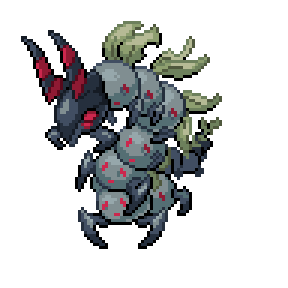
These Pokémon are always hopping around to find a place to take root, which each individual is very peculiar about. Once they've taken root with their long, springy vine they will use psychic powers to defend themselves from being uprooted.

Despite an appearance found charming by many, Oriorb are dangerous due to the explosive mix of fire and electricity broiling within them. They explosively release their energies when angered, which is all too easy to accomplish.
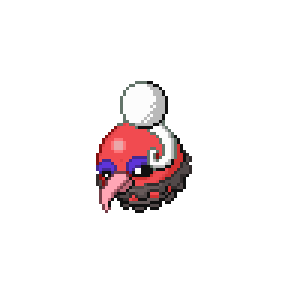
Orits's lower body is clad in many small feathers densely packed together. It performs a careful dance when it is happy, and with people or Pokémon it trusts, but the friction of its feathers can easily spark fires if near kindling.
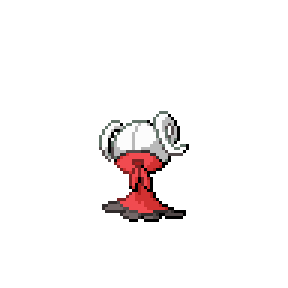
By beating its wings together, Orilia can create flames; it frequently beats its wings together as it dances. Orilia dances during battle and when it is happy.
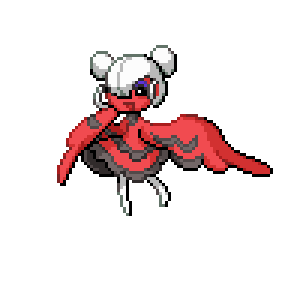
Orivoir create flames through the friction of their many feathers as they dance. They wield telekinetic powers to control and command these flames either for battle or to enhance their performances.
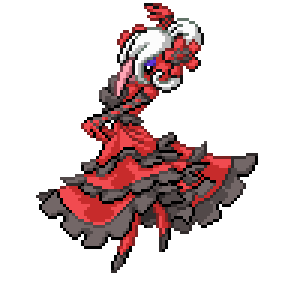
What appears to be an Oricorio atop its box-like body is actually just a very accurate replica. This replica can dance as if it were alive, but only when the crank on the side of its body has been fully wound up.

It beats its wings together to create fire and launch it at foes. It is well-known for the courtship dances it performs, which are enjoyed by many people as well as by potential mates.
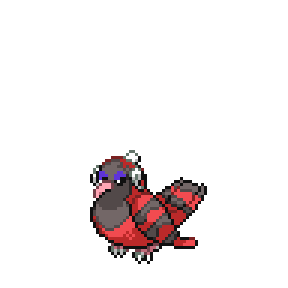
Oriwellow fling fireballs from a distance to entrap their targets. When they have ensured their targets cannot escape, they dive down to deliver a finishing blow.
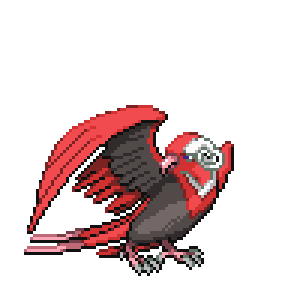
Orilia emit elative psychic waves as they dance and generate considerable electricity when their feathers rub together. Both of these factors have led quite a few medical facilities to utilize these Pokémon.

Oriorb use their long beaks both to drink pink nectar, which is what they favor most, and to stop themselves from rolling out of control. They sway themselves from side to side to help calm and focus their minds.

Emotionally reactive by nature, Orichic keep themselves relaxed by gently swaying. By keeping themselves relaxed, they also regulate their own body heat; their flame sacs become far more productive when they are not relaxed.
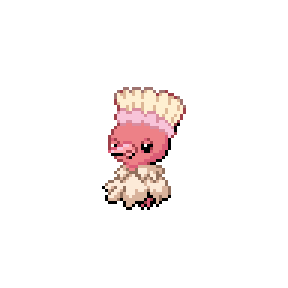
Although small, even a single Orits exhibits enough psychic influence to calm a moderately sized crowd with its gentle, swaying dancing. They are incredibly shy Pokémon, however, and most would sooner flee than quell others.

Whether perched or in flight, Orilow always sway from side to side; even in large flocks, they sway in unison without colliding. Their swaying movements help to calm their minds, which allow them to remain sharply focused on specific tasks.
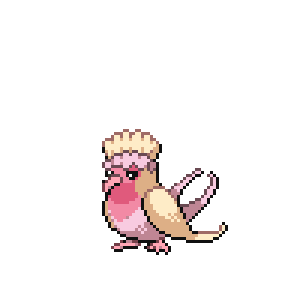
It generates electricity while it rolls around, while its metabolization of special, purple nectar helps to regulate this electricity. It is easy to anger and will emit eerie screeches when angry; these screeches are said to inflict horrible curses.

Trubwak clad their filthy bodies with pieces of trash. Specifically, they will typically wear tattered trash bags. They are infamous nuisances, as they will uproot signs to wield as weapons.
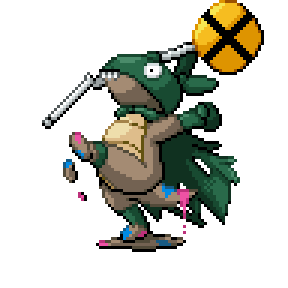
Trubmagius appear to wear metal trash can lids, but this is simply camouflage their bodies developed. Many rumors claim they are spirits born from overflowing waste.
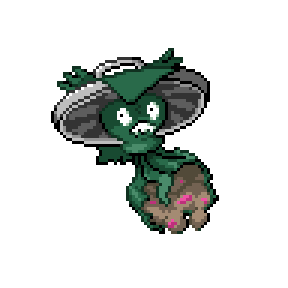
Trubchic are common landfill occupants because they feed on waste; they can even feed on liquid waste in lieu of water. They can spit fire, which also serves as a sign of their health; if Trubchic spits out any black smoke, it is likely ill.
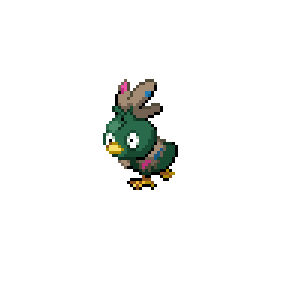
Trubts are drawn to the emotions of others, so they are often discovered near towns and cities. They are timid, so they tend to hide amidst that which they also eat from: piles of waste and rubbish.
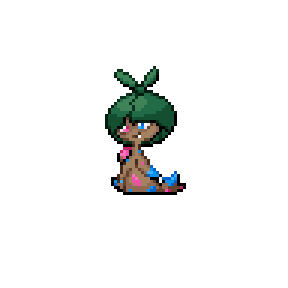
Trubwile disguise themselves as a small pile of trash bags and overflowing waste to avoid attention. The largest bags are actually mouths, which they use to quickly eat through piles of actual waste to sate themselves.
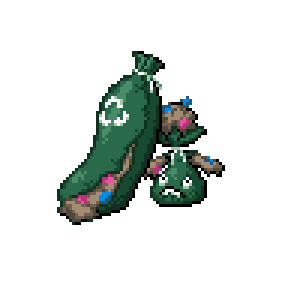
These Pokémon gorge themselves upon human trash and other waste, which adds more and more mass to their bodies. They have no need to fear predators due to the horrendous stench their bodies emit.
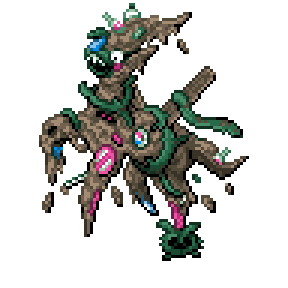
Trublup love to play within and consume waste, though their consumption rate is rather low due to how little they need to eat per day. Oddly, they produce water that is entirely clean of any pollutants despite their environs and diets.
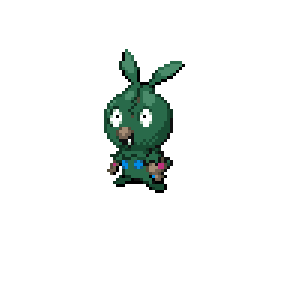
Trubpass have keen senses of smell that allow them to easily locate spoiled goods. Because Trubpass can also safely eat most spoiled goods and seem to love doing so, they are considered vital by some businesses.

Trubveon feed on waste, even non-organic waste. When they have eaten their fill, they exude a toxic gas; this gas quickly relaxes and calms others, sometimes to a dangerous degree.
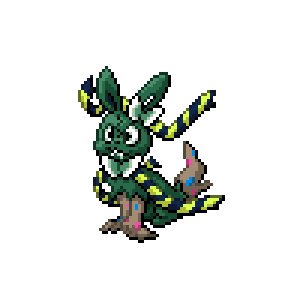
Trubmer are drawn to pollutants, so many are often found near the ports of large cities. They feed on waste and gradually grow larger; it was discovered that part of their growth is due to noxious gases produced by digestion.
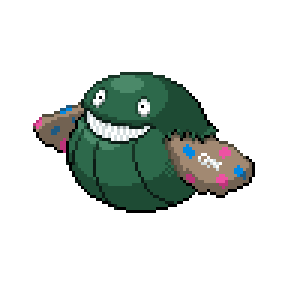
Trubvanha are found often in deep waters, though they are easily drawn to polluted waters as well. They primarily feed on waste, resulting in them being clad in pieces of waste and having toxic scales. They are violent enough to attack ships for food.
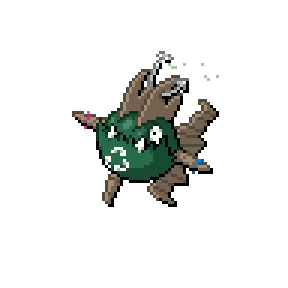
No matter their age, Trubtump display childlike demeanors, such as by frolicking within trash. They cry loudly if their favorite piles of trash are cleaned up, making them difficult to raise for some Trainers.
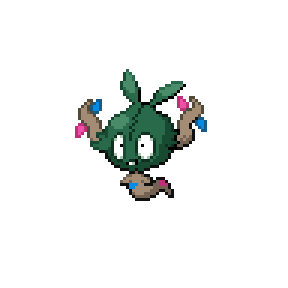
Its body grows larger with every piece of waste and refuse it consumes, even if only marginally larger. By lugging its own weight around each day, it grows remarkably strong. Due to its strength and its pungent odor, it has no known predators.
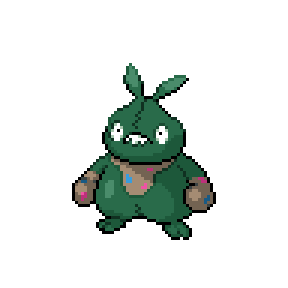
Although most would agree that Trubitty act adorably, the horrid stench these Pokémon exude repels most people and Pokémon. Though they feed on waste, they often roll trash and refuse into balls to play with as well.
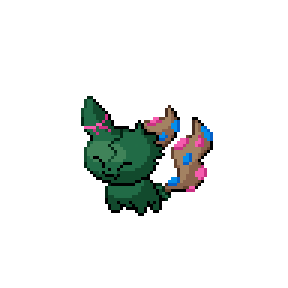
Wild Garbwak are commonly found sifting through trash and other waste, feeding on scrap metal and rotten food scraps. They favor large pieces of rebar as weapons and tools, but also as something to gnaw on for days.
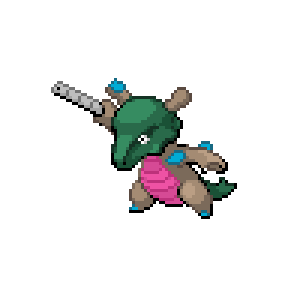
Garbfing are common inhabitants of landfills and garbage dumps, picking up trash with their right hands to then eat. They release poisonous gas from their left arms to defend themselves.
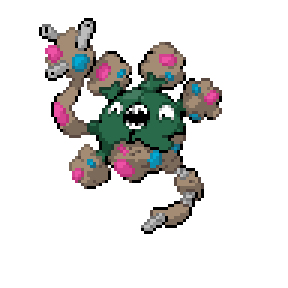
The bodies of Garbking have developed to resemble various pieces of human trash floating in polluted waters. Though this is believed to have been to protect themselves from bird Pokémon, their bodies seem far too toxic to be consumable.

The horns and fangs of a Garbsir have become like metal grinders that can churn large waste into little pieces for it to eat. Although some humans fear them a bit, they are often utilized in landfills to break apart larger pieces of trash.
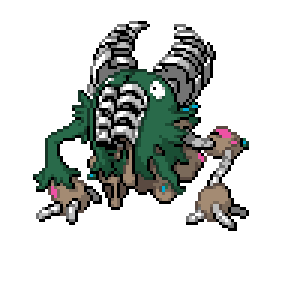
These airborne predators favor landfills and other poisonous areas, diving down to snatch prey within their pointed jaws. They appear to have eaten the fossilized remains of certain Pokémon and their bodies developed around the remains.

The body of a Garblosion contains a highly combustible gas that can be ignited by clacking its teeth. They can form small bombs from this gas and hurl them at enemies.

Garblix typically live under the landfills that they also eat from. Their bodies resemble the trash they devour, especially the discarded bars of rebar that they especially favor.
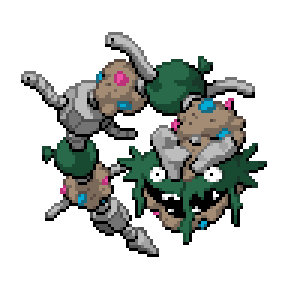
A Garbzor's legs are like sturdy needles that can rather easily skewer myriad junk and debris which eventually gets absorbed into their upper bodies. They can "belch" toxic gas from their pincers to daze foes before pummeling them with punches.
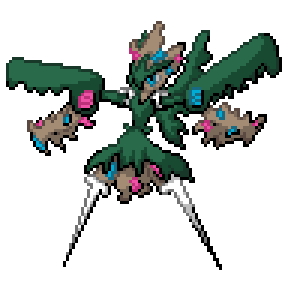
This Pokémon uses its strong arms to compact its own refuse into tight balls that they throw at their opponents. Wild Garbcross can often be found effectively swimming through mounds of trash and refuse.

Wild Garbcune are drawn to polluted lakes and ponds, seemingly trying to clean them by feasting upon the waste floating in them. Unfortunately, their own bodies are so toxic they often add a different form of pollution to the water.

The toxic gas released by a Garbmagius is so thick and horrid that it is visibly an eerie purple color. They can easily subdue most opponents through the smell of this gas alone, but it is also so toxic that it may quickly end their torment.
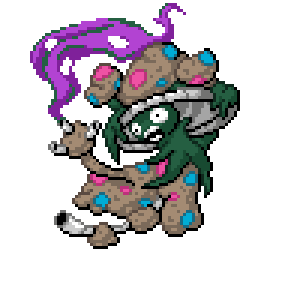
These Pokémon have adapted to living within large, human cities where they feed off small refuse. The horn atop a Garbwile's head has taken the form of a dumpster to better secure food for it to eat later.

Garbceus are orbited by myriad junk due to all of the magnetic debris they have consumed, but their most prized possession is their globe. The stench of their bodies is enough to drive away even most Poison-type Pokémon.
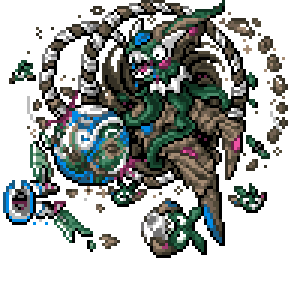
The white smoke of a Garbram comes from burning refuse within its body. Its flames remove pollutants in the process, and the resulting smoke is surprisingly pleasant. Some humans use them to help clean up garbage.

Garbtump body grows as it eats waste, as does the pungent odor emanating from the ends of its limbs and from its mouth. It displays a childlike love for games and tricks, to the chagrin of many people.
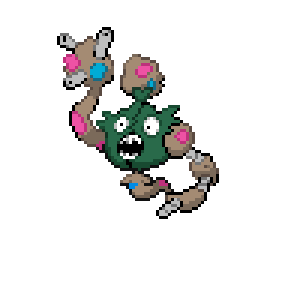
Wild Garbliper nest within landfills and garbage dumps. They release puffs of toxic gas as they fly, often diving down to scoop up clumps of trash to eat.
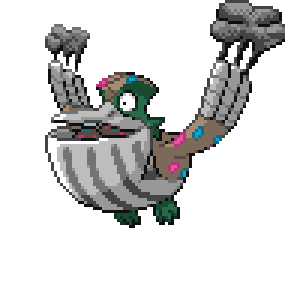
Wild Garbrein favor swimming within polluted seas, ironically helping to clean them as they absorb the trash and pollutants into their bodies. They are frequent invaders of garbage barges and sometimes even sink them to use them as homes.
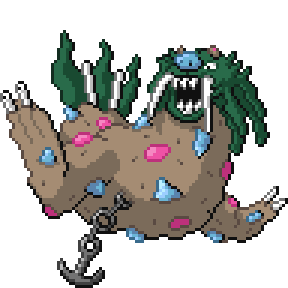
Wild Garblem roll around in trash and other debris, which is all eventually absorbed into their bodies if they do not fall off. Once a year, they must shed some of their garbage-like bodies so that they do not grow so large that they cannot move.

Because they are individually weak, Carpie live and hunt in large swarms. Their small fangs are strong enough for them to tear through weak metal and solid wood; they demonstrate this by targeting supply caravans for their food.

Carorb are commonly spotted along beaches and aside ocean-leading rivers, though they are easily carried away by the currents. They have explosive tempers and will launch themselves at the source of their agitation and then viciously bite it.

With shells as hard as iron slabs, wild Carpod launch themselves at prey and at ships trespassing through their territory. Though they sustain many minor injuries by using themselves like missiles, they continuously grow stronger as well.
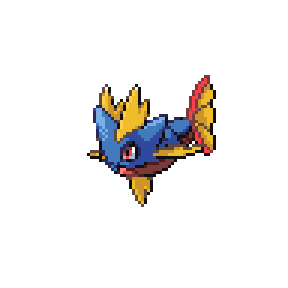
Cardos are infamously known for their insatiable appetites and ferocious tempers. They lash out at anything that enters their territory with such reckless abandon that they often destroy their own home and force themselves to have to relocate.

Commonly referred to as the "Vermin of the Sands" by desert travelers, Carshrew are aggressive Pokémon that effectively swim through the sands. They typically attack travelers in an effort to steal, and consume, their supplies.

Carcko store water within their rubbery, transparent tails so they can explore and hunt on land. When they run low on stored water, their tails shrivel, and they quickly flee to any water to recuperate.

Carvyle live and hunt in packs of at least five individuals, delivering quick attacks with the sharp fins on their arms. Because they can store water within their tails, they often hunt near shores as well.
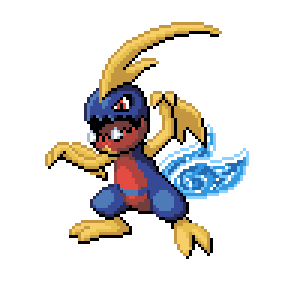
Although the largest schools of Carkip are found within saltwater, some much smaller schools have been discovered in freshwater. They are quick and merciless predators who will swarm and assail prey with many vicious bites.

Careon are freshwater fish Pokémon that can perfectly camouflage themselves within the water. They only move when potential prey draws near enough, lunging toward them and attempting to bite down on them.

Cargron are the rarely-seen leaders of Caron schools that tend to stay and guard the underwater caves that they dig out. Their claws and fangs are often tough enough to tear through metal, which they use to defend their homes and schools of Caron.
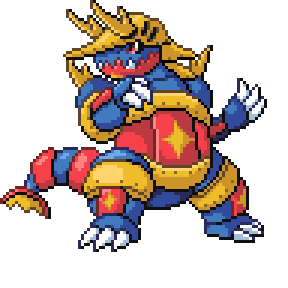
Carogre have incredibly rough scales that are capable of grating solid rock and damaging ship hulls if they collide against either. They typically hunt down large schools of small Pokémon, swallowing many of them whole per meal.
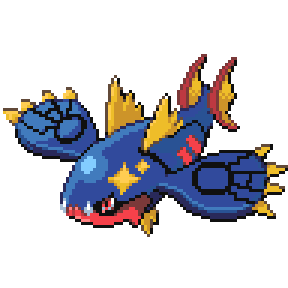
Carloom have jaws powerful enough to tear a hole in a ship's hull and use their strong legs on land or underwater to launch themselves at high speeds. Their strength fades the longer they go without water exposure.
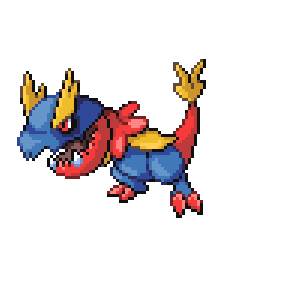
The pheromones exuded by these Pokémon effectively induce drowsiness within others near them. Though Carkoth initially appear to laze around, they will viciously lash out when their prey or foes succumb to their pheromones.
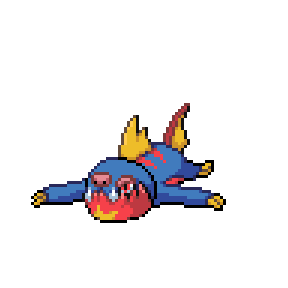
Caron are considerably slow on land but stunningly quick in water, with rock-solid fangs that can withstand biting solid rock. Caron hunt in schools of up to 10 capable of taking down other Pokémon larger than themselves rather swiftly.
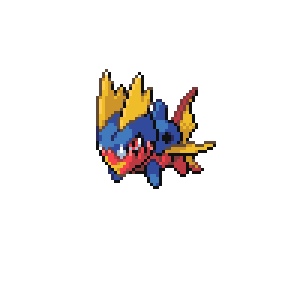
Caras are a common species of underwater Pokémon that often laze about near along the shores of rivers, often becoming the hosts of mushroom spores. If disturbed from their rest, they will viciously bite at the nearest living thing.

Carzagoon swim in zigzag patterns, even as they hunt prey. They are capable of temporarily walking on land, though they still move in zigzag patterns. Carzagoon tend to live in large groups and collectively target large prey.
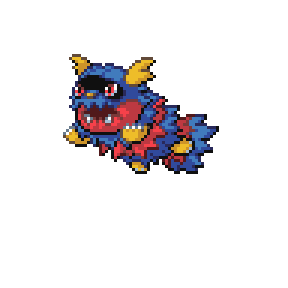
So long as Carnoone move in straight lines, they can achieve swimming speeds that surpass small motorboats. They struggle to turn while swimming, so they hunt in large packs so that at least one of them will catch their prey.

Carple live in large swarms and will gang up on larger foes. Though they are small, the venom in their horns is potent. They can also spit a toxic fluid, which is capable of corroding ship hulls.
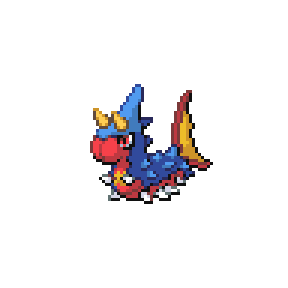
Carlow are most dangerous in groups, as they will coordinatedly swarm their targets, tearing into them with talons and fangs alike. They are capable of breathing underwater and can swim as easily as they can fly, so they have a broad list of prey.
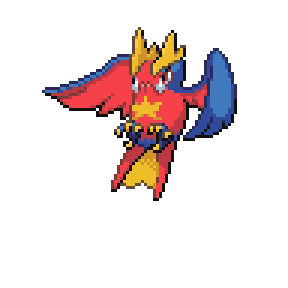
Carhita cannot swim well, so they mostly just walk along the seabed; this ironically causes many predators to see them as easy prey. Carhita are strengthened by constant attempts made by predators and the crushing, watery depths they reside in.
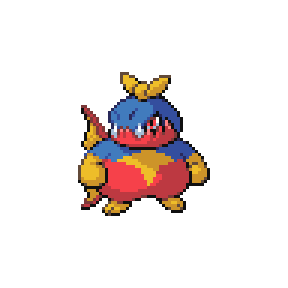
Carle live in large groups because they are weak by themselves. Together, by joining hands, they can properly release electricity and take down most prey. If a Carle is found alone, it will lash out with weak strikes and even weaker bolts.
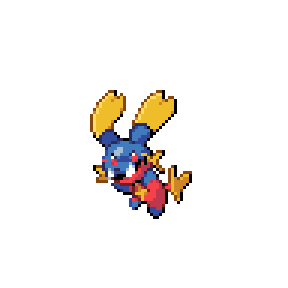
Caratone charge at their prey at full speed, seeking to wedge their prey within their crescent bodies and cutting into them with their beaks. Their activity is seemingly affected by the phases of the moon, with them being most active when it is full.
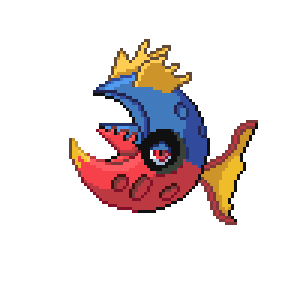
Cara are often seemingly floating in water as they sleep. If a Cara is disturbed from its slumber, it will either lash out with a Bite or use Teleport to change its location. Cara have rarely warped aboard ships and raided them for food.
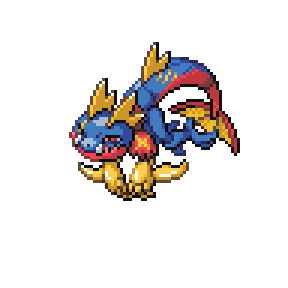
It is a common pest at hydroelectric dams, as it will bite into anything flowing with electricity and leech that energy for itself. It is difficult to safely remove a Sharporb, as the slightest stimulus could cause it to fly into an explosive rage.

Despite their size, Sharpkip can swim through thick mud as easily as they can swim in water. Their head fins are a common sight within marshes and swamps as they encircle their targets and prepare to pounce.

Wild Sharpceus are so quick to challenge other Pokémon near the beaches they live upon that their bodies are always covered in many scars. Their many fangs break rather easily during battle as they bite their foes but they always grow back tougher.
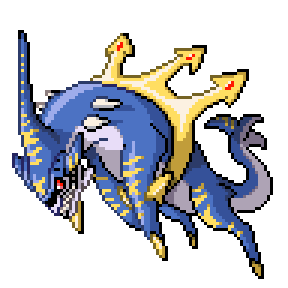
A colossal underwater behemoth with jaws that easily shred ships' hulls and surprisingly cunning intellects. Sharpgron are clad in the remains of ships they've torn apart as proof of their terrifying cunning.

Its many teeth are often the last sight for unaware deep sea divers and small aquatic Pokémon alike. The markings along the bodies of these Pokémon glow within the depths and only dim when they are hunting.

This underwater leviathan of a Pokémon lives within only the deepest, darkest undersea trenches. Sharpquaza's body is covered in countless scars from its many battles with other underwater Pokémon over over territory and prey alike.

This Pokémon lives and hunts in arctic waters, though it is capable of staying on land for periods of time. The ice along its body protects it while also giving it a deadly horn that allows it to quickly impale any of its prey.
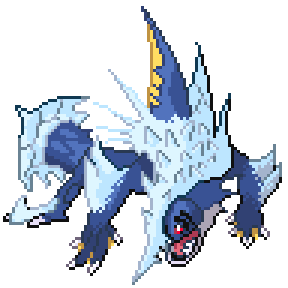
Although the range is limited, Sharploom can stretch their necks around half a foot and ambush targets with swift, biting attacks. They can move swiftly in water and are agile on land, which makes them tricky foes to overcome.
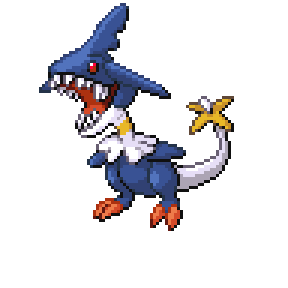
The jaws of Sharpron are unassumingly strong enough to tear through metal ship hulls and deep sea rocks. Their teeth quickly regrow if they break, and they grow back stronger thus resulting in them being tougher than most metals.
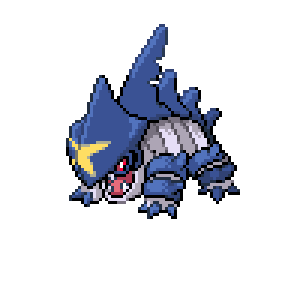
These Pokémon began to display lower brain function as mushrooms accumulated upon their bodies, causing them to be swept away by rivers and carried into oceans. Somehow, when they become injured in battle, mushrooms will grow from the scars.
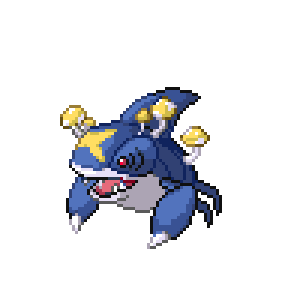
Sharpnoone can achieve remarkable speeds in water so long as they move in straight lines. Because they struggle to turn at high speeds, they often crash; most of their scars are from crashing.
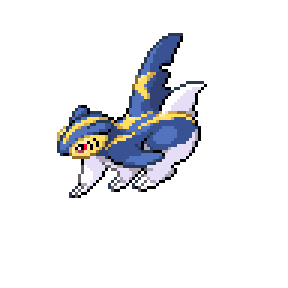
Although small, it is a vicious Pokémon that will target and harass individuals one at a time; this behavior is most noticeable with prey. It does not hesitate to assail targets larger than itself; as testament to this, it has many battle scars.
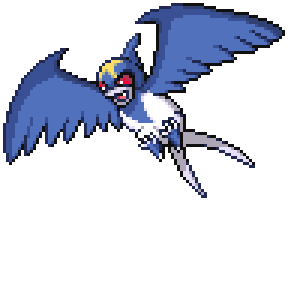
Sharpitty are easily distracted and allured by moving objects, lunging toward them to bite into them; sometimes, they even bite their own tails. They are typically clad in various scars, many of which come from them biting each other by accident.
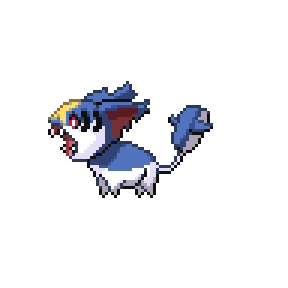
These nocturnal forest Pokémon wear and wield pieces of old trees. They seem to need only moonlight and water to survive, yet they wander every night as if in search of something.

Parts of the forest have become fused with their bodies as they grow. They carve intimidating heads onto large, thick branches, wielding them as weapons to strike fear into enemies.

Phanto hide along trees and wait for prey, which they can sense the movements of with their wisp-like horns. They will launch themselves toward their prey and cling on with their claws as they proceed to drain their prey's life essence.

Though it displays a unique ability to detach its own head, it can only do so for less than an hour before it must be returned to its body. It typically only detaches its head to reach foods that are far away and/or high up.
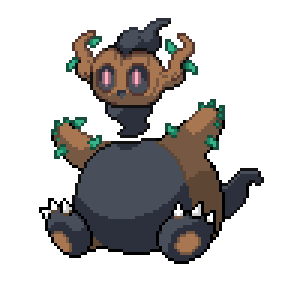
Phantu are infamously known as "Silent Watchers," as they will perch atop tree stumps and branches to watch passersby without uttering a single noise. Some believe they can see into the hearts of others and that they will act if they see malice.
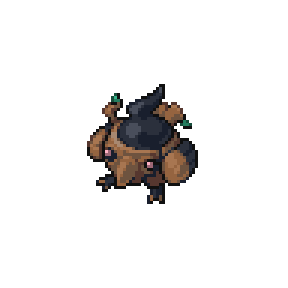
Phantsaur are most active during rain, which is absorbed by their foliage and brings back color to their floral bulbs. They are happy to share their leaves with those they trust, but they release a tear-inducing pollen to repel all others.

Phantsparce dig burrows within damp, nutrient-rich soil and absorb nutrients and moisture as they rest. They never sleep in the same burrow, as they will carefully bury seeds in their burrows so new life may grow.

The loud cries of these Pokémon are so alike to the voices of human children that many travelers have been deterred from the forests Phantrow call home. Phantrow nest within tree canopies and prey upon Bug-type Pokémon that feed on said trees.
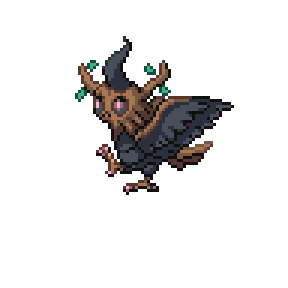
Wild Phantshrew live in burrows they have dug out under trees. They live off trace amounts of nutrients and water acquired from the tree roots above their burrows.

These Pokémon wander forests and spit fire at anything or anyone they deem to be a threat to the forest. If they encounter anyone who is lost, they will try to guide them to safety; some stories claim this is because Phantchic were once lost spirits.

These Pokémon are said to be the decayed remains of trees possessed by mothers who perished in search of their lost children. They wander forests at night, as if still continuing their search for their long-lost children.
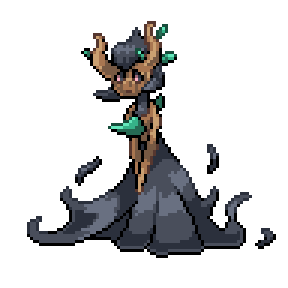
Phantinja are said to be created when spirits possess the shed shells of bug Pokémon that tree bark has grown around. Their bark-like bodies continue to grow as they metabolize sunlight, so some have been seen stuck to trees.
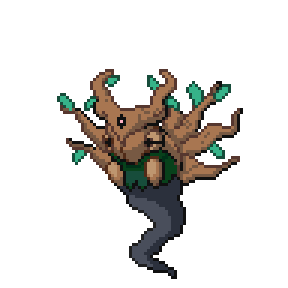
These Pokémon are incredibly shy, yet they have kind hearts. They typically conceal themselves within foliage and by utilizing their hue-shifting abilities, but they will reveal themselves to comfort or protect a crying individual.

Phantdum are drawn to one another, so they always live in large groups. They can move in nigh-perfect unison, as if connected by a hivemind. They coordinate their attacks to defeat strong foes and to defend their forest homes.

It is said that Phantang are the result when the spirits of two Phantdum merge. Their "noses," much like the rest of their bark-like parts, are harder than steel and can cleanly penetrate solid rock when they charge forward.
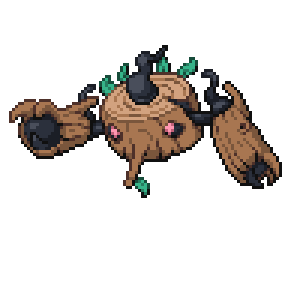
Some tales claim that Phantcario are connected to the very "spirit" of their entire forest homes, allowing them to sense all that happens within. They will show up to protect young humans and Pokémon alike if they are in danger.
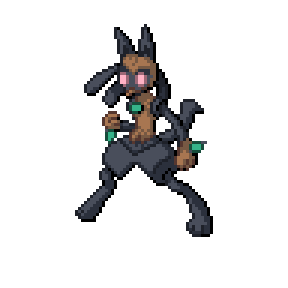
Phantsaur leaves are known for their medicinal properties when properly ground up and mixed with water and sap. They shake loose some of their leaves when they come across injured travelers, which scatters a cool, calming pollen from their petals too.

Phantgron is highly territorial and will fly into a rage if it ever discovers that its forest has been damaged. So long as it is shown respect, though food offerings help as well, it will allow others to pass through.
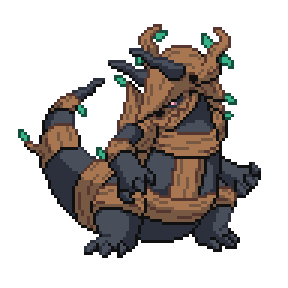
These small Pokémon wield a weak power that accelerates the growth of plants. Using this power too often leaves them so tired that they will be rendered immobile until they absorb enough sunlight and water.
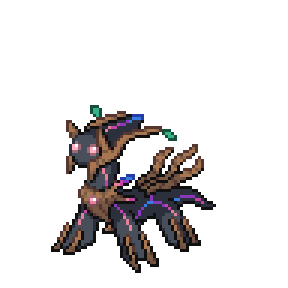
Phantpunny use their slender, prehensile ears to ensnare foes that harm those they care for, then dispatch them with powerful kicks. Though they aggressively defend others, they are otherwise docile and shy.

Phantjask move with such speed that they are often difficult to see, though within forests they blend in quite well even while still. Their eerie cries can achieve disorienting pitches that may induce migraines.
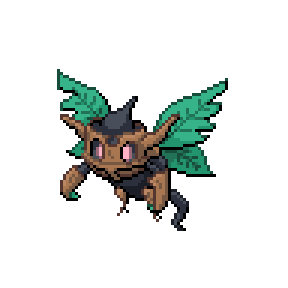
Phantfairy are believed by many to have come from beyond our world, be they as spirits or as extraterrestrial Pokémon. They scatter a shiny, pollen-like dust that boosts the health and growth of plants, making them treasured by many people.
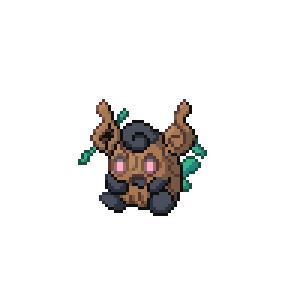
Though they can ride upon gentle winds, Phantcott are deathly afraid of strong winds, as those will scatter most of their leaves. Their leaves wilt in minutes when detached, yet they have great medicinal properties as well.
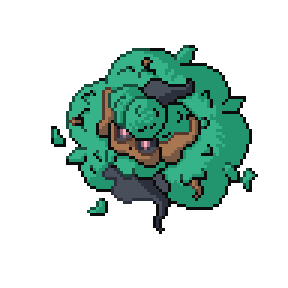
Their shadowy tail splits into many tails as they grow stronger, though they can never surpass six on their own. The spirits they were born of are said to have been those of children, which may explain why Phantpix are so friendly and playful.
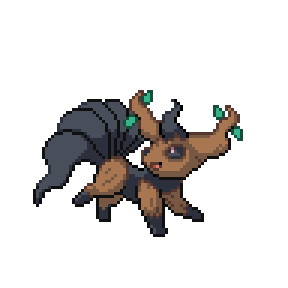
Phantkoth are so rarely sighted that they were once mostly known through tales and rumors. As many tales claimed, they do rest for long periods of time, especially atop the remains of trees. When awake, they emit cries as if grieving something.
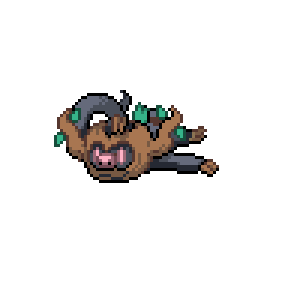
Phantpuff are known for their melancholic songs that can often be heard resounding throughout forests at night. These Pokémon are light enough that a strong gust of wind will launch them off their feet.
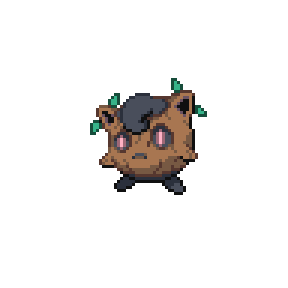
Phanton feed on rocks and metal scraps, making them valued partners for Pokémon Rangers for the sake of keeping forests clean of harmful debris. The leaves on their bodies are rich with iron nutrients and exude fresh air via photosynthesis.
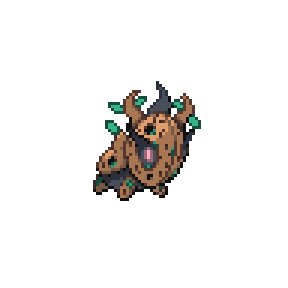
Phantrua have long been called "Fell Spirits" due to the belief they were born of the spirits of felled trees. Such a belief is bolstered by how these Pokémon fervently guard and protect tree stumps using their illusionary abilities.
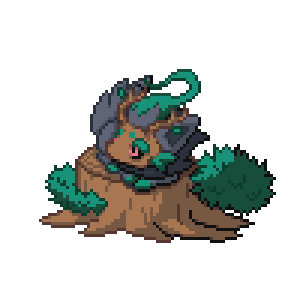
Phantmander have been spotted within forest clearings at night, cheerfully dancing with their fellow kind while their red flames flared and flicked about. They have kind hearts and have often helped to guide lost travelers they had only just met.

Phanteary flowers, albeit small, contain concentrated medicinal compounds coveted by many. Unfortunately, these Pokémon were hunted for their flowers and only now have begun to prosper again, albeit with a greater aversion to humans.

By crouching and curling its ears up, Phanteary disguises itself as a shrub to avoid humans and Pokémon alike. If it is attacked, it lets out a piercingly loud cry and quickly hops away.

During the day, this Pokémon hides itself in piles of leaves and twigs or in hollowed-out logs as it rests and conserves its energy. At night, it comes out to explore and to absorb moonlight.
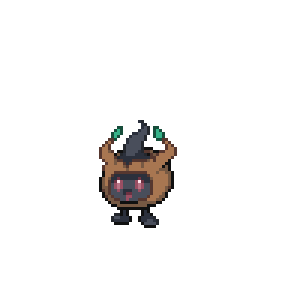
These small Pokémon are common sights within old forests, scurrying along the ground and devouring any rotten matter they come across. Though their leaves contain poison, they also exude an exotic aroma that attracts many Pokémon.
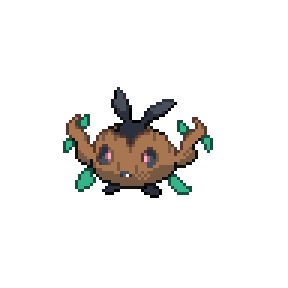
It is rumored that these Pokémon were born of the spirits left behind by forest fires, now possessing the burnt remains of trees. They are incredibly docile and shy, though when happy their flames noticeably grow and they cannot help but dance a bit.
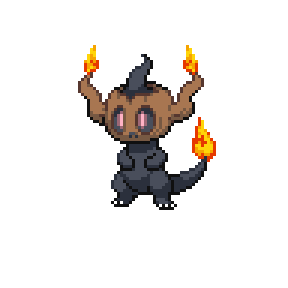
Its red flames are said to be otherworldly energies made manifest, which may explain how they do not set their forest homes aflame. A Phantmeleon will fight viciously to defend their homes, using their claws, horns, and flames alike.

Because of their long, wood-like bodies, these Pokémon can easily camouflage themselves within forests. They are commonly found near trees or upon tree branches, as they mostly eat leaves.

Phantmur are typically quiet when they cry out, with some comparing their cries to young children. However, if their branch-like horns are grabbed, Phantmur emit shrieks strong enough to blow leaves off trees.
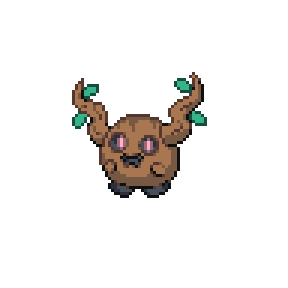
Although a Phantnine will enshroud itself in spectral flames to intimidate others, it's only able to do so for at best an hour before it exhausts itself. It is usually seen near sites of forest fires and perceives nearly anything as a possible threat.
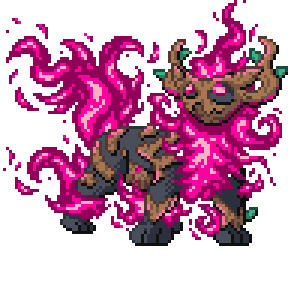
In battle or when cornered, Phantmeleon display a ferocity that is often compared to wildfires. Their flames burn so strong, even as they rest, that they have isolated themselves within caves near the forests they once called home.
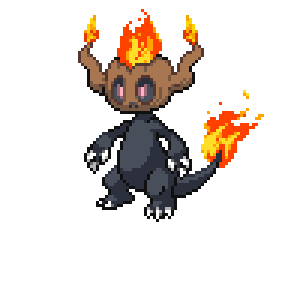
It spits out a fast-hardening latex to ensnare and quickly finish off the Bug-type Pokémon it preys on. It will also use this latex to help seal the wounds on larger plants and trees.
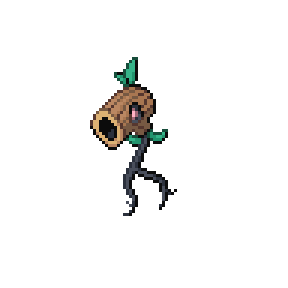
Because its head glows with fiery light during battle, some have theorized its head is hollow. Despite this, it is a clever fighter who makes use of its environments to the fullest. When not battling, Phantizard will gently tend to plants nearby.
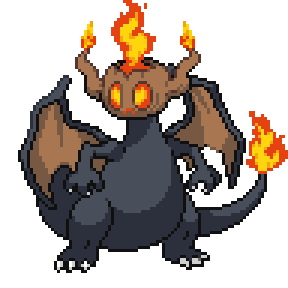
A Pokémon born of a small spirit's choice to inhabit a large piece of driftwood. It tends to the moss on its belly and makes enjoyable patterns of it. Its body is surprisingly tough, and it can withdraw inside to further enhance its defenses.

Phantcool live within forest lakes and ponds, their light bodies allowing them to float with their glassy, green orbs above the surface. They only need sunlight to survive, but some tales claim they will drag others underwater if they get too close.

It emits alluring lights from its glassy orbs to draw others closer to the edge of its lake habitat, then drags them down to feed on their life force. Phantcruel can also emit child-like cries from the hole on its head to lure humans closer.

Perhaps due to their inherent weakness from the moment they are born, Phanta will only ever let children ride upon their backs. Their trust must still be earned first, lest their black flames harm their rider.
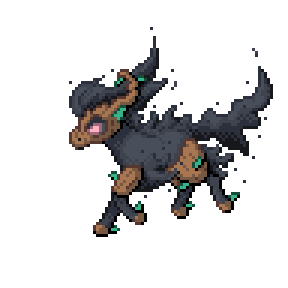
Despite their size and strength, Phantdash mostly only let children ride upon their backs. They are known to make exceptions for loving families, however. Their black flames will never hurt those they trust, and they help to conceal their movements.

Their leafy tails are a sign of age and garner respect among their kind; how much respect is gained depends on the length and thickness. They subsist on sunlight, moss, and water, so they are frequently spotted near ponds and streams.
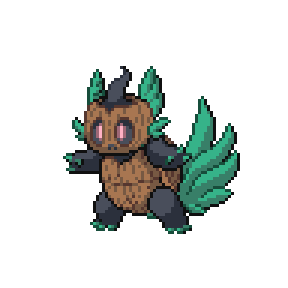
Debate persisted for quite some time over which was the head of this Pokémon, though further study revealed the face on the shell is a diversion meant to trick others. Its shell has the composition of wood, yet the durability of iron.
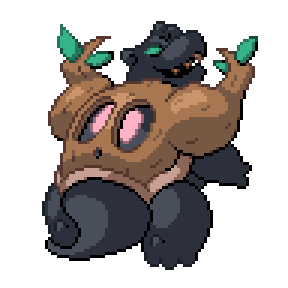
To prevent their gaseous bodies from being blown away, Phantly seek refuge within tree hollows, which often also become their nests. They are infamous for startling and frightening travelers, yet they do not seem to do so out of malice.

Phanter display an abnormal capacity to influence the plant life around them with their hands, as if they were puppeteering without any strings. They use this ability to lure humans and Pokémon into their forests, who are rarely ever seen again.
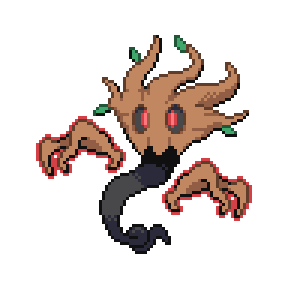
Its red eye never blinks and always follows an intruder within its forest territory, even if they are behind cover. As they wave their branches wielded as clubs, they display the ability to exert control over other plants near them.

Their cloaks of leaves and the branches upon their heads all grow with age. The one with the longest of both is the leader of its pack. They display a level of intellect by forming powerful weapons out of wood for themselves and for others.

Tredeen swim so slowly near the surface that they are often mistaken for driftwood. The tips of their horns glow bright red to distract, disorient, and unnerve their foes.

Wild Treking nest within fields of seaweed, which they can control to ensnare any prey or threats so long as their grassy fins are dug in. It is said that looking directly into their glowing red lights will sap one's very life force.

Treros are untrusting of all others and will charge at anyone they see within their forest domains. Their legs pack enough power that they soften hard ground when they rampage, allowing new life to more easily take root.

It sharpens its scythes against dense rocks and uses them to trim the forest overgrowth, the scraps of which it feeds on. It shares its leaves with ill Pokémon, for they contain medicinal compounds and plentiful nutrients.

Tretops pose as trees so they may watch for any threats to their forest homes and strike as they see fit. They extend roots from their feet to absorb nutrients and water. They may use their roots to connect to and control nearby plants as well.

Although multiple Tredactyl may be found near the same forests, they live independently of each other and may even clash over territory. Their dens are covered in amber that formed from their resin-like saliva, indicating they may be ancient.
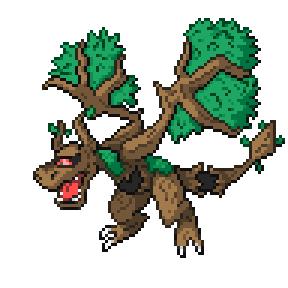
The apples that grow upon its branches vary in size and taste, with "Perfect Apples" being the rarest to grow and the most sought after. It will only let its friends even touch these apples and will bring down its full might on would-be thieves.

Tregar's saliva is like tree resin, which they use to mark their territories and to tend to their own wounds. They cling to the sides of trees and glide toward their prey, which they fell using their pincers and venomous stingers.
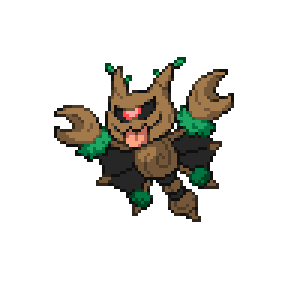
Trepy use their small trees on their trunks to mop up loose water and puddles, which is absorbed and filtered within them. They are playful Pokémon who love letting others trim their trees, which helps keep them from overgrowing.

Some few legends refer to this Pokémon as a guardian deity of the eldest forests, with even fewer citing that it is the manifestation of a forest's spirit. It has an uncanny power over nearby plants and trees, using them to ward off others.
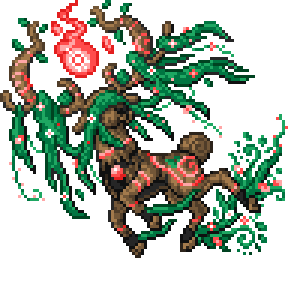
Its skull-like head is made of petrified wood, which serves well to unnerve and intimidate others in tandem with the glowing mark on its chest. It tightly wraps around its targets and drains them of their life essence within less than an hour.
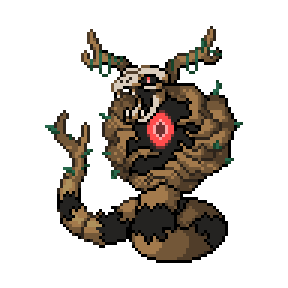
It hangs from tree branches using its tail, even when it rests. It is skilled at using its gliding membrane to ride on even the weakest breezes and can swiftly navigate through the forest as it hunts.
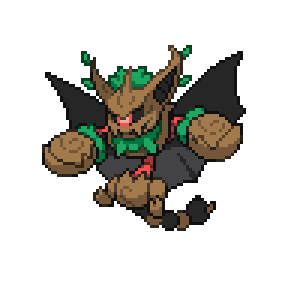
Treslash can exert control over nearby trees by burying most of their bodies in the ground, save for their leafy backs. By ingraining themselves like this, they can also acquire nutrients and water from the ground and flora around them.

There are a few fables that say Treceus has the power to control an entire forest to defend itself or the other Pokémon within. While this is yet unsure, what is known is that Treceus attacks any threat with many roots and vines.
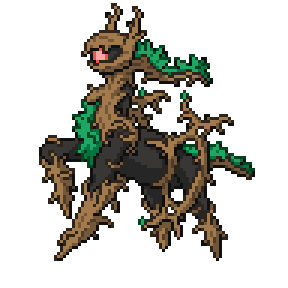
Within each of its tails is said to be a mournful spirit of those who were forever lost within forests and jungles. By digging in even one of its tails into the ground, it can exert control over nearby plants and use them to repel would-be threats.

When a Tretrum roars, the trees around it quiver and sway as if responding to its call. Despite initial assumptions, Tretrum are gentle giants that prefer not to fight. They use their claw-like tails to till the ground so new life may take root.
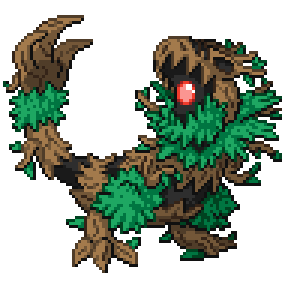
Trelie can spin fast enough to churn the ground, allowing them to partially bury themselves. While buried, they can extend roots to control nearby plants. They can release freezing air all around them to impede any foes nearby.

Trelass produce a special form of resin within them that can harden like amber within minutes of exposure to cold air. They preserve their prey in amber and feed on their lingering life force; when no life remains, Trelass discard them.
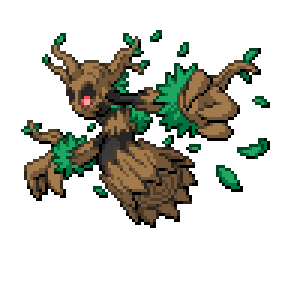
Its seven eyes are always blinking in patterns, which some believe allows it to communicate with bygone spirits. Its den is within a dead forest, yet by ingraining its many roots, it can control the dead plants to drive off threats.
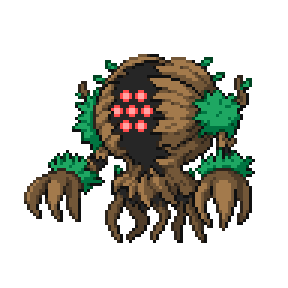
Trekie clad themselves in protective cloaks of leaves held together with sticky bubbles; as such, they nest within tree foliage. They spit out many bubbles to put out flames and prevent forest fires, then hunt down those responsible.
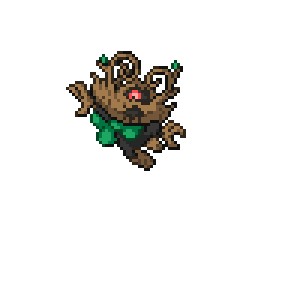
Its cloak of leaves is held together with green, adhesive bubbles, which helps it to blend in while perched atop tree branches. It throws leaves at lumberjacks with remarkable accuracy and at such speeds that they will leave painful cuts.
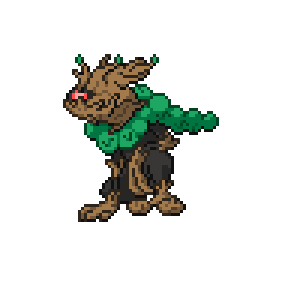
The appendage around its neck is a long root that allows it to connect with and control nearby plants through their roots. From the shadows, it monitors those in its forest and attacks them with precise Water Shuriken if they harm the forest at all.
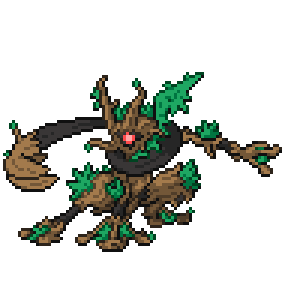
When agitated, such as in battle, parts of their bodies become red hot, and they exude a thick, black haze around them. This haze is laced with ash that works well as a fertilizer on its own, so their habitats are considerably lush.
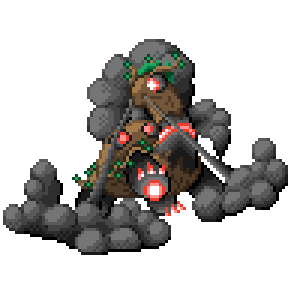
Trekoal move awkwardly, though some would call it shambling more than walking, and fight by manipulating nearby plants and their roots. Reportedly, people have seen the red lights in Trekoal's shells following their movements and blinking.
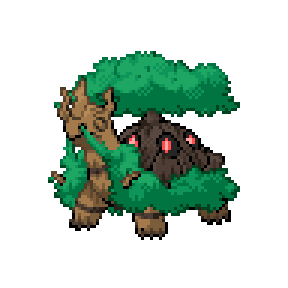
A storied Pokémon said to reside deep within ancient forests, with some stories claiming it resides at the very center. It will dig its mass of roots into the ground and then exert control over nearby plants to defend itself and its home.

It has the power to manipulate nearby plants, but that power is still weak. To intimidate others, it will bark at them and make nearby foliage rustle at the same time. If its threats fail, it will whimper and hastily flee.
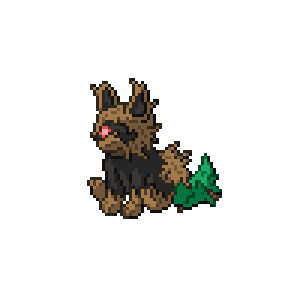
Though Tretyena live and hunt in packs, at least one member of the pack will use their powers to manipulate the surrounding forest to aid the other pack members. Though they are loyal when their trust is gained, that trust is difficult to earn.
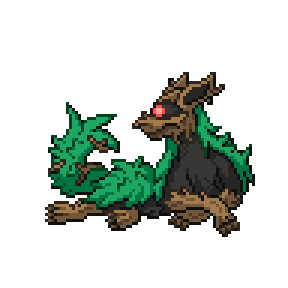
Tretry is capable of churning vicious winds with its fan-like hands, which it does to protect the very forest that serves as its home. Although plant-based, it sweats a resin-like compound, which it will slather onto trees to repair any damage.
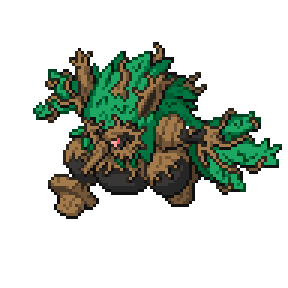
Tredol move slowly through their forest territories, patrolling for any troublemakers. Though they may sometimes go idle, they are always alert and will fire powerful, precise Solar Beams from their hands if they detect a threat.

Treperl are common sights within flooded forests, nestled together at the bases of trees. Their inner leaves are rich with nutrients gained by filtering the water they absorb through their iron-hard shells.
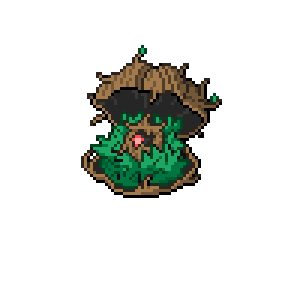
Using their red eyes, Tretail distract their quarry before driving their sharp tail tips into them. Either through their tail tips or their fangs, Tretail feed on the life force of their prey.
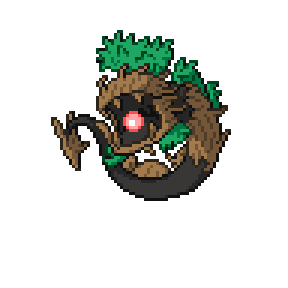
Trebyss drives its thin mouth into the base of trees within a flooded forest and siphons the fluids within; it will do the same to prey if it is starved. It delivers rock-shattering Wood Hammer attacks with the tips of its tail.
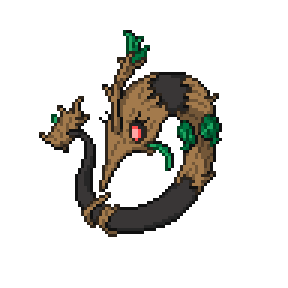
These long-lived Pokémon reside within large forest lakes, though they stay close to the bottom. They use their lower leaves to "scrub" the bottoms of lakes for microscopic organisms to feed on.
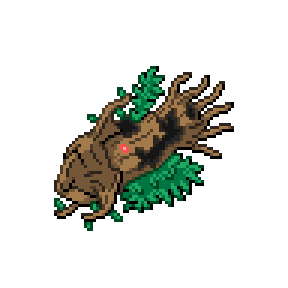
A Pokémon thought to have gone extinct that was rediscovered in the lake of an ancient forest. It rises to the surface to sleep, absorbing sunlight or moonlight through its leaves to replenish its energy.
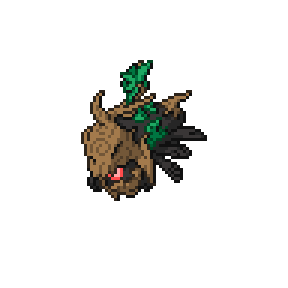
Treamo float and fly using electromagnetism, with the friction of their many leaves serving to generate plenty of static electricity. Schools of Treamo will latch onto prey and shock them so they can safely leech their life force.
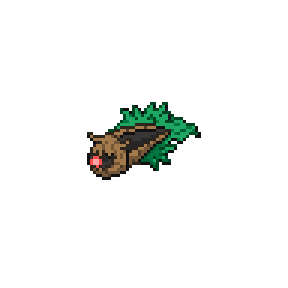
Trelektrik wrap themselves around trees to blend in while watching for prey. When a Trelektrik spots desirable prey, it will launch itself and wrap tightly around its target and deliver a devastating electric shock.
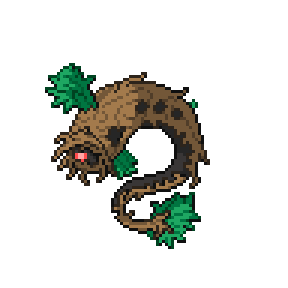
Using its claws, this Pokémon crawls along the bed of a flooded forest or climbs up trees while patrolling its territory. By dragging itself along surfaces, it generates enough electricity to quickly dispatch any foes or prey.
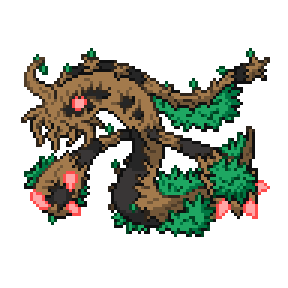
Wild Tredude notoriously cling to the sides of trees and mountains that are near forests, though they will fall if struck by anything, even a small pebble. Their bodies are as hard as stone, so even by falling they can cause considerable damage.

Its own honey-like saliva is so intoxicating that even this Pokémon is often cognitively impaired. It will wave around its large leaf to keep threats at bay, but often stumbles about and eventually falls over.

Glooleef drool honey that is intoxicatingly aromatic, though the flavor differs between each individual depending on their diet. The tree shoots within the curled leaves around their necks secrete sap with consistencies that match their honey.

It drools honey that is nutritious enough to boost the growth of most known plants and the growth of most known Grass-type Pokémon. Each of its bulbs are extremely fragrant and are often used in cooking.

Gloolava secrete an viscous fluid from their mouths that is equally aromatic and flammable. They will fling this fluid and set it aflame to protect themselves.

It seems to be unaware of how rancid its viscous, honey-like saliva is, as Gloosire frequently tries to make friends with others. There are some connoisseurs that find the scent decadent, and some perfumes have been made with it.

They produce a special, noxious liquid that smells like honey or sap depending on the season. This liquid is perfect bait for prey and is also very sticky, making it versatile in battle as well.

The sweet-smelling honey that secretes from the mouths of Glooh was once sought after by chefs, until they realized it was highly toxic. They use their honey to attract Bug-type Pokémon and fly off with them after they try to consume it.

Glooshrew secrete honey from between their plates, the flavor of it being influenced by what they consume. The bulbs upon the tips of their tails are full of nutrients and, thus, are coveted by many.

Glooleep root themselves along damp shores of dirt or shores of dark mud. They produce a noxious honey-like liquid within their rather hollow upper bodies. To defend themselves, they will flail their upper bodies and send this liquid flying about.

Noiveon use their sonars to determine which fruits are ripe enough to be consumed, which is why many of them are used to help farmers. They can sense ultrasonic waves with their feelers, so they never get lost in pitch-black caves.

Because their bodies are physically weak, Noita emit ultrasonic waves from their ears to daze foes before fleeing. They can breathe weak flames that help hunt prey and startle predators.
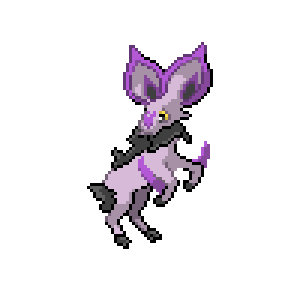
Noiwile's dual, jaw-like horns can emit powerful Boombursts capable of pulverizing thick steel plates. However, it prefers to sing tranquil songs and will only emit sonic shockwaves when threatened.

Noilithe can fly for short bursts thanks to their small wings, though they often prefer to run. Their ears help to amplify their bark into a roar that will often scare off foes larger than it.
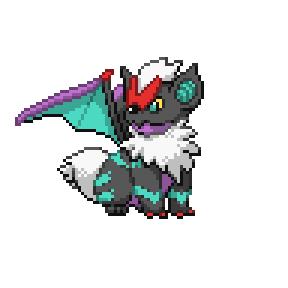
Noita dash across plains and leap far with their wings while clad in crimson flames. Their flames burn whoever tries to ride them without taming them and their tails can send most of their foes flying.

Noidash are very loyal companions to Trainers who treat them well. The crimson flames of a Noidash will continue to burn longer than normal fire, so even a single fireball can be enough against most prey.

The "cloud" on its back is made of cotton spores that are laced with various pollens. Its body is remarkably light, allowing it to make large jumps and to leap rather far.
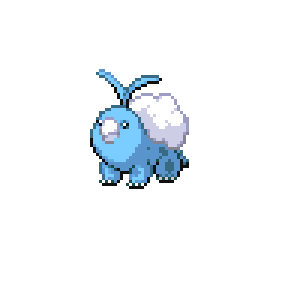
Swabchic rarely migrate for winter due to their inherently warm bodies and their cottony feathers. If attacked, they emit high-pitched noises produced by venting their own heat; they produce similar noises whenever they spit fire.

Swabeon are meticulous about their nests and their immediate surroundings, taking care to organize and clean up whatever they can. Their bodies change color to reflect their health and mood; lighter colors are a sign of joy and good health.

Its small size conceals a voracious appetite. Within the cloud-like mass extending from its head is a powerful set of jaws, with which it can consume large foods to sate itself. It is light enough to ride the winds across fair distances.

Swabwile fly by letting updrafts and strong gusts lift them into the air and land by folding their cloud-like wings against their sides. The cloudy plumes extending from their heads can close like mouths, so they use them to store food.
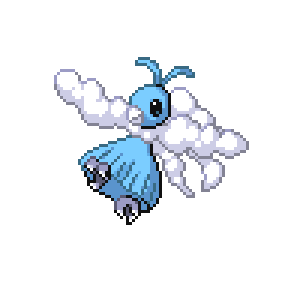
Its body is as light as its many cotton-like tufts. It takes great care to keep its tufts clean. Some say that its tufts are so soft that they soothe anyone who touches them; it does not share its shed tufts with anyone but those it trusts, however.

It clads its upper limbs in cotton spores to make them appear larger than they are. Given its docile and gentle demeanor around others, it is believed it uses its cotton spores to dampen the impact of its own attacks as well.

Swabzagoon can float on strong winds due to their hollow bones and their incredibly light fur. Because they always zig and zag as they explore, they often track plenty of debris within their cloud-like fur, so they must regularly shed tufts of it.
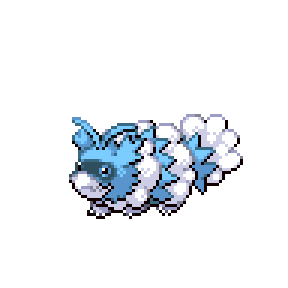
Altaros are renowned for their strength and for their soft, white fur. Despite how strong and wild they can be, when their trust is earned, they become faithful companions, even for children.

Altabok can emit light within their cloud-like furs to imitate storm clouds and intimidate others. To lure in prey, Altabok have evolved to emit hums and sounds like an alluring melody; they can also emit harsh noises to scare away threats.

By rubbing the cloud-like fur on its wrists together, it generates static electricity, which is channeled to and stored within its tail. Its tail darkens with more stored electricity, increasingly looking like a storm cloud as it builds a charge.

The blue spikes in its tail are quills that become rigid when it is agitated; the cloud-like fur of its tail becomes bristly as well. It routinely sharpens its claws at least twice a day until they are sharp enough to gouge a large stone.
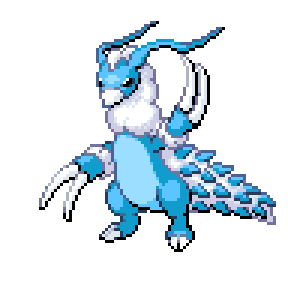
Altaloom tend to appear rather docile and protective of others, even if Altaloom are attacked by them. Their upper limbs can stretch up to a foot away and can hit hard enough to crack a tree; they prefer to subdue foes with soporific spores, however.

Its fluttering white fur is softer than silk and yet is burning hot to the touch if its trust has not been gained. When it is with those it trusts, it hums and cries in a beautiful soprano voice.

A Altadash's lush, white fur is always warm, even when sheared or shed, but can achieve the heat of an active flame to ward off threats. Although Altadash live in herds, they rarely group up closely due to their own emitted heat.

Gooveon use their feelers to help spread out their own mucus, which helps them to remain hydrated even during dry weather. Though this mucus is cool to the touch, it contains many germs that could be harmful to others.

The slime secreted from its ribbon-like organs has a calming effect on those it touches. Sliveon's slime is used in many remedies and even in some anesthetics.

It contains a remarkable amount of energy within its body, which empowers its every attack. Those who pick on it or the ones it cares about are often met with a powerful strike of its tail or fierce blows from its horns.

The webbing of their wings is clad in a concentrated mucus that keeps them clean and free of debris. Though typically meek, they fight fiercely to protect others.

Its powerful punches release bursts of sticky goo that will trap opponents for long periods. It prefers not to fight, so once its foe is stuck, it will often trot away.
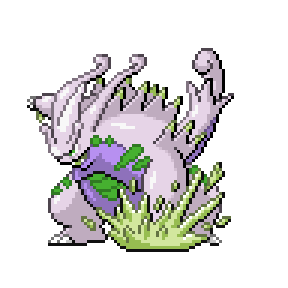
Gooizard are typically docile yet are capable of becoming incredibly aggressive within a few minutes. Their mucus has adrenaline-inducing effects, which many believe may be why they can turn aggressive so swiftly over the slightest provocation.

It contains vast energy that allows it to release devastating Hyper Beams to defend itself. It burrows through loose rocks to repair or replace any of its body that gets damaged in battle.
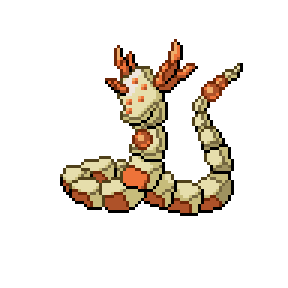
By curling upon itself, it can appear as a cluster of rocks and boulders in order to avoid others. Its "trunk" of multiple rocks is strong enough to lift a large truck with ease.

Wild Regitar often go immobile and blend into their rocky environments when they need to rest and regain their strength. They can lift boulders twice their size with relative ease and defend their homes with destructive Hyper Beams.

This massive cluster of living rock uses its smaller body as a decoy to lure foes and prey alike into its cavernous maw. Once they are too far within to escape, its cave-like jaws seal shut and all within are eventually digested.

It replaces any of its damaged stones, though it is quite picky about which stones it will replace them with. Its patterns of flashing lights have an effect akin to subliminal messaging, which subdues agitation before a fight might break out.
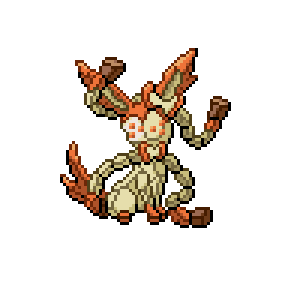
Regipunny are incredibly shy and will utilize their rock bodies to pose as inanimate statues to avoid strangers. If given cause to fight, they will swing the long rock formations on their heads around with enough force to snap a tree in half.

Despite being made of solid ice, Regifing are surprisingly light and stay aloft with little issue. The frigid haze they exude has a numbing effect on those who inhale it.

Regizing is the result of two Regifing colliding and their bodies fusing together due to their extreme cold temperatures. The cold, toxic haze it emits has grown strong enough to numb and lull most who inhale it.

These playful Pokémon are often witnessed rolling across fields of snow, which easily cling to their bodies made of solid ice. There are often signs warning Trainers of their presence due to how easy it can be for them to roll out of control.
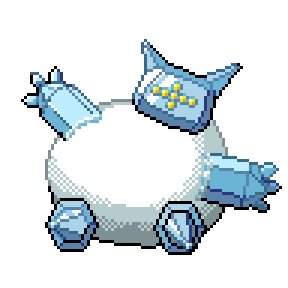
Regilosion's body is so cold that not even the flames that burst free around its neck can melt it. It often creates a path of ice using its frigid breath and then launches itself with its flames to hurl itself into its opponents.
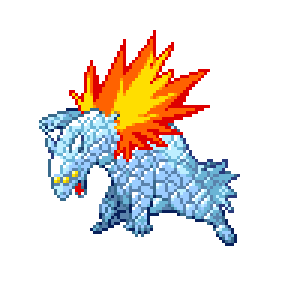
Regisparce are very timid Pokémon that often remain underground, only surfacing to feed upon berries and to drink water which helps sustain their bodies of ice. They live in constant fear of their ice bodies being shattered or melted.
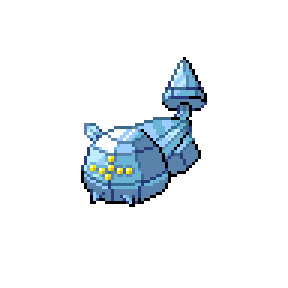
Its entire body is incredibly similar to liquid helium, save for its shell that is simply made of solid ice. Its body easily tracks ice and snow within it, which it can expel to defend itself.
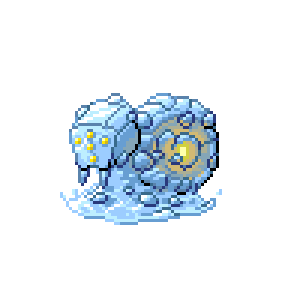
Regioh's many feathers of solid ice glisten and shine with the colors of rainbows within them. Only a few of these feathers survive their fall, and those who find ones intact will be blessed with good fortune for a year.

Regivile are snowy tricksters that only live in areas constantly visited by snow or hail. Though not malicious, they will pelt any travelers in their sights with many snowballs until someone fires back.

Wherever these Pokémon fly shall be graced with a gentle snowfall. They only appear during Winter and ensure that no city or town will be unvisited by at least one snowfall a year.
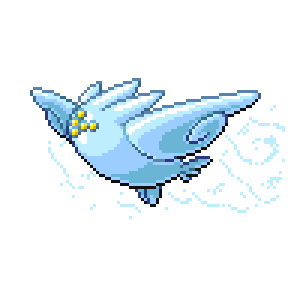
Regidon are ancient Pokémon that have lived for over a million years without the ice of their bodies ever melting. They only need to drink water to sustain themselves, and this same water will form new ice should any of their ice break off.
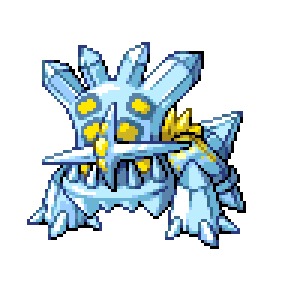
These Pokémon only seem to appear during snowstorms, and even then they are only recognizable by their bright, yellow eyes. Their manes of pure, flowing snow allow them to create illusions that lure prey into cold obscurity.
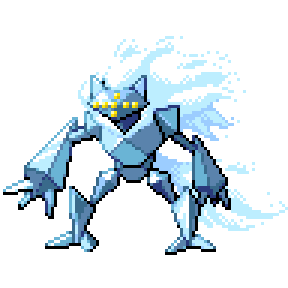
Regiogre's entire body is made of solid ice yet there is also an abundance of water flowing within its hollow spaces. Despite how cold its body must be, it can swim safely through any water without freezing said water around itself.

Although a Reginiclus's body appears to be frozen solid, it is actually rather malleable and capable of moving with no difficulty. Trainers are advised to not touch them, for they are so cold that even mere seconds of contact could result in frostbite.
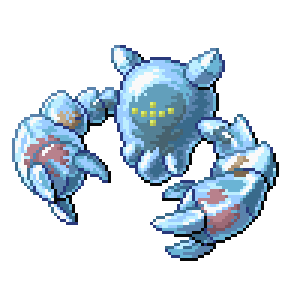
This Pokémon is born from the grief-filled soul of a traveler who became lost in northern areas and their body became encased in a chunk of solid ice. They wander frozen plains to warn others to not succumb to the same fate as they once did.

Regiodor gorge themselves upon large quantities of snow and ice together with various berries. Their snowy bodies often become stained with the juices of the berries they eat, causing them to bear various color combinations.
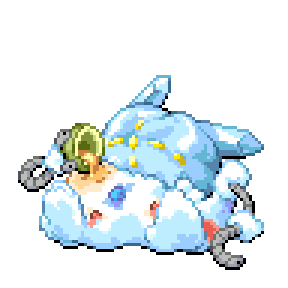
The hollow hump of a Regirupt is said to be so cold inside that anything will be frozen solid should it fall within. When enraged, this hump erupts like a volcano that scatters snow instead of ash and rains chunks of ice instead of balls of fire.
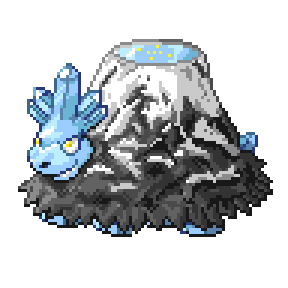
Regidol are often mistaken for ice sculptures within certain ruins that serve as their homes. They wield potent psychic powers that sustain their forms and repel invaders of their homes.

These Pokémon live within deep lakes, often slumbering without a need to eat. They will rampage for an entire day if disturbed from this slumber. Stories claim they will only truly awaken in response to ecological disasters.

The body of this artificial Pokémon, supposedly modeled after Mew, is made of an unknown material that can change its shape. Its red eyes are always flashing because it is always learning and adapting, even when its body is completely still.

This Pokémon's strange body is always in a state of flux, shifting between various shapes and consistencies as it scours the world. Anything it deems to be a threat shall be met with a powerful beam of energy let loose by its cannon.

From Regidrill's cannon-like arms, it precisely fires darts packed with venomous payloads at its targets; the venom causes severe pain, but it has been deemed nonlethal. For particular tough foes, it utilizes its drill and charges at them.
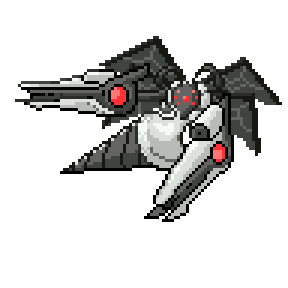
Regiowl were designed and deployed for the sole purpose of observation and the study of the world around them. They have minor weapon systems meant only to distract aggressors so that they may flee.

The mind of this artificial Pokémon is theorized to be connected to the minds of many other artificial Pokémon with designs similar to it. As such, any models of Regiking are carefully observed, even though they're always thinking rather than acting.
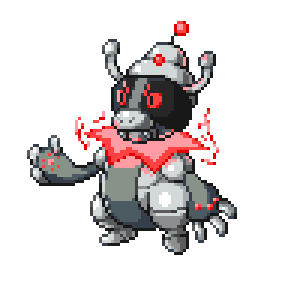
Ancient texts describe this artificial Pokémon as an ever-tunneling weapon that will tear through any obstacle as it digs. Supposedly, it has myriad weapons installed within its body, but none have dared approach it to determine if this is true.
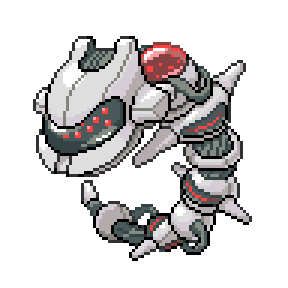
Very few Regimory have ever been sighted. These Pokémon fly about, propelled by the same energy that powers their precision weapons along their underbellies.
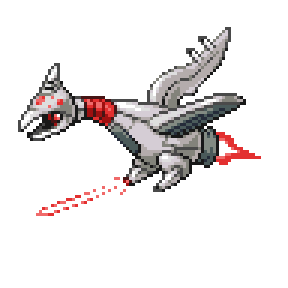
These Pokémon are always traveling to and from bodies of water across the world. They use their feelers to analyze the purity of the waters and will take action to cleanse these waters if they detect hazardous materials within.
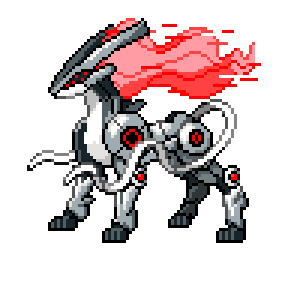
At a glance, the bodies of these Pokémon appear to be covered in a tangled mess of various cables and cords. But, upon closer inspection, researchers learned that they are tendrils made of an unknown material that protect the core of Regigrowth.

Years of living deep within jungles have honed this Pokémon's body into a form fitting of an apex jungle predator. The energy that surges from its tail helps to propel it forth at great speeds, while the energy blades on its arms slice through foes.
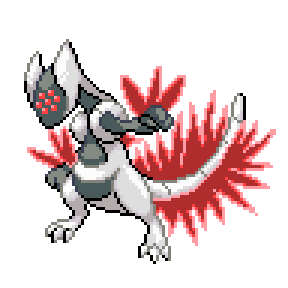
Regishrew are believed to have been artificially made, though the materials of their bodies are yet unknown. They are powered by a potent energy that glows red, which allows them to dig through ground and rock without rest for multiple days.

These Pokémon are able to generate a mysterious energy within themselves that they can release as condensed blasts or shape into weapons. They only engage opponents they deem worthy of the effort or those who threaten the defenseless.
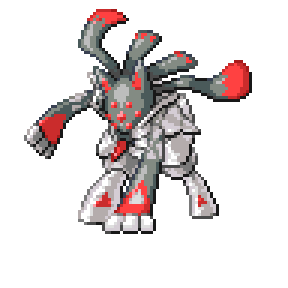
These Pokémon are usually found in a state of hibernation. When they awaken, it is often for a short time because they will use most of their energy to pulverize misshapen terrain with a single punch.
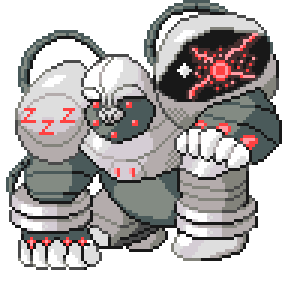
Its feelers are composed of a malleable, unknown material that has limited transformative capabilities. Its six red "eyes" are almost always flashing with light in oddly-soothing visual patterns.

The cannon upon a Regiesect's back is capable of rapidly releasing multiple projectiles of pure energy that quickly eradicate any potential threats. Thankfully, it very rarely labels anything else as a threat worthy of firing upon.
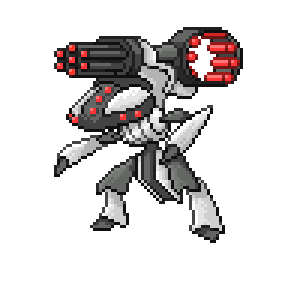
Regipunny were engineered to serve as street performers for the masses, though especially for children. The long arms upon their head are often seen juggling objects or helping them to perform outlandish acrobatic maneuvers.
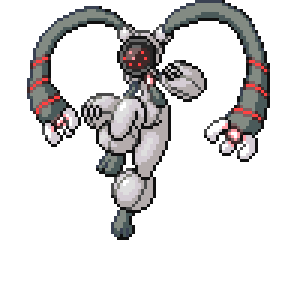
It can exert some level of control over machines it grabs hold of, though the smaller they are the more control it can exert. It releases red electricity from its palms and by clapping its hands together, it can create dangerous bolts.
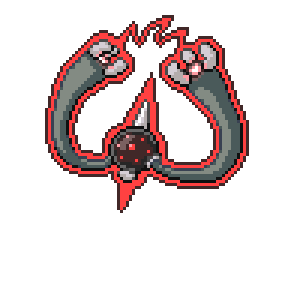
Although Regicott have bodies as tough as steel, they are also light enough to ride upon wind currents. Although Regicott tend to act rather mischievously, they will genuinely attempt to aid anyone in trouble.

These anomalous Pokémon dwell within ancient ruins, their flexible, yet durable, limbs allowing them to cling to walls and ceilings. They generate an unknown type of energy that they can loose in myriad ways to dispatch foes and invaders.
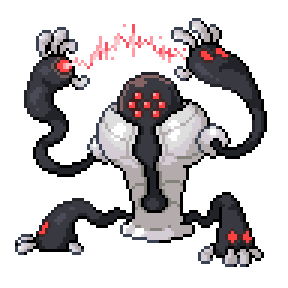
These artificial Pokémon were designed to be stealth units with the shared goal of observation of other life. When a Regitias feels threatened, it is able to wrap reality around itself and render itself invisible for a period of time.
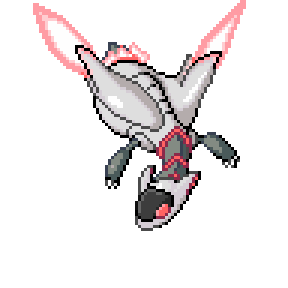
These artificial Pokémon were designed to be stealth units with the shared goal of studying the emotions of living beings. Many Regitios have gone rogue as they learn what it means to feel rather than just think and will strive to live with others.

This anomalous Pokémon's seemingly-metal arms are able to stretch, shrink, and/or grow however it desires. The pattern of red dots on its head flicker and glow as if it is actively trying to communicate.

Regivern were engineered as aerial assault units capable of emitting sonic attacks that disrupt enemy machinery. While the enemy reels from their sonic attack, they will swoop down and swing their tail like a wrecking ball upon them.

The unknown, malleable material of these Pokémon oozes and drips from their bodies as they wander in search of companions. The drippings of their bodies eventually return to them after a few hours, even though they have already wandered far away.

When a Regiapex detects a threat, the antennae atop its head will emit a shrill noise that alerts nearby Pokémon. Its hollow shell is able to house enough supplies to allow many young Pokémon to survive for days within its shelter.

Regiaura are artificial Pokémon that survey northern lands with climates too cold for humans to properly survive. Their task is to monitor the state of massive glaciers should any melt and/or break apart.
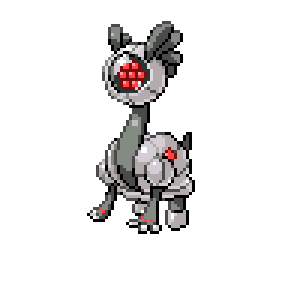
Regirorus are artificial Pokémon tasked with preventing massive glaciers from breaking apart. Should any massive glaciers begin to break, nearby Regiaura will alert the nearest Regirorus to come secure the pieces and freeze them back together.
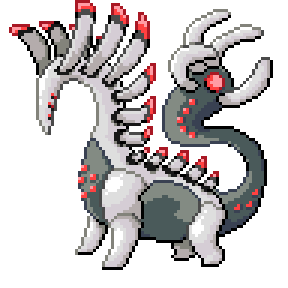
This artificial Pokémon is clad in various disc-like drones that it can control without having to move much, if at all. These drones can fire precise energy blasts or project expansive shields, which make Regimo-o a dangerous foe to ever face.
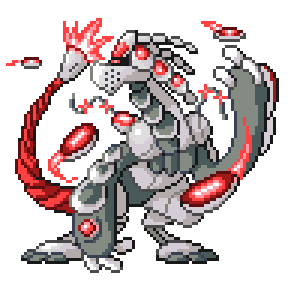
These strange Pokémon dwell in deep caverns, emitting lights from the red portions of their bodies that scan all around them. When they find something interesting, their ears will perk up and they will emit a short, shrill noise before going dormant.
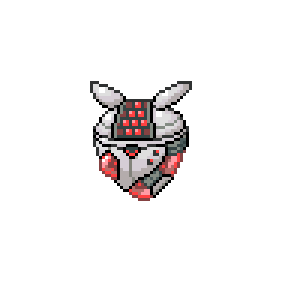
Regiphox is an anomalous, mechanical Pokémon capable of wielding mystical powers. The tip of its wand is a mass of unknown material that can take any number of forms for the sake of an unknown mission.
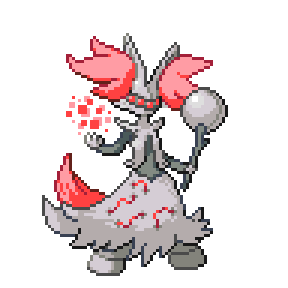
Regity appear to be cybernetic Pokémon with the mechanical portions of their bodies made of an unknown, malleable material. For a yet-unknown reason, they often can be found gathering and leading groups of Regiggy.
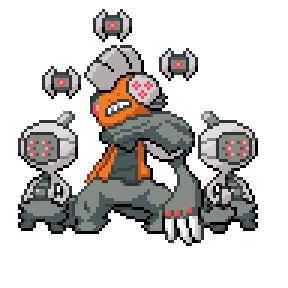
Regicolo bear a satellite dish atop their heads, which transmit data signals about local weather phenomena. The dishes are also prone to filling with rain water and Regicolo will inevitably engage in a frantic "dance" to rid themselves of this water.
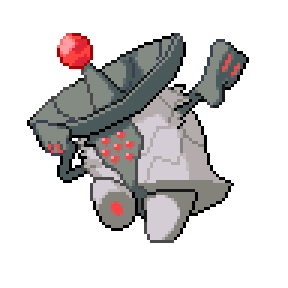
The strange material of a Regicie's body is harder than diamonds and yet is extremely malleable as well. These strange Pokémon are typically found within deep caverns using their lower body as a laser emitter to mine for various materials.
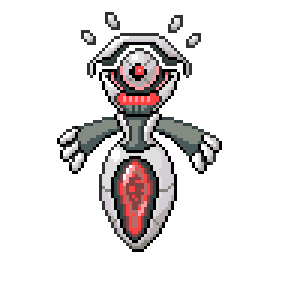
Researchers are still unsure what this consumes or absorbs to sustain itself, if it even needs anything to sustain itself. It is oddly drawn to transmission towers, utilizing its weak magnetism to adhere to them; it causes interference with signals.

Regigull are orbital observers that were deployed with the mission to analyze weather phenomena. It took less than a year before they had to be recalibrated to only analyze natural weather phenomena.
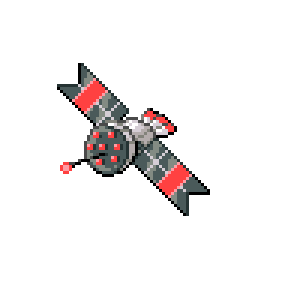
These adorable, mechanical Pokémon were once mass-produced and deployed to entertain people across the globe. A production error resulted in them having no sense of balance and so they would trip over themselves so often they fell into disrepair.

These artificial Pokémon can often be found scouring ancient mechanical ruins and abandoned facilities. Their exact purpose is unknown, but they will fire weak lasers from their chest if they detect a threat.
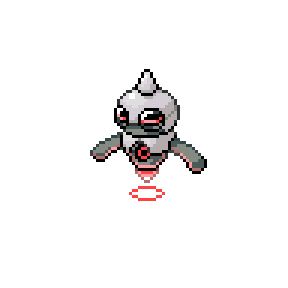
Regidol were designed to serve as custodians and guardians for their ancient creators. As such, they are found within special ruins and their arms can transform into laser cannons capable of dispatching most threats.

Regiling are artificial Pokémon tasked with maintaining peace within cities and with broadcasting important news to the city's inhabitants. Their only "weapon" is a speaker that can reach pitches so high it could even render a Loudred unconscious.
The large tail of a Regibro is said to contain potentially-infinite information that could bring enlightenment to all. Unfortunately, it is either completely unaware of this or has completely forgotten about it and instead lazes about all day.

A startled Vilehorn will scatter thick, yellow spores that can cause paralysis and disorientation. Once it starts running, it cannot stop until it collides with something.
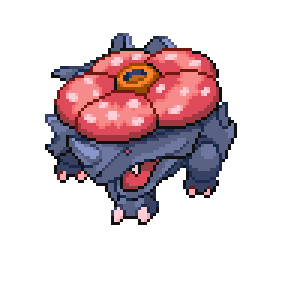
When it spins its drill-like horn, it also scatters disorienting spores all about from its petals. A Viledon's body is packed with thick muscles and is as hard as stone.
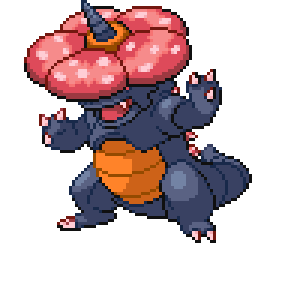
Vilereon are often wreathed in plumes of a warm, comforting, and orange pollen. This pollen can be so warm that it can melt snow, so many gardeners have a Vilereon to aid them during winter.
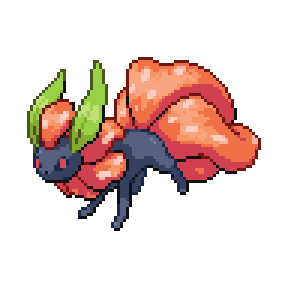
When pollen is loosed from its flower, it is about to awaken from its slumber. It will continue to loose this irritating, but otherwise harmless, pollen while awake. It falls asleep after gorging itself on berries and fruits.

They twirl the leaves on their heads around to cast around their noxious pollen, typically as a deterrent for threats. Vilerita feed on berries and small plants, which influence the aromas of their leaves.
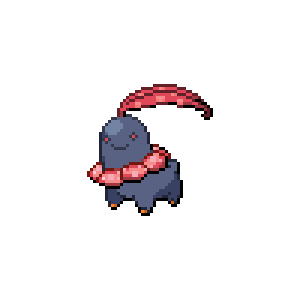
Vilequil flowers are fireproof and dense enough to offer substantial defense. They are typically very timid Pokémon that will hide under their own flowers.
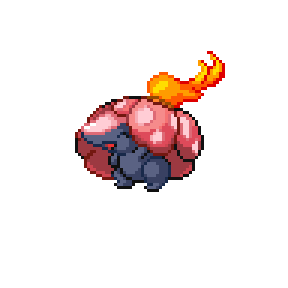
Thick plumes of noxious pollen erupt from its flowers when it feels threatened. Each speck of pollen will violently burst if set aflame. Although this serves it well in battle, this pollen is also used in some fireworks.
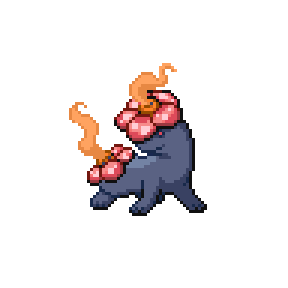
Vilewoodo are common alternatives to scarecrows in fields and gardens. They pose as trees and loose paralytic pollen to dispatch threats.
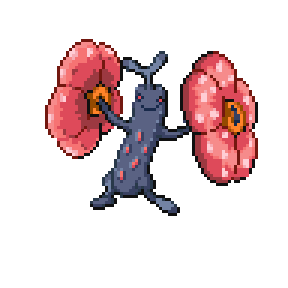
These Pokémon move by hopping about and with every hop, they release puffs of yellow spores from the flowers atop their heads. This pollen is rich with nutrients, which help fields and farms to grow lush.
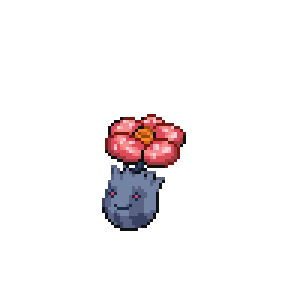
Vileflora sway their long-necked heads around as they walk, scattering clouds of thick, yellow pollen around them. This pollen is nutrient-rich from the sunlight they absorb and feels warm to the touch.
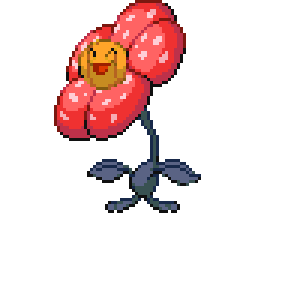
Because Vilesire are rather lazy, the large flowers on their heads are often mistaken for normal flowers that bug and bird Pokémon try to feed on. When they or their flowers are assailed, Vilesire release plumes of toxic pollen and run away.

Their tusks are hollow and serve more like hoses that loose their spores during specific seasonal times. Their trunks are strong enough to lift boulders and are very efficient at absorbing nutrients from the land and at absorbing water.
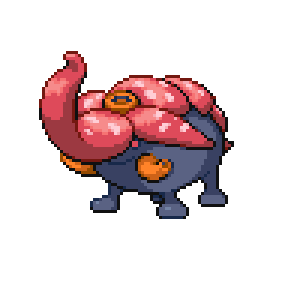
The large feathers upon the heads of these Pokémon are often mistaken for a large flower when they are resting. They are trailed by plumes of harmless, yellow pollen as they fly through the sky.
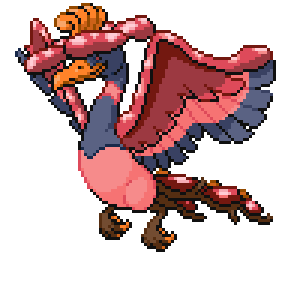
Its large flower helps it to hide from threats, though it also causes it to absorb too much water. To balance its fluid levels, it releases the excess as tears.

Vileperior can use the muscles in its arms and the open ports in its palms to fire spore bombs and large seeds at foes. They prefer to live near mountains on the edge of forests or within grassy caves.

It digs holes to hide in, with its large flower kept above ground and serving as camouflage. It hates if its body gets wet, but loves when its flower is watered.
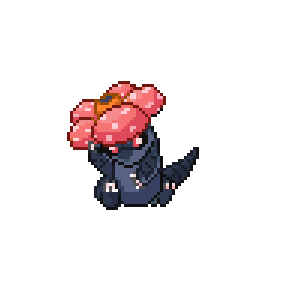
Vilebusken train their legs daily so they can support the growing flowers on their heads. The gyration that results from the many kicks they perform results in plumes of pollen being scattered from their flowers.